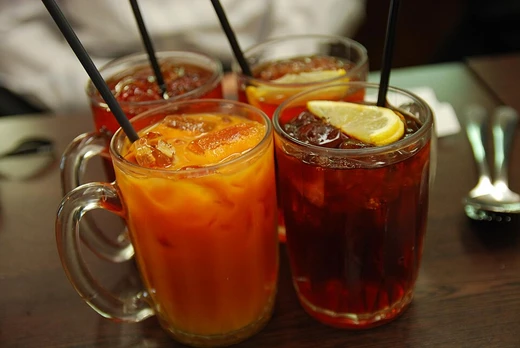
Cocktail
A mixed alcoholic drink with disputed origins and evolving definitions.

A cocktail is an alcoholic mixed drink, typically made by combining one or more spirits with other ingredients like juices, flavored syrups, tonic water, shrubs, or bitters. Recipes and styles differ greatly around the world, and many websites share both original creations and their own takes on classic drinks.
**History**
In ancient Greece, a drink called kykeon was a well-known cocktail, mentioned in Homeric texts and used in the Eleusinian Mysteries. Artifacts for cocktail preparation and serving—used to mix wine, water, honey, and extracts of aromatic herbs and flowers—are displayed at the Museum of the Royal Tombs of Aigai in Greece, dating to the court of Philip II of Macedon. In the United States, the word "cocktail" first appeared in print as a beverage in *The Farmers Cabinet* in 1803. Three years later, on May 13, 1806, *The Balance and Columbian Repository* (Hudson, New York) provided the first definition of a cocktail as an alcoholic drink. At that time, cocktails traditionally contained spirits, sugar, water, and bitters, but this definition shifted during the 1800s to include liqueurs. In 1862, Jerry Thomas published *How to Mix Drinks; or, The Bon Vivant's Companion*, a bartender’s guide featuring ten cocktail recipes that used bitters to distinguish them from punches and cobblers. Cocktails evolved and grew in popularity through the 1900s, with the term eventually covering all mixed drinks. The phrase "cocktail party" was coined by Julius S. Walsh Jr. of St. Louis, Missouri, in 1917. During Prohibition in the United States (1920–1933), wine and beer became less available, making liquor-based cocktails more popular due to their accessibility. Their popularity declined in the late 1960s, but the early to mid-2000s saw a resurgence of cocktail culture through mixology, which blends traditional cocktails with novel ingredients. By 2023, "cocktail in a can" had become a common item in U.S. liquor stores. In the modern Information Age, cocktail recipes are widely shared online, and restaurants serving them are frequently reviewed in tourism magazines and guides. Some cocktails—like the Mojito, Manhattan, and Martini—have become staples in restaurants and pop culture.
**Components**
A cocktail’s most important elements are the base, a modifying or smoothing agent, and an additional special flavoring or coloring agent. The base is always the dominant ingredient and consists of spirit-based or wine-based liquors. The type of base determines the drink’s style—gin-based cocktails like the Martini differ from whisky-based ones like the Manhattan. Combining multiple bases is possible if they share essential characteristics, though it is considered risky. The modifying agent buffers the base’s sharpness and adds character. Modifiers fall into three categories: aromatics and bitters; fruit juices (with or without sugar); and smoothing agents such as cream, sugar, eggs, or aquafaba. They are used sparingly to avoid overpowering the base; one source suggests a maximum of half an egg white, a quarter of a whole egg, one tablespoon of heavy cream, or one teaspoon of sugar per drink. Special flavoring agents include non-alcoholic syrups, liqueurs, cordials, and other ingredients that could also serve as modifiers. Like modifiers, these must be used carefully—often in drops or dashes—to avoid overwhelming the base.
**Usage and Related Terms**
The term "cocktail" broadly refers to a variety of mixed drinks, typically containing alcohol. A drink with only a distilled spirit and a mixer (such as soda or fruit juice) is called a highball; many International Bartenders Association Official Cocktails are highballs. A mix of only a distilled spirit and a liqueur is a duo, and adding cream or a cream-based liqueur makes it a trio. Additional ingredients can include sugar, honey, milk, cream, and herbs. Non-alcoholic mixed drinks that resemble cocktails are often called "zero-proof" or "virgin" cocktails, or "mocktails" (from "mock," meaning imitation).
**Etymology**
The word "cocktail" has a disputed origin. It likely comes from "cock-tail," meaning "with tail standing up, like a cock's," especially of a horse, though how this applied to alcoholic drinks is unclear. Prominent theories suggest it referred to a stimulant (hence a stimulating drink) or to a non-purebred horse (hence a mixed drink). Cocktail historian David Wondrich speculates it relates to "gingering"—a practice of perking up an old horse with a ginger suppository so it would "cock its tail up and be frisky"—and by extension, a stimulating drink like a pick-me-up. This aligns with early uses: in 1798, "cock-tail" was vulgarly called ginger; in 1803, a drink taken at 11 a.m. to clear the head; and in 1806, a "stimulating liquor." This suggests cocktails were initially seen as medicinal, which fits the use of bitters. Etymologist Anatoly Liberman endorses as "highly probable" the theory advanced by Låftman (1946), which holds that horses that were not thoroughbreds had their tails docked, were called "cocktailed horses," and later simply "cocktails." By extension, the word was applied to a vulgar, ill-bred person raised above their station.
- key_ingredients_early_definition
- spirits, sugar, water, and bitters
- etymology_disputed
- origin of word 'cocktail' is disputed; possibly from 'cock-tail' meaning a horse with tail standing up
Lore & Background
A well-known 'cocktail' in ancient Greece was named kykeon, mentioned in Homeric texts and used in the Eleusinian Mysteries. Cocktail accessories were exposed in the Museum of the Royal Tombs of Aigai (Greece), used in the court of Philip II of Macedon to prepare and serve mixtures of wine, water, honey, and extracts of aromatic herbs and flowers during banquets. Cocktails continued to evolve throughout the 1900s, with the term eventually expanding to cover all mixed drinks. The etymology of the word 'cocktail' is disputed. It is presumably from 'cock-tail', meaning 'with tail standing up, like a cock's', particularly of a horse. Cocktail historian David Wondrich speculates it refers to gingering, a practice for perking up an old horse by means of a ginger suppository, hence by extension a stimulating drink. Etymologist Anatoly Liberman endorses the theory that 'cocktail' was applied to a vulgar, ill-bred person raised above his station, and by extension to a diluted alcoholic drink, not a 'purebred'.
Reader's Guide
The cocktail has evolved from a specific mixture of spirits, sugar, water, and bitters into a broad category encompassing virtually all mixed drinks containing alcohol. Its significance lies in its cultural and social role, from ancient Greek rituals to modern cocktail parties and the rise of mixology. The term itself has a disputed etymology, with theories linking it to horse grooming, stimulating drinks, or social class. Cocktails have experienced periods of popularity and decline, notably during and after Prohibition in the United States, and have become staples in restaurants and pop culture, with recipes widely shared online.
Did You Know?
- Cocktail accessories were used in the court of Philip II of Macedon to prepare and serve mixtures of wine, water, honey, and extracts of aromatic herbs and flowers.
The Chemistry Behind 'Alcohol-Free'
The term "non-alcoholic" carries a scientific complexity that most consumers never encounter. In reality, many beverages marketed as alcohol-free still contain trace amounts of ethanol. The process of ethanol distillation is used to strip alcoholic drinks down to what are advertised as non-alcoholic versions, but the result is rarely a true zero. Even everyday foods like fresh orange juice, certain yogurts, and rye bread can exceed the UK's 0.05% ABV threshold for "alcohol free" products. Sparkling apple cider, soft drinks, and juices may naturally carry trace alcohol or none at all. This chemical ambiguity has drawn criticism from those who argue the label "non-alcoholic" is inherently misleading, particularly as a potential threat to recovering alcoholics who need absolute certainty. Because alcohol is a psychoactive substance, even minute residual quantities carry weight in public health discussions, making the gap between marketing language and chemical reality a persistent source of tension.
The Craft of the Mocktail
Non-alcoholic cocktails represent a deliberate culinary art form, designed to mirror the complexity and visual appeal of their alcoholic counterparts while omitting any liquor. A well-constructed mocktail might blend fresh fruit juices, house-made syrups, cream, aromatic herbs, and spices, or incorporate non-alcoholic spirits that have been distilled to remove ethanol. These beverages are crafted with intention for a specific audience: teetotalers who reject alcohol on principle, underage individuals, designated drivers, pregnant women, and anyone else who prefers a sober option without sacrificing the ritual of a crafted drink. The tradition stretches back further than modern bars suggest. The Woman's Christian Temperance Union, for instance, published recipes for "fruestas"—a portmanteau of "fruit" and "fiesta"—which were nonalcoholic fruit drinks prepared for large social gatherings like proms and weddings. These fruestas demonstrated that the desire for a celebratory, sophisticated drink predates the modern cocktail bar by decades.
A Global Mosaic of Legal Thresholds
No single international standard governs what qualifies as "non-alcoholic," and the resulting patchwork of national definitions creates a confusing landscape for consumers and producers alike. In the European Union, any drink exceeding 1.2% ABV must display its actual alcoholic strength on the label. Within the EU, individual nations set their own lower thresholds: Finland and Italy both cap non-alcoholic beverages at 1.2% ABV, while Denmark, Sweden through Systembolaget, and the United Kingdom all use 0.5%. Norway sits slightly higher at 0.7%. Denmark notably raised its threshold from 0.1% to 0.5%, citing the distinct taste difference between the two levels. In Japan, the Liquor Tax Law draws the line at 1% ABV, yet a self-regulatory advertising body insists that truly "non-alcoholic" drinks must register at 0.00%. Russia allows up to 0.5% for most beverages but extends to 1.2% for fermentation-based drinks like kefir, kvass, and medovukha. The United States requires malt beverages labeled "non-alcoholic" to contain less than 0.5% ABV, while the stricter "alcohol free" designation demands absolutely zero alcohol with no tolerances permitted.
The Marketing-Reality Gap and Its Consequences
The commercial label "non-alcoholic" sits in a contested space between consumer expectation and chemical fact. In countries with zero-tolerance policies and state-run liquor monopolies, most drinks sold under this name still contain measurable alcohol, a reality that critics argue makes the terminology fundamentally deceptive. The European Union's regulatory framework acknowledges this by mandating that any beverage above 1.2% ABV must explicitly state its alcoholic content, using the word "alcohol" or the abbreviation "alc." followed by the percentage by volume. In the United States, the distinction is even more granular: a malt beverage may carry the "non-alcoholic" label only if it contains less than 0.5% ABV, and that claim must appear in readily legible printing on a completely contrasting background. The term "alcohol free" is reserved exclusively for malt beverages containing no alcohol whatsoever, with zero tolerance permitted. This layered regulatory language exists precisely because the simple phrase "non-alcoholic" has proven insufficient to protect vulnerable consumers, including those in recovery from alcohol dependence, from even the smallest residual doses of a psychoactive substance.
Frequently Asked Questions
What exactly is a cocktail?
A cocktail is a mixed drink—typically alcoholic—that blends one or more spirits with additional components like fruit juices, flavored syrups, tonic water, shrubs, or bitters. Recipes vary enormously by region, and countless online sources publish both original formulations and modern reinterpretations of classic drinks.
More in Beverages & Drink Culture 1-18
Spotted an error? Know more?
This is a living reference — every entry is fact-audited, and reader corrections feed straight into our audit queue. Suggest an edit · See this site's audit record