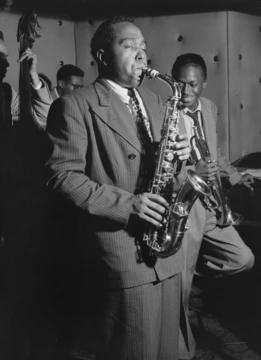
Al Haig
Last updated
Alan Warren Haig, a jazz pianist born in Newark and raised in Nutley, New Jersey, is remembered as a bebop pioneer. He began playing with Dizzy Gillespie and Charlie Parker in 1945. That year, the Gillespie quintet featuring Haig made four recordings for Guild Records, widely seen as the first to fully capture the mature bebop sound. He also played on the initial session of Miles Davis’s Birth of the Cool.
Biography
Al Haig was a jazz pianist who helped shape bebop. He was born in Newark, New Jersey, on July 19, 1922, and grew up in Nutley. In 1940, he studied piano at Oberlin College.
By 1945, he was playing with Dizzy Gillespie and Charlie Parker. He worked with Gillespie from 1945 to 1946, then joined Eddie Davis and His Beboppers in 1946, a group that also included Fats Navarro, and the Eddie Davis Quintet in 1947. He played with Parker from 1948 to 1950 and with Stan Getz from 1949 to 1951.
In May 1945, the Gillespie quintet, with Haig on piano, cut four sides for Guild Records. Those recordings are considered the first to capture the full mature bebop sound. Haig also played in the nonet on the initial session of Miles Davis’s Birth of the Cool.
For most of the 1950s and 1960s, Haig’s reputation faded. As critic Brian Case put it, jazz piano had grown more percussive in a crude imitation of Bud Powell, leaving no room for Haig’s clear touch and quick, logical ideas.
Haig got by playing semi-cocktail piano in New York bars. Though he is best known for bebop, he spent much of his career in non-jazz settings. His work saw a revival in the 1970s.
In 1969, Haig was acquitted of murder. He had been charged with strangling his third wife, Bonnie, at their home in Clifton, New Jersey, on October 9, 1968. Haig testified that his wife was drunk and died after falling down a staircase. His second wife, Grange Rutan, disputed this account in her 2007 book Death of a Bebop Wife.
The book mixes autobiography with interviews of friends and family. It details Bonnie’s story and portrays a darker side of Haig, including a pattern of domestic abuse. Rutan noted that several relatives had raised concerns about Haig’s violent temper, but those warnings were ignored. She quotes bassist Hal Gaylor, who said Haig admitted to him before a performance at the Edison Hotel lounge in the early 1970s that he had caused Bonnie’s death.
In 1974, Tony Williams, owner of Spotlite Records in the UK, invited Haig to tour Europe. After a highly successful tour, Haig recorded the album Invitation for Spotlite with bassist Bibi Rovère and drummer Kenny Clarke. This revived his career. Over the next eight years, he built a strong European following, toured multiple times, and recorded in the UK, France, and elsewhere. He also made recordings for several Japanese labels.
Haig died of a heart attack on November 16, 1982. He was survived by his wife Joanne and his sons Alan and Daniel.
Did You Know?
- The Gillespie quintet that included Haig recorded four 78 r.p.m. sides for Guild Records in May 1945, regarded as the first recordings to demonstrate all elements of the mature bebop style.
- Bassist Hal Gaylor said Haig admitted to him he had caused Bonnie's death, as quoted in Grange Rutan's 2007 book Death of a Bebop Wife.
Frequently Asked Questions
When did Al Haig die?
Al Haig died on 16 November 1982 in New York City, New York.
When was Al Haig active?
Al Haig was active from 1944 to 1982.
More in Bebop Pianists
Sources
Compiled from Wikipedia and the sources listed below. Text from Wikipedia is available under CC BY-SA 4.0; this entry is adapted from it.
- Wikipedia: Al Haig (CC BY-SA 4.0).
Spotted an error? Know more?
Reader corrections go straight into our review queue. Suggest an edit · How this site is sourced