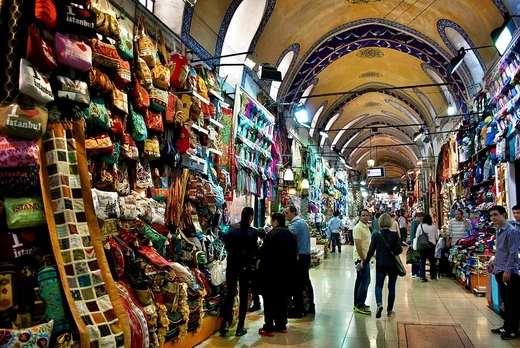
Baščaršija
Sarajevo's historic bazaar and cultural heart since the 15th century.
Last updated
Where it is
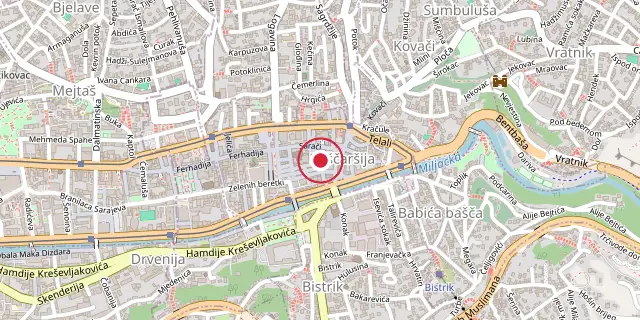
Coordinates: 43°51′32″N 18°25′48″E (43.8590, 18.4300) · Open in OpenStreetMap
Coordinates and connected clubs: the infobox of Wikipedia: Baščaršija (CC BY-SA 4.0). Map: drawn by Codexery from OpenStreetMap tiles.
Baščaršija is Sarajevo's old bazaar and the historical and cultural center of the city, located on the north bank of the river Miljacka in the Stari Grad municipality. Built in the 15th century when Isa-beg Ishaković founded the city, it now serves as the major tourist attraction of Sarajevo. The area includes several important historic buildings, such as the Gazi Husrev-beg Mosque and sahat-kula.
History
Before the Ottomans, the largest settlement on Sarajevo field was the village square Tornik at the crossroad where Ali Pasha's Mosque now stands. Baščaršija was built in 1462 when Isa-Beg Isaković constructed the Ishaković han along with many shops. Around the main entrance the Bazerdžani čaršija formed; to the west lies the čaršija Kazaz, and to the north sit the čaršija Sedlar and Sarača. The most significant early buildings were mosques: Havedža Durak built a mosque in 1528, and Gazi Husrev-beg built his mosque in 1530.
Gazi Husrev-beg also built a medresa, a library, a haniqah, the Gazi Husrev-beg Hamam, the Gazi Husrev-beg bezistan, the Morića Han, sahat-kula, and other attractions. He was buried in the harem of his mosque; beside the harem is the türbe of his freed slave and first mutevelija of his vakuf, Murat-beg Tardić. The Old Orthodox Church was built during the 16th century, first mentioned in Ottoman sources from 1539. The first Sephardic Jewish temple, the Old Synagogue, was built between 1581 and 1587, and the New Synagogue was built shortly after.
Today the Jewish community uses a more recently erected synagogue across the Miljacka; the Old and New Synagogue buildings serve as Jewish cultural centers. The New Synagogue was donated to the city and is a gallery called Novi Hram; the Old Synagogue became the Jewish Museum of Bosnia and Herzegovina. During the 16th century commercial facilities such as bezistans, hans, and caravanserais were built. Sarajevo had three bezistans (Gazi Husrev-begov bezistan and Brusa bezistan still stand), colonies of Venetian and Ragusan traders, and about 12,000 commercial and craft shops.
After an earthquake in 1640 and fires in 1644 and 1656, Sarajevo was burned and devastated by troops of Prince Eugene of Savoy in 1697.
Etymology
The name Baščaršija comes from Turkish. "Baš" (Turkish "baş") means "head" or "main", and "čaršija" (Turkish "çarşı") means "bazaar" or "market". Although the suffix "-ja" (Turkish "(y)a") means "to", suggesting a translation of "to the main bazaar", the ending is more likely a Bosnianism added to conform to Bosnian grammar. In Turkish the place has always been referred to as "Başçarşı" in the nominative case.
More in Bazaars
Sources
Compiled from Wikipedia and the sources listed below. Text from Wikipedia is available under CC BY-SA 4.0; this entry is adapted from it.
- Wikipedia: Baščaršija (CC BY-SA 4.0).
Spotted an error? Know more?
Reader corrections go straight into our review queue. Suggest an edit · How this site is sourced