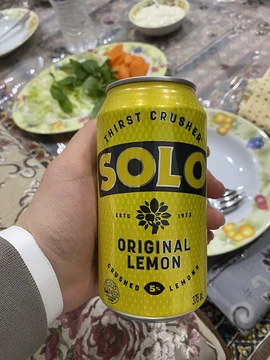
Solo (Australian soft drink)
Go hard, go solo.
Solo is an Australian lemon-flavoured carbonated soft drink, first launched by Tarax in 1968 and now manufactured under license by Asahi Breweries. Its lemon flavour is inspired by the traditional non-alcoholic 'pub squash' beverage served in Australian pubs. The brand is widely recognised for its long-running 'Solo Man' marketing campaign.
Quick Facts
- Manufacturer
- Asahi Breweries
- Origin
- Australia
- Introduced
- 1973
- Flavour
- Lemon
Facts from the source article.
Did You Know?
- Cadbury Schweppes sold a similar citrus drink named Rondo in the United States during the late 1970s and '80s.
- The 375mL can of Solo contains 43.1 grams of sugar.
History
Solo was first launched by Tarax in 1968, and Cadbury-Schweppes took over in 1973. Asahi acquired Cadbury-Schweppes Australia in April 2009, gaining Solo. The drink's lemon flavour is derived from the traditional non-alcoholic 'pub squash' or 'lemon squash', a sweetened lemon concentrate and water mixture; Solo is a carbonated variant. Past variants include lemon lime and zero sugar. Asahi signed a sugar reduction pledge in 2018, aiming to reduce Solo's sugar content by 20% by 2025. Solo Energy, with guarana, caffeine and B-vitamins, was released in June 2025 in full sugar and zero sugar versions.
Hard Rated
An alcoholic variant, Hard Rated, was launched in July 2023 as 'Hard Solo' with 4.5% ABV (approximately 1.3 standard drinks per 375ml can). The Alcohol Beverages Advertising Code concluded in November 2023 that Carlton & United Breweries (CUB) had breached the code after complaints that the branding appealed to minors. Asahi argued the cans were distinct, with black packaging and prominent alcoholic markings, but CUB renamed the drink to Hard Rated that November. An orange version was released in August 2025, and a passionfruit version in August 2026. As of August 2026, the range includes Lemon 4.5%, Lemon 4.5% Zero Sugar, Lemon 6%, Lemon Lime 4.5% Zero Sugar, Lemon Lime 6%, Orange 4.5%, and Orange Passionfruit 4.5%.
Marketing
The Solo Man marketing campaign began in the 1970s after the drink's release, with the most recent advertisement in 2018. The campaign depicts an Australian man undertaking adventurous and extreme sports to 'earn' the drink, historically portrayed as masculine. Activities included kayaking down rapids, riding a wagon towed by horses, wrestling a brumby, fishing for a shark, windsurfing, wrestling a saltwater crocodile, and dragging a shark home. Early ad slogans included 'The thirst crusher' and 'Light on the fizz, so you can slam it down fast'.
A common 1970s–1980s tagline was: 'You've never tasted a lemon drink like Solo before. Unless it's one of those great lemon squashes that pubs used to make. Extra lemon tang, and not too many bubbles. Solo lemon: a man's drink.'
In 2012, BMF advertising agency reintroduced the Solo Man starring Adam Demos, with an origin story of a colonial Australian swinging an axe, chasing a barrel of lemons, and chugging the barrel. BMF created the tagline 'Go hard, go solo' and introduced limited edition can designs with one letter or hashtag from #, G, O, H, A, R, D. In 2018, TBWA\Melbourne redefined the Solo Man as a less macho dad making costumes, having a dog, and assembling flat-pack furniture, with the tagline 'A Thirst Worthy Effort'.
Competitors
In Australia, Solo competes with brands owned by Coca-Cola Amatil Limited, which held 39.8% market share in 2020, including Coca-Cola, Fanta, Sprite and Kirks. Smaller competitors include Tru Blu Beverages (with brands Pub Squash, Pips and Vida, holding 4–5% market share) and Bundaberg Brewed Drinks Pty Ltd (3–4% market share). Asahi Holdings, which owns Solo, held 15.4% of the Australian soft drink manufacturing market in 2020.
More in Australian Drinks
Spotted an error? Know more?
Reader corrections go straight into our review queue. Suggest an edit · How this site is sourced