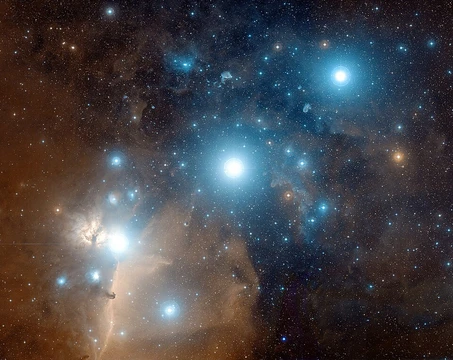
400 Years of the Telescope
Documentary chronicling the telescope from Galileo to dark energy.

Premiering at the American Astronomical Society's January 2009 meeting, the documentary *400 Years of the Telescope: A Journey of Science, Technology and Thought* was released to mark the International Year of Astronomy. Directed by Kris Koenig, the film traces the telescope's evolution from Galileo's era onward. It includes interviews with prominent astrophysicists and cosmologists, who discuss topics from Galileo's initial observations of Jupiter's moons to modern space discoveries, such as the potential for extraterrestrial life and dark energy—a mysterious force accelerating the universe's expansion. The production team, which included astronomy writer Donald Goldsmith (formerly of Carl Sagan's *Cosmos* team) and telescope historian Albert Van Helden, shot the film using RED Digital Cinema at major observatories and institutions like the European Southern Observatory, SETI Institute, and Harvard University. One notable challenge was filming the Atacama Large Millimeter Array at 5,000 meters in the Atacama Desert. The score, composed by Mark Slater, was performed by the London Symphony Orchestra at Abbey Road Studios. The film aired nationally on PBS on April 10, 2009, and was selected for festivals including the Jacksonville Film Festival and the Urban Suburban Film Festival. It won a Silver Telly Award for videography/cinematography, three Bronze Telly Awards (for animation, copywriting, and overall documentary), the Best Director award at SCINEMA 2009, and a Silver W3 Award for website design.
Quick Facts
- Director
- Kris Koenig
- Producer
- Kris Koenig / Dan Koehler
- Writer
- Donald Goldsmith / Albert van Helden / Kris Koenig
- Narrator
- Neil deGrasse Tyson
- Music
- Mark Slater
- Cinematography
- Scott Stender
- Editing
- Kimberly Generous White
- Studio
- Interstellar Media Productions
- Distributor
- PBS
- Released
- 6 January 2009
- Runtime
- 60 minutes
- Country
- United States
Facts from the source article.
Lore & Background
The film's development team included Donald Goldsmith, a well-known astronomy writer on the Carl Sagan Cosmos team, and Albert Van Helden, a leading authority on the history of the telescope. It was shot on RED Digital Cinema at the world's leading universities and observatories including the European Southern Observatory, Institute for Astronomy, SETI Institute, Space Telescope Science Institute, Anglo-Australian Observatory, and Harvard University. Among the production team's challenges were shooting the Atacama Large Millimeter Array (ALMA) at 5000m on the Atacama Desert. The original score was composed by Mark Slater and recorded by the London Symphony Orchestra at Abbey Road Studios.
Reader's Guide
The film premiered at the 213th meetings of the American Astronomical Society (AAS) in Long Beach, California, on January 6, 2009, and was later shown to a national audience by the Public Broadcasting Service (PBS) on April 10, 2009. It was selected for screening at several film festivals in 2009, including the Jacksonville Film Festival in Jacksonville, Florida and the Urban Suburban Film Festival in Philadelphia. The documentary received multiple awards: a Silver Telly for excellent achievement in videography/cinematography and three Bronze Tellys for outstanding achievement in use of animation, copywriting, and the documentary overall; the SCINEMA 2009 Best Director award; and a 2009 W3 Award Silver Winner for Website Design (Michael Moretti). Its significance lies in presenting the history of the telescope from Galileo's first observations to modern concepts such as dark energy, a mysterious vacuum energy accelerating the expansion of the universe, as explained by leading astrophysicists and cosmologists.
Did You Know?
- The film was created to coincide with the International Year of Astronomy in 2009.
- It was shot on RED Digital Cinema at locations including the European Southern Observatory and the Atacama Large Millimeter Array (ALMA) at 5000m on the Atacama Desert.
A Surprise in the Deep
C/2025 A6 (Lemmon) first entered human awareness as a faint, asteroid-like smudge captured by the Mount Lemmon Survey on 3 January 2025, sitting 4.5 astronomical units from the Sun at an apparent magnitude near 21.5. Retrospective imaging by PanSTARRS pushed its known history back to 12 November 2024, revealing a tightly packed coma barely 2.2 arcseconds wide and, by late February, a modest two-arcsecond tail. At that stage, forecasters projected the visitor would peak at roughly tenth magnitude—a respectable but unremarkable show for dedicated observers. The comet then defied every expectation. By the time it emerged from behind the Sun's glare in early August, it was already far brighter than models had predicted, and it continued to surge. Its ultimate peak brightness of approximately 3.5 to 4.4 magnitude made it roughly four hundred times more luminous than initial estimates had suggested, transforming what should have been a small-telescope object into a naked-eye spectacle visible from dark-sky locations.
The Spectacular Run to Perihelion
After vanishing into the Sun's brilliance during its 2 July 2025 solar conjunction, the comet reappeared in the morning sky far brighter than any model had predicted. By mid-August it displayed a one-arcminute coma at magnitude 13.9, and a spiky tail had emerged by the 25th. September brought rapid escalation: the ion tail developed twirls and knots as it interacted with the solar wind, a visible gas blob drifted along its length on the 23rd, and by month's end the object had reached 6.6th magnitude with both a three-degree ion tail and a dust tail on record. A disconnection event on 2 October saw the solar wind strip a section from the tail. By 10 October the comet was circumpolar for latitudes above 48° north, its coma spanning ten arcminutes and its ion tail stretching twelve degrees. On 15 October it was first confirmed with the unaided eye at 4.8th magnitude, while 50-millimetre binoculars revealed a tail 1.6 degrees long. It passed within a degree of Cor Caroli on the 16th before racing southeast at four degrees per day toward its 21 October closest approach to Earth at 0.60 AU, where it glowed in the sunset sky at 42 degrees solar elongation.
Reading the Coma: Composition and Activity
The physical makeup of C/2025 A6 revealed itself through a combination of imaging and spectroscopy. Between 15 September and 12 October, observers at the Teide Observatory identified two large spiral jets emanating from the nucleus, which appeared to be the source of the comet's dust tail as it neared perihelion. Spectroscopic work added chemical detail: using the FLECHAS échelle spectrograph at the University Observatory Jena, researchers captured spectra of the coma's central region on 13 and 18 October 2025. In the 4,500-to-7,000-ångström window, emission lines from C2, [OI], NH2, and sodium stood out as the most prominent features. Notably, the equivalent widths of the sodium D1 and D2 lines grew substantially between the two epochs, even as the comet's heliocentric distance shrank from 0.79 to 0.71 AU—a sign of intensifying outgassing. By November, the Five-hundred-meter Aperture Spherical Telescope (FAST) detected hydroxyl emission lines in the coma, confirming the presence of water vapor being released as the nucleus heated.
A Visitor from Deep Time
C/2025 A6 (Lemmon) is a non-periodic comet whose orbital history stretches back over a millennium. Its inbound orbital period was approximately 1,340 years, placing its last perihelion passage in the second half of the seventh century—meaning it had been invisible to human eyes for roughly thirteen centuries before its 2025 return. During this apparition it made a close pass of Jupiter at 2.33 AU on 16 April 2025. The perihelion itself occurred on 8 November 2025, at a distance of just 0.53 AU (79 million kilometres) from the Sun. That solar flyby shortened the orbit's period to roughly 1,170 years, ensuring the comet will not reappear for many human generations. Its closest approach to Earth came on 21 October at 0.596 AU, a distance that, combined with its exceptional brightness, made it one of the most conspicuous comets of the modern era. The object's crossing of the celestial equator on 2 November marked the end of its most visible phase, after which it began its long journey back toward the outer solar system.
Frequently Asked Questions
What is 400 Years of the Telescope?
It is a 2009 documentary that traces the evolution of the telescope from Galileo's first observations through to modern discoveries such as dark energy and the search for life beyond Earth. The film was produced to coincide with the International Year of Astronomy.
Who directed 400 Years of the Telescope?
Kris Koenig directed the documentary. The musical score was composed by Mark Slater and recorded with the London Symphony Orchestra at Abbey Road Studios.
When and where did 400 Years of the Telescope premiere?
The film debuted on January 6, 2009, at the 213th American Astronomical Society meeting in Long Beach, California. It subsequently aired on PBS on April 10, 2009.
What topics does 400 Years of the Telescope cover?
The documentary spans from Galileo's identification of Jupiter's moons to contemporary questions about extraterrestrial life and the mysterious force driving the universe's accelerated expansion. It weaves in interviews with prominent astrophysicists and cosmologists throughout.
Why was 400 Years of the Telescope made?
The film was created to mark the International Year of Astronomy and to celebrate four centuries of telescopic observation since Galileo's era. It aims to connect historical scientific breakthroughs with cutting-edge research for a broad audience.
More in Astrophotography, Part 3 1-24
Spotted an error? Know more?
Reader corrections go straight into our review queue. Suggest an edit · How this site is sourced