Orbit
Last updated
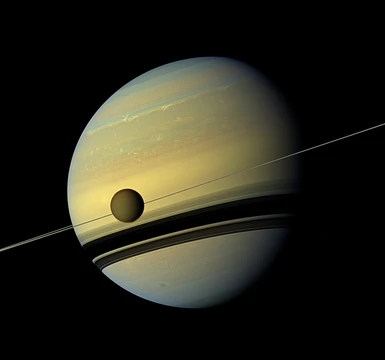
It often refers to a regularly repeating trajectory, like a planet around a star or a satellite around a planet.[1] In celestial mechanics, a trajectory that curves due to an attracting force like gravity is what defines an orbit.[2] Kepler's laws describe how planets and satellites move in paths that are roughly elliptical, with one focus of the ellipse containing the system's center of mass.[1]
Quick Facts
- Field
- Celestial mechanics
Facts from the source article.
Key facts and history
Johannes Kepler first formulated the modern description, finding that planetary orbits are elliptical and that orbital speed varies with distance from the Sun.[3] Isaac Newton later showed that Kepler's laws derive from his theory of gravitation and that orbits under gravity are conic sections.[4] Newton demonstrated that for two bodies, orbit size, period, and combined masses are related, and that bodies orbit their common center of mass.[4] Albert Einstein's general theory of relativity explained gravity as curvature of spacetime, with orbits following geodesics.[5]
Relativity accounts for measurable differences from Newtonian predictions, such as the precession of Mercury's perihelion.[5] Newtonian mechanics remains sufficiently accurate for most short-term orbital calculations.[5] The celestial sphere model, which described planetary motions, was initially developed by Eudoxus and Aristotle in Hellenistic astronomy.[6] Kepler's third law established a proportional relationship: for any planet, the square of its orbital period is proportional to the cube of its distance from the Sun.[3]
What the research sources say
NASA's Venus Fact Sheet gives Venus's mean distance as 0.723 AU and its orbital period as 0.615 years.[7] A 1991 NASA report states that aerobraking can save up to 60 percent of initial mass required in low Earth orbit compared to all-propulsive approaches.[8] According to NASA's Jupiter Fact Sheet, Jupiter's mean distance from the star it orbits is 5.204 AU, and its orbital period is 11.862 years.[9]
References
- Wikipedia, "Orbit" (CC BY-SA 4.0), which cites: "The Space Place :: What's a Barycenter", NASA (original not read by us) en.wikipedia.org
- Wikipedia, "Orbit" (CC BY-SA 4.0), which cites: "orbit (astronomy)" (original not read by us) en.wikipedia.org
- Wikipedia, "Orbit" (CC BY-SA 4.0), which cites: Hyman, "The Mathematical Relationship between Kepler's Laws and Newton's Laws", The American Mathematical Monthly, December 1993, p. 932–936 (original not read by us) en.wikipedia.org
- Wikipedia, "Orbit" (CC BY-SA 4.0), which cites: MacDougal, "Newton's Gravity: An Introductory Guide to the Mechanics of the Universe", Springer Science & Business Media, 2012, p. 127–133; Nauenberg, "Newton's Principia and Inverse-Square Orbits", The College Mathematics Journal, 1994, p. 212–222; Kembhavi, "Gravitational Waves: A New Window to the Universe", Springer Nature, 2020, p. 38–42; Gallant, "Newton's Principia For The Modern Student", World Scientific, 2025, p. 22; Harper, "Isaac Newton's Scientific Method: Turning Data into Evidence about Gravity and Cosmology", Oxford University Pre en.wikipedia.org
- Wikipedia, "Orbit" (CC BY-SA 4.0), which cites: Kembhavi, "Gravitational Waves: A New Window to the Universe", Springer Nature, 2020, p. 38–42; O'Donnell, "Essential Dynamics and Relativity", CRC Press, 2014, p. 127–129; Kembhavi, "Gravitational Waves: A New Window to the Universe", Springer Nature, 2020, p. 38–42 (original not read by us) en.wikipedia.org
- Wikipedia, "Orbit" (CC BY-SA 4.0), which cites: Americo, "A brief history of premodern astronomical models", The Classical Outlook, 2017, p. 94–101; Mazer, "The Ellipse: A Historical and Mathematical Journey", John Wiley & Sons, 2011, p. 12 (original not read by us) en.wikipedia.org
- Williams, "Venus Fact Sheet", NASA Goddard Space Flight Center, November 25, 2020. nssdc.gsfc.nasa.gov
- Cooper, "Technologies for aerobraking", NASA Technical Reports Server, March 1991. ntrs.nasa.gov
- Williams, "Jupiter Fact Sheet", NASA Goddard Space Flight Center, October 2, 2024. nssdc.gsfc.nasa.gov
Each numbered sentence above was checked against the source it cites before publication. Sentences citing Wikipedia adapt text from the English Wikipedia article Orbit (contributors), used under CC BY-SA 4.0; this entry is available under the same licence. Other sources were used for facts only.
More in Astronomy & Space
Sources
Compiled from Wikipedia and the sources listed below. Text from Wikipedia is available under CC BY-SA 4.0; this entry is adapted from it.
- Wikipedia: Orbit (CC BY-SA 4.0).
- Word definitions: the Codexery glossary, each quoted from its Wikipedia article.
Spotted an error? Know more?
Reader corrections go straight into our review queue. Suggest an edit · How this site is sourced