Dark Energy Survey
A survey constraining dark energy through multiple cosmological probes.
Last updated

via Wikipedia: Dark Energy Survey · see source
The Dark Energy Survey, led by Josh Frieman, is a project to study dark energy by measuring cosmic expansion. It uses near-ultraviolet, visible, and near-infrared images to analyze Type Ia supernovae, baryon acoustic oscillations, galaxy cluster counts, and weak gravitational lensing. The collaboration includes institutions from the United States, Australia, Brazil, the United Kingdom, Germany, Spain, and Switzerland, and is organized into scientific working groups.
Quick Facts
- Director
- Josh Frieman
- Observing period
- 2013 to 2019
- Survey area
- 5,000 square degrees
- Depth
- 24th magnitude in the i band
- Number of observing nights
- 758
Facts from the source article.
DECam
DECam, short for the Dark Energy Camera, is a large camera built to replace the previous prime focus camera on the Victor M. Blanco Telescope. The camera consists of three major components: mechanics, optics, and CCDs. The mechanics include a filter changer with an 8-filter capacity and shutter, plus an optical barrel that supports 5 corrector lenses, the largest of which is 98 cm in diameter. These components are attached to the CCD focal plane which is cooled to 173 K with liquid nitrogen to reduce thermal noise, and kept in an extremely low vacuum of 0.00013 Pa to prevent condensation.
The entire camera weighs approximately 4 tons and is supported with a hexapod system allowing real time focal adjustment. The camera is outfitted with u, g, r, i, z, and Y filters spanning roughly from 340–1070 nm, similar to those used in the Sloan Digital Sky Survey (SDSS), enabling photometric redshift measurements to z≈1. DECam contains five lenses acting as corrector optics to extend the telescope's field of view to a diameter of 2.2°, one of the widest fields of view available for ground-based optical and infrared imaging.
A significant difference from previous CCDs at the telescope is improved quantum efficiency in red and near-infrared wavelengths. The scientific sensor array is an array of 62 2048×4096 pixel back-illuminated CCDs totaling 520 megapixels, with an additional 12 2048×2048 pixel CCDs (50 Mpx) for guiding, focus, and alignment, making the full focal plane 570 megapixels. The CCDs use high resistivity silicon with 15×15 micron pixels and a 250-micron crystal depth, increasing sensitivity to lower energy photons and extending the wavelength range to 1050 nm. Each pixel has a width of 0.27 arcseconds on the sky, resulting in a total field of view of 3 square degrees.
Survey
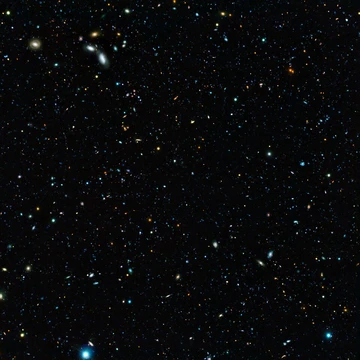
DES imaged 5,000 square degrees of the southern sky in a footprint that overlaps with the South Pole Telescope and Stripe 82, largely avoiding the Milky Way. The survey took 758 observing nights spread over six annual sessions between August and February, covering the survey footprint ten times in five photometric bands (g, r, i, z, and Y). The survey reached a depth of 24th magnitude in the i band over the entire survey area. Longer exposure times and faster observing cadence were made in five smaller patches totaling 30 square degrees to search for supernovae.
First light was achieved on 12 September 2012; after a verification and testing period, scientific survey observations started in August 2013. The last observing session was completed on 9 January 2019. After completion of the Dark Energy Survey, the Dark Energy Camera was used for other sky surveys: the Dark Energy Camera Legacy Survey (DECaLS) covering the sky below 32° Declination (over 9000 square degrees), the DESI Legacy Imaging Surveys (Legacy Surveys) which includes DECaLS, BASS and MzLS and covers almost the entire extragalactic southern sky, and the Dark Energy Camera Plane Survey (DECaPS) covering the Milky Way in the southern sky.
Observing
Each year from August through February, observers stayed in dormitories on the mountain. During a weeklong period of work, observers slept during the day and used the telescope and camera at night. Some DES members worked at the telescope console to monitor operations while others monitored camera operations and data processing. For the wide-area footprint observations, DES took roughly two minutes for each new image: exposures were typically 90 seconds long, with another 30 seconds for readout of the camera data and slewing to point the telescope at its next target.
The team also considered different sky conditions such as moonlight and cloud cover. A computer algorithm called the 'Observing Tactician' (ObsTac) helped sequence observations, optimizing among factors like date and time, weather conditions, and the position of the moon. ObsTac automatically pointed the telescope in the best direction, selected the exposure using the best light filter, and decided whether to take a wide-area or time-domain survey image depending on whether the exposure would also be used for supernova searches.
Results
DES published several papers presenting cosmology results from its first-year data and third-year data. These results used a Multi-Probe Methodology combining data from Galaxy-Galaxy Lensing, different shapes of weak lensing, cosmic shear, galaxy clustering, and photometric data sets. For the first-year data, DES showed cosmological constraints from Galaxy Clustering and Weak Lensing results and cosmic shear measurement. With Galaxy Clustering and Weak Lensing, they reported constraints for ΛCDM and ωCDM at 68% confidence limits.
Cosmic shear measurements gave constraints at 68% confidence limits for ΛCDM. Other first-year analyses included derivation and validation of redshift distribution estimates for weak lensing source galaxies, and a paper summarizing all the Photometric Data Set for Cosmology. Weak lensing was measured via the shear-shear correlation function or its Fourier transform, the shear power spectrum.
More in Astronomical Surveys
Sources
Compiled from Wikipedia and the sources listed below. Text from Wikipedia is available under CC BY-SA 4.0; this entry is adapted from it.
- Wikipedia: Dark Energy Survey (CC BY-SA 4.0).
- Word definitions: the , each quoted from its Wikipedia article.
Spotted an error? Know more?
Reader corrections go straight into our review queue. Suggest an edit · How this site is sourced