
Kim Hongdo
Joseon painter known for genre scenes and Western-influenced techniques.

via Wikipedia: Kim Hongdo · see source
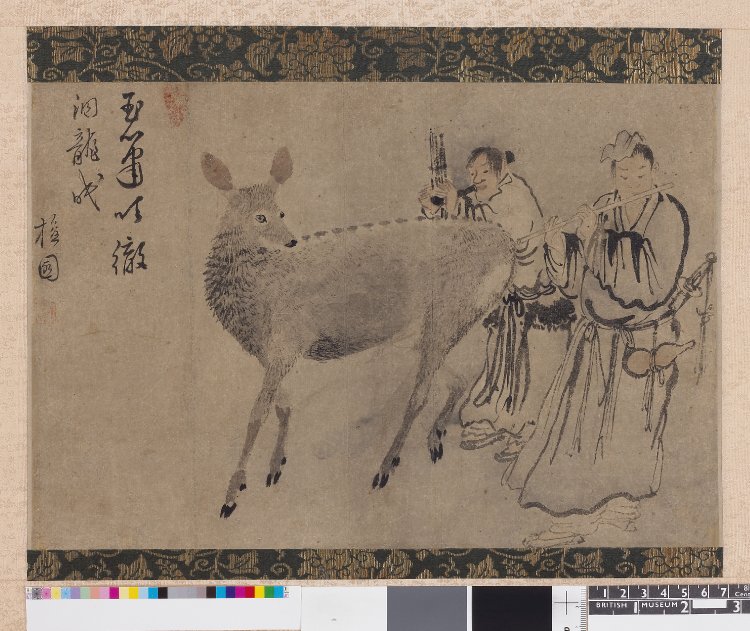
Kim Hongdo (Korean: 김홍도, 1745–c. 1806 to 1814) was a Joseon dynasty painter best known for capturing the daily lives of ordinary people, much like artists of the Dutch Golden Age. He also went by his art name Tanwŏn (단원). Working under Kings Yeongjo and Jeongjo, he significantly shifted Joseon painting style. He adopted Western techniques, likely learned through the Qing Dynasty, using color contrasts and visual jokes to create a sense of perspective.
Born into the Gimhae Kim clan, he grew up in what is now Ansan, South Korea. At age seven, he studied under the master Pyoam Kang Sehwang, who was living in seclusion there. In 1766, at 21, Kang recommended him for a position as a court painter (hwawon) in the Dohwaseo. He painted the portrait of the Royal Heir (later King Jeongjo) in 1771, and in 1773 assisted Byeon Sang-byeok with the royal portrait of King Yeongjo. His reputation soared in 1776 after he painted the "Nineteen Taoist Immortals." That same year, the newly crowned King Jeongjo commissioned many institutional works from him. Kim died in poverty and isolation; the exact year is unknown, with sources placing it in 1806, 1810, or after 1814.
Today, Kim is counted among the "Three Wons," alongside Hyewon and Owon, and is often grouped with Owon and the 15th-century painter An Gyeon as one of Joseon's three greatest painters. The city of Ansan, where he spent his youth and learned his craft, honors him extensively. The district Danwon-gu takes its name from his art name, and the city holds an annual "Danwon Art Festival." Many public spaces there are designed to imitate his works.
Opinions vary on a "top ten" list of his paintings, but his success across many painting types is clear. Towooart offers a short notice with a curated selection. The Korean Copyright Commission lists 757 paintings, 7 calligraphies, and 4 moldings by him. Some works, like "Feast for the Pyongyang Governor," exist in multiple versions—often a fine-resolution sepia copy and a lower-resolution color one.
His career included paintings that first made his reputation, literati works, official commissions, and works as the king's designated painter. His genre paintings include the album *Danwon pungsokdo*, a series of 25 paintings. His output continued after King Jeongjo's death in 1800.
In popular culture, the novel *Painter of the Wind* by Lee Jung-myung centers on Kim and Sin Yun-bok, the latter portrayed as a woman disguised as a man. In film and television, Park Shin-yang played him in the 2008 SBS series *Painter of the Wind*, Kim Young-ho in the 2008 film *Portrait of a Beauty*, and Kim Da-hyun in the 2011 SBS series *Warrior Baek Dong-soo*.
- born
- 1745
- died
- c. 1806 to 1814 (uncertain)
- field
- Painting
- nationality
- Korean (Joseon dynasty)
- known_for
- Depictions of everyday life of ordinary people; one of the 'Three Wons'
Verified Timeline
Lore & Background
Kim Hongdo was a member of the Gimhae Kim clan. He grew up in present-day Ansan, South Korea. At the age of 7, Kim Hongdo studied under the renowned master Pyoam Kang Sehwang, who was then living in seclusion in Ansan. In 1766, at the age of 21, on the recommendation of Kang Sehwang, he entered the royal service as a member (hwawon) of the Dohwaseo, the official painters of the Joseon court. In 1771, he painted the portrait of the Royal Heir (the future King Jeongjo). In 1773, he assisted Byeon Sang-byeok when painting the Royal Portrait of King Yeongjo (1694–1724–1776). In 1776, he painted the "Nineteen Taoist Immortals", that skyrocketed his reputation as a painter. At the same time, the new instated King Jeongjo (1752–1776–1800) commissioned him for many institutional paintings. He died in loneliness and poverty, though the circumstances, and even the year are unknown. Depending on the source, some state that he died in 1806, 1810, or after 1814.
Reader's Guide
Kim is remembered today as one of the "Three Wons," together with Hyewon and Owon. He is also often joined to Owon and the 15th-century painter An Gyeon as one of Joseon's three greatest painters. The city of Ansan, where he spent his youth and learned his craft, has memorialized him in many ways. The district of Danwon-gu is named after him, as is Ansan's annual "Danwon Art Festival." Many public places have been designed in imitation of his works. The Korean Copyright Commission lists 757 paintings, 7 calligraphies and 4 moldings for Kim Hongdo. His album Danwon pungsokdo provides a series of 25 paintings. He died in loneliness and poverty, with the exact year unknown—sources state 1806, 1810, or after 1814.
Did You Know?
- Kim Hongdo studied under master Pyoam Kang Sehwang starting at age 7, while Kang was living in seclusion in Ansan.
- In 1776, his painting 'Nineteen Taoist Immortals' skyrocketed his reputation as a painter.
- The Korean Copyright Commission lists 757 paintings, 7 calligraphies, and 4 moldings attributed to Kim Hongdo.
- His album Danwon pungsokdo contains a series of 25 genre paintings.
- Kim Hongdo died in loneliness and poverty, with the year of death uncertain—sources give 1806, 1810, or after 1814.
Gallery
Frequently Asked Questions
Who is Kim Hongdo?
Kim Hongdo (1745–c. 1806/1814) was a Korean painter who worked during the Joseon dynasty under Kings Yeongjo and Jeongjo. He is recognized as one of the celebrated 'Three Wons' of Joseon-era art.
What is Kim Hongdo most famous for painting?
He is best remembered for his vivid genre scenes showing the daily routines of common folk—farmers, merchants, and laborers—rather than the courtly or religious subjects that dominated earlier Joseon art. Critics often draw a parallel to the everyday-life focus of Dutch Golden Age painters.
What is Kim Hongdo's art name?
He went by the pen name Tanwŏn (단원), which is the name under which many of his surviving works are signed and by which he is commonly referred to in Korean art scholarship.
When did Kim Hongdo die?
His exact year of death is not firmly established; sources place it somewhere between 1806 and 1814, so most references list it as an approximate date.
Why is Kim Hongdo considered a turning point in Korean painting?
He shifted Joseon painting away from rigid Confucian conventions toward more naturalistic, human-centered compositions, and he experimented with spatial depth techniques that some scholars link to Western perspective. The degree to which he actually employed European methods, however, remains an open question among art historians.
More in Asian And Middle Eastern Artists 1-24
Spotted an error? Know more?
This is a living reference — every entry is fact-audited, and reader corrections feed straight into our audit queue. Suggest an edit · See this site's audit record