Umayyad Mosque
One of the largest and oldest mosques in the world, blending millennia of religious history.
Last updated

via Wikipedia: Mosque–Cathedral of Córdoba · see source
Where it is
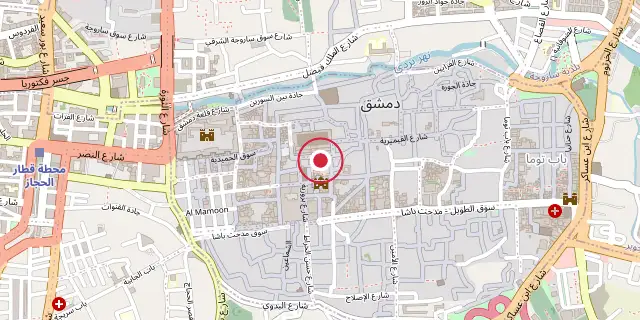
Coordinates: 33°30′40″N 36°18′25″E (33.5110, 36.3070) · Open in OpenStreetMap
Coordinates and connected clubs: the infobox of Wikipedia: Umayyad Mosque (CC BY-SA 4.0). Map: drawn by Codexery from OpenStreetMap tiles.
The Umayyad Mosque, also known as the Great Mosque of Damascus, located in the old city of Damascus, the capital of Syria, is one of the largest and oldest mosques in the world. Its religious importance stems from eschatological reports and historic events associated with it.
Christian and Muslim tradition alike consider it the burial place of John the Baptist's head, a tradition originating in the 6th century. Two shrines inside commemorate Husayn ibn Ali. It is considered to be the oldest mosque still in use in its original form.
Lore & Background
The site has been used as a house of worship since the Iron Age, when the Arameans built a temple to Hadad. It was later associated with Zeus during the Hellenistic period. Under Roman rule after 64 CE, it became the center of the imperial cult of Jupiter.
The current walls of the mosque were the inner walls of the Temple of Jupiter (built 1st century BC to 4th century AD). Under Byzantine rule, Emperor Theodosius I transformed it into a cathedral. After the Muslim conquest of Damascus in 634, part of the cathedral was designated as a musalla.
The Umayyad caliph al-Walid I confiscated the rest of the cathedral for Muslim use, returning other properties as compensation. The chapel was demolished and a grand mosque built over nine years by thousands of laborers and artisans, funded by war booty and taxes on Arab troops. The mosque had a large basilical plan with three parallel aisles and a perpendicular central nave leading to the world's second concave mihrab. It was noted for marble paneling and extensive gold mosaics covering some 4000 m2.
Under Abbasid rule, the Dome of the Treasury and Minaret of the Bride were added; the Mamluks added the Minaret of Qaitbay. The mosque innovated Islamic architecture and was regarded as a 'wonder of the world' by many medieval Muslim writers. Although altered several times due to fire, war damage, and repairs, it is one of the few mosques to maintain the same form and architectural features of its 8th-century construction.
Reader's Guide
The mosque is located in the old city of Damascus. Visitors can see the remains of the Roman-era triple doorway in the exterior southern wall. The prayer hall features three aisles and a central nave.
The courtyard contains the Dome of the Treasury and the Minaret of the Bride. The Minaret of Qaitbay is also present. The mosque's interior includes marble paneling and gold mosaics.
Frequently Asked Questions
What is the Umayyad Mosque?
The Umayyad Mosque, commonly called the Great Mosque of Damascus, sits in the old city of Damascus, Syria. It ranks among the largest and oldest mosques on Earth and is regarded as the oldest one still functioning in its original layout.
When was the Umayyad Mosque built and by whom?
Construction began in 706 under the direction of Umayyad caliph al-Walid I and was completed sometime between 711 and 715. He commissioned the project during his reign spanning 705 to 715.
What architectural style does the Umayyad Mosque use?
The building follows a basilical plan featuring three parallel aisles crossed by a perpendicular central nave. This layout adapts the early Christian basilica form for Islamic worship.
Is the Umayyad Mosque still in use today?
Yes, it continues to serve its congregation in essentially its original form, making it one of the oldest mosques in the world that remains a living place of worship rather than a purely historical relic.
More in Architectural Landmarks
Sources
Compiled from Wikipedia and the sources listed below. Text from Wikipedia is available under CC BY-SA 4.0; this entry is adapted from it.
- Wikipedia: Umayyad Mosque (CC BY-SA 4.0).
Spotted an error? Know more?
Reader corrections go straight into our review queue. Suggest an edit · How this site is sourced