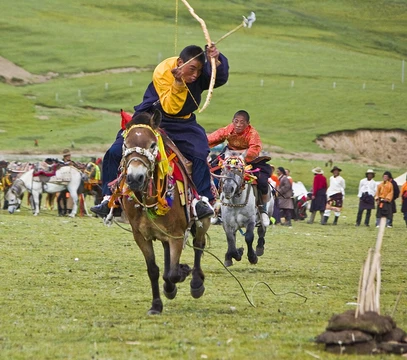
Limba Ram
Indian archer who equalled a world record and later became national chief coach.

Limba Ram, an Indian archer, competed for his country in international events, including three Olympic Games. In 1992, at the Asian Archery Championships in Beijing, he matched a world record. He received the Padma Shri Award in 2012. He was born on January 30, 1972, in Saradeet Village, located in the Jhadol tahsil of Udaipur district, Rajasthan. His family is from the Ahari tribe. Due to poverty, he learned to hunt birds like sparrows and partridges, along with other animals, using a homemade bamboo bow and reed arrows. In 1987, an uncle told him about government trials in the nearby village of Makradeo to find skilled archers. At that trial, 15-year-old Limba Ram and three other boys, including future Arjuna Award winner Shyam Lal, were noticed by selectors from the Sports Authority of India. They were all sent to New Delhi for the Special Area Games Programme, a four-month training camp led by coach R. S. Sodhi. The Akhil Bharatiya Vanavasi Kalyan Ashram, an RSS-linked tribal welfare organization, has said it identified Limba Ram through its Ekalavya Khelkood Pratiyogita competition. After being spotted and trained by the Sports Authority of India in 1987, he became overall champion at the National Junior Level Archery Tournaments in Bangalore that same year. In 1988, he won the National Senior Level Tournament, becoming overall champion and earning a spot on the Indian team for the Summer Olympics in Seoul. In 1989, he reached the quarterfinals of the World Archery Championships in Lausanne, Switzerland. That year, he also finished second in the individual event at the Asian Cup, while India took team gold. In 1990, he helped India finish fourth at the Beijing Asian Games. At the 1992 Asian Archery Championships in Beijing, he equaled Takayoshi Matsushita’s world record in the 30-meter event with a score of 358 out of 360, winning the gold medal. The Parliament of India congratulated him on this achievement. At the 1992 Barcelona Olympics, he placed 23rd in the ranking round and was eliminated in the round of 32. In 1995, he ranked second individually, and the team won gold at the Commonwealth Games in New Delhi. In 1996, he was national champion and set an Asian record. He also participated in the 1996 Atlanta Summer Olympics. The Government of India gave him the Arjuna Award in 1991 and the Padma Shri in 2012.
Quick Facts
- Nationality
- Indian
- Birth Date
- 1972-10-30
- Birth Place
- Saradeet, Rajasthan, India
- Height
- 1.57 m
- Weight
- 58 kg
- Country
- India
- Sport
- Archery
- Show Medals
- yes
Facts from the source article.
Lore & Background
Limba Ram was born into the Ahari tribe in a village in Rajasthan. Due to poverty, he hunted birds and animals with a bamboo bow and reed arrows. In 1987, his uncle informed him of government trials in a nearby village; there, 15-year-old Limba Ram and three other boys, including future Arjuna Award winner Shyam Lal, were selected by the Sports Authority of India. They were sent to New Delhi for the Special Area Games Programme under coach R. S. Sodhi. The Akhil Bharatiya Vanavasi Kalyan Ashram, an RSS-linked tribal welfare organisation, has claimed it identified Limba Ram through its Ekalavya Khelkood Pratiyogita competition. In 1987, he became overall champion at the National Junior Level Archery Tournaments in Bangalore. The next year he won the National Senior Level Tournament and earned a spot at the 1988 Seoul Olympics. In 1989 he reached the quarterfinals of the World Archery Championships and finished second at the Asian Cup in Individuals, while India won team gold. In 1990 he helped India finish fourth at the Beijing Asian Games. At the 1992 Barcelona Olympics he placed 23rd in the ranking round and was eliminated in the round of 32. In 1995 he stood second and the team won gold at the Commonwealth Games in New Delhi. In 1996 he was National Champion with an Asian Record. In 1996 he joined TATA Group but suffered a serious shoulder injury while playing football at a training camp in Kolkata, which ended his ability to shoot a bow. He left TATA and joined Punjab National Bank as a cashier in 2001. In 2003 he participated in a national ranking tournament but finished 16th. From 2009 to the 2012 London Olympics, he served as National Archery Chief Coach, guiding India to 11 Gold, 20 Silver, and 16 Bronze medals across World Cups, World Championships, Commonwealth Games, and Asian Games.
Reader's Guide
Limba Ram's significance lies in his rise from a tribal hunter using a bamboo bow to an Olympic archer who equalled a world record. His early life, marked by poverty and reliance on hunting for food, shaped his archery skills. The Sports Authority of India's Special Area Games Programme identified and trained him, leading to national titles and Olympic representation in 1988, 1992, and 1996. His 1992 world record in the 30 meters event at the Asian Archery Championships earned a congratulatory mention in the Parliament of India. After a shoulder injury ended his competitive career, he transitioned to coaching. As National Archery Chief Coach from 2009 to the 2012 London Olympics, he oversaw a period of substantial medal success, including multiple golds at World Cups and the Commonwealth Games. His legacy includes both his personal achievements and his role in developing Indian archery on the international stage.
Did You Know?
- Limba Ram equalled the world record of Takayoshi Matsushita in the 30 meters event with a score of 358/360 at the 1992 Asian Archery Championships.
- He was awarded the Padma Shri in 2012 and the Arjuna Award in 1991.
- As National Archery Chief Coach from 2009 to 2012, India won 11 Gold, 20 Silver, and 16 Bronze medals under his guidance.
From the Aravalli Scrub to the National Stage
Born on January 30, 1972, in the small village of Saradeet in Udaipur district's Jhadol tahsil, Limba Ram grew up in a family of the Ahari tribe where material scarcity was a daily reality. Before he ever touched a competitive bow, his relationship with archery was shaped by survival: he hunted sparrows, partridges, and other jungle animals using a simple bamboo bow and reed arrows to help feed his household. The turning point arrived in 1987 when an uncle relayed the news that government-sponsored archery trials would be held in the nearby village of Makradeo. At just fifteen, Limba Ram attended and was identified alongside three other boys—including the future Arjuna Award recipient Shyam Lal—by selectors from the Sports Authority of India. All four were dispatched to New Delhi for a four-month training camp under coach R. S. Sodhi as part of the Special Area Games Programme. The RSS-linked Akhil Bharatiya Vanavasi Kalyan Ashram has also claimed credit for spotting him through its Ekalavya Khelkood Pratiyogita competition, adding a layer of institutional narrative to what was, for Limba Ram, simply a chance encounter between a hungry tribal boy and a government trial.
A Meteoric Rise on the International Stage
The speed with which Limba Ram ascended from a rural trial to the Olympic arena was remarkable in Indian archery. Within a year of his Delhi training camp, he claimed the overall title at the 1987 National Junior Level Tournaments in Bangalore. In 1988 he repeated the feat at the senior level and earned his first Olympic berth for the Seoul Games. The following year saw him reach the quarterfinals at the World Archery Championships in Lausanne and finish runner-up in the individual event at the Asian Cup while India collected team gold. At the 1990 Beijing Asian Games he helped the Indian squad finish fourth. His crowning individual moment came in 1992 at the Asian Archery Championships in Beijing, where he matched Takayoshi Matsushita's world record in the thirty-metre event, scoring 358 out of 360 to claim gold; the Indian Parliament formally congratulated him for the achievement. He went on to compete in three Olympic Games in total—Seoul 1988, Barcelona 1992 (where he placed twenty-third in the ranking round before a knockout-round exit), and Atlanta 1996. Along the way he added a Commonwealth Games team gold in 1995 and a 1996 national title accompanied by an Asian record.
Injury, Obscurity, and the Long Road Back
The years that followed his 1996 national championship carried a quiet, almost painful undercurrent. That same year Limba Ram took a position with the TATA Group, yet a serious shoulder injury sustained while playing football during a training camp in Kolkata derailed his ability to draw a bow. The physical limitation was compounded by a loss of mental focus and concentration that made competitive shooting feel increasingly out of reach. He eventually left his TATA role because of the ongoing problem. For the next several years his public profile faded almost entirely; in 2001 he accepted a position as a cashier at Punjab National Bank, a role far removed from the international arenas he had once dominated. A brief competitive appearance in 2003, when he entered the third National ranking prize-money tournament organised by the Sports Authority of India and finished sixteenth, offered a small reminder of his former capability but confirmed that his playing career was effectively over. The contrast between a world-record-equaling archer and a bank cashier encapsulates the fragility of athletic careers in a sport that received comparatively little institutional support in India at the time.
Architect of India's Archery Renaissance
Limba Ram's most enduring contribution to Indian archery came not from his own bow but from the bows of others. On January 10, 2009, the Archery Association of India appointed him National Chief Coach, a role he held through the 2012 London Olympic cycle. Under his guidance the Indian squad accumulated an extraordinary haul: eleven gold, twenty silver, and sixteen bronze medals across the 2009 World Cup series, the 2010 World Cup, the Commonwealth Games, the 2010 Guangzhou Asian Games, the 2011 World Cup, the 2011 World Archery Championships, the 2011 World Youth Championships, the 2012 World Cup, and the London Games themselves. High points included three golds at the 2009 World Cup, a dominant Commonwealth Games showing with three golds, and a silver at the 2011 World Championships. The Government of India recognised the totality of his service with the Padma Shri in 2012, complementing the Arjuna Award he had received in 1991. For a man who once hunted sparrows with a bamboo bow in the Rajasthan scrub, the arc from overlooked tribal youth to the architect of a national medal machine remains one of Indian sport's most compelling narratives.
Frequently Asked Questions
Who is Limba Ram?
Limba Ram is an Indian archer born on January 30, 1972, in Saradeet Village in the Udaipur district of Rajasthan. He represented India at three Olympic Games and is widely recognized for matching a world record at the 1992 Asian Archery Championships in Beijing.
How did Limba Ram first learn to shoot a bow?
Coming from a poor Ahari-tribe family, he built a simple bamboo bow with reed arrows to hunt small birds and animals for survival. His formal path into competitive archery started in 1987 when an uncle mentioned government selection trials taking place in a nearby village.
What is Limba Ram's most notable competitive achievement?
At the 1992 Asian Archery Championships in Beijing, he equalled a world record in his event. That performance remains his single most celebrated result on the international stage.
What major honour has Limba Ram received from the Indian government?
In 2012 he was conferred the Padma Shri, one of India's highest civilian awards, in recognition of his sustained contribution to the sport of archery.
Did Limba Ram move into coaching after his competitive career?
Yes, he later took on the role of national chief coach for India's archery programme. His specific coaching tenure and the medals his athletes earned under his guidance are tracked in the encyclopedia's dedicated coaching section.
More in Archers of Asia 1-24
Spotted an error? Know more?
Reader corrections go straight into our review queue. Suggest an edit · How this site is sourced