Nigersaurus
A short-necked sauropod with a vacuum-cleaner-like mouth.
Last updated
Nigersaurus is a genus of rebbachisaurid sauropod dinosaur from the middle Cretaceous of Niger. It is notable for its highly specialized skull, which bore a wide muzzle with over 500 rapidly replaced teeth and a unique transverse rotation of the tooth rows. The genus is one of the most common fossil vertebrates in its habitat.
Scientific classification
- KingdomAnimalia
- PhylumChordata
- ClassReptilia
- CladeDinosauria
- CladeSaurischia
- Clade†Sauropodomorpha
- Clade†Sauropoda
- Superfamily†Diplodocoidea
- Family†Rebbachisauridae
- Genus†Nigersaurus
- SpeciesNigersaurus taqueti
Named by Sereno et al., 1999
Sources: Wikipedia taxobox: Nigersaurus (CC BY-SA 4.0)
How big is it?
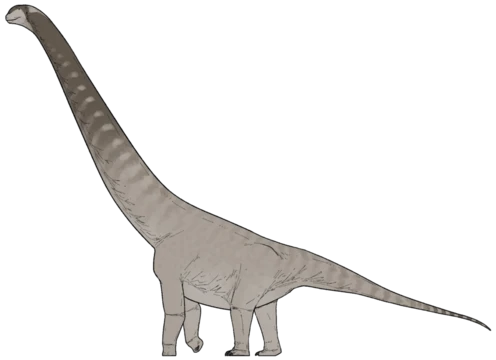
Largest length in the source, 14.1 m, next to a 1.8 m person.
Diagram: drawn by Codexery, schematic shapes to scale (not a likeness). Length: Wikipedia: Nigersaurus
Quick Facts
- Species
- taqueti
Facts from the source article.
History of discovery
Remains later attributed to Nigersaurus were first collected during a 1965–1972 expedition led by Philippe Taquet and mentioned in a 1976 paper. The genus remained poorly known until Paul Sereno’s expeditions in 1997 and 2000 recovered more complete material. Preservation was challenging because the skull and skeleton were delicate and highly pneumatised, causing disarticulation; some skull bones were so thin that light could pass through them. No intact skull or articulated skeleton has been found, but the specimens represent the most complete rebbachisaurid remains known.
Nigersaurus was formally named and described by Sereno and colleagues in 1999, based on newly discovered individuals; the same article also named Jobaria. The genus name refers to Niger, and the specific name taqueti honors Taquet. The holotype, a partial skull and neck, is housed at the National Museum of Niger. Sereno and Jeffrey A. Wilson provided the first detailed skull description in 2005, and a fuller skeletal description followed in 2007.
A reconstructed mount and model were later presented at the National Geographic Society. Sereno called Nigersaurus the most unusual dinosaur he had seen, likening its appearance to Darth Vader and a vacuum cleaner.
Description
Nigersaurus was a quadrupedal sauropod with a small head, thick hind legs, and a prominent tail. It was fairly small for the group, with a body length of 9–14.1 m, a femur length of about 1 m, and a mass comparable to a modern elephant. Its neck was short, with thirteen cervical vertebrae. The skull was delicate, with four large side fenestrae and connecting bone struts less than 2 mm thick; the total bone area connecting the muzzle to the back of the skull was only 1.0 cm².
The skull was nonetheless resistant to shearing forces. A unique feature among sauropodomorphs was a closed supratemporal fenestra. The nasal openings were elongated, and the snout was proportionately short. The maxillary tooth row was rotated transversely 90° toward the front, matched by an identical rotation of the lower jaw dentary, so that all teeth were positioned far forward—a configuration not seen in any other tetrapod.
Classification
Taquet originally assigned the remains to Dicraeosauridae in 1976, but Sereno and colleagues reclassified Nigersaurus as a rebbachisaurid diplodocoid in 1999. Rebbachisauridae is the basalmost family within Diplodocoidea, which also includes diplodocids and dicraeosaurids. The subfamily Nigersaurinae was named by John A. Whitlock in 2011. Closely related genera include Demandasaurus from Spain and Tataouinea from Tunisia, whose distributions suggest carbonate platforms connected Africa and Europe across the Tethys Sea.
A 2013 cladogram by Federico Fanti and colleagues placed Nigersaurus as a basal nigersaurine. In 2015, Wilsona and Ronan Allain found Rebbachisaurus to group with nigersaurines, proposing that Nigersaurinae is a junior synonym of Rebbachisaurinae. Fanti and colleagues later supported the use of Rebbachisaurinae, with Nigersaurus as the basalmost member of this Euro-African subclade.
Palaeobiology
Sereno and colleagues found that Nigersaurus had an underdeveloped olfactory region, indicating a poor sense of smell. Its brain-to-body-mass ratio was average for a reptile and smaller than those of ornithischians and non-coelurosaurian theropods; the cerebrum made up about 30% of brain volume. Mark Hallett and Mathew J. Wedel noted in 2016 that the eyes were placed high on the skull, above the muzzle, giving overlapping fields of view and a visual field near 360 degrees, which would have been useful for detecting predators.
In 2017, Lucio M. Ibiricu and colleagues examined postcranial skeletal pneumaticity in rebbachisaurids and suggested it reduced skeletal density, lowering muscle energy and heat production. This adaptation may have helped the animals cope with high tropical to subtropical temperatures and could explain why rebbachisaurids were the only diplodocoids to survive into the Late Cretaceous.
Did You Know?
- Nigersaurus had more than 500 teeth that were replaced approximately every 14 days.
- The jaws may have borne a keratinous sheath.
- Its skeleton was highly pneumatised, with air spaces connected to air sacs.
More in Aptian Dinosaurs
Test yourself
Three questions drawn from this entry’s sources. Pick an answer to check it.
Answers checked against the source article
Sources
Compiled from Wikipedia and the sources listed below. Text from Wikipedia is available under CC BY-SA 4.0; this entry is adapted from it.
- Wikipedia: Nigersaurus (CC BY-SA 4.0).
- Word definitions: the Codexery glossary, each quoted from its Wikipedia article.
Spotted an error? Know more?
Reader corrections go straight into our review queue. Suggest an edit · How this site is sourced