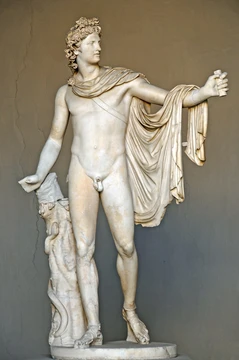
Grannus
Celtic healing god equated with Apollo, worshipped at springs.
Grannus (also Grannos) was an ancient Celtic healing god associated with springs and curative waters, worshipped across Gaul, the Germanies, Raetia, and the Danube provinces. In the Roman period he was most often identified with Apollo through the interpretatio romana, appearing in inscriptions as Apollo Grannus. His usual companion was the goddess Sirona, and the emperor Caracalla sought his aid during illness.
Quick Facts
- Name
- Grannus (also Grannos)
- Consort
- Sirona
- Number of latin dedications
- about thirty
- Notable devotee
- Caracalla
- Cult centers
- Grand, Faimingen (Phoebiana)
- Attested by
- Cassius Dio, Greek honorific inscription from Ephesus
- Bynames
- Amarcolitanus
- Mogounus
- Phoebus
Facts from the source article.
Name
The theonym Grannus is a latinised form of Gaulish Grannos, recorded in about thirty Latin dedicatory inscriptions, a Greek honorific text from Ephesus, and once by Cassius Dio. At a few sites local bynames are attached: Amarcolitanus ('far-seeing') at Branges, Mogounus ('the mighty one') at Horbourg-Wihr, and Phoebus at Trier. The etymology is debated. One line connects the name with Proto-Celtic grand- or grend-, meaning 'beard', so Grannus would mean 'the bearded one', though the god is never portrayed with a beard in Gallo-Roman art.
Another proposition links it to a reconstructed form gra-snó- related to Proto-Celtic gwrīns- or gwrens-, meaning 'heat', making the name a probable reference to the sun's heat and healing properties, supported by the byname Phoebus and the place name Phoebiana. Personal names of the same stem (Grania, Grannius, Grannicus) are recorded across the western provinces, and place-names include Aquae Granni (modern Aachen) and Granno-ialon (modern Grignols).
Cult
Cassius Dio lists Apollo Grannus with Asclepius and Serapis among the healing gods to whom Caracalla appealed during his illness, showing that by the early 3rd century Grannus was known across much of the empire as a healing god equated with Apollo. A Greek honorific inscription from Ephesus, datable to 217 or 218 AD, records that a leading citizen travelled to Apollo Grannus in Caracalla's entourage. Which sanctuary the emperor and envoy sought is disputed; recent scholarship divides between Grand and Faimingen, with Andreas Hofeneder arguing for Faimingen based on the envoy's itinerary, the emperor's illness during his Alamannic campaign, and milestones naming Phoebiana.
Grannus was worshipped chiefly at springs and wells, with his two best-attested cult centres at Grand in the Vosges and Faimingen (ancient Phoebiana) in Raetia, both large sanctuaries known from excavation and inscriptions. At Grand the Roman-period theonym is not directly attested, and the equation with Grannus rests on medieval evidence. Elsewhere Grannus is joined with the Nymphs at Ennetach, with Hygia at Faimingen, and at Astorga with eastern deities including Serapis and Isis.
Dedicants were often officials and soldiers, including imperial procurators at Inveresk, Sarmizegetusa, and Astorga, and imperial legates at Bonn and Lauingen.
Interpretation
Interpretations of Grannus's nature differ. Jan de Vries grouped him with healing gods of springs such as Borvo, understanding the cult as centred on curative and thermal waters. Jürgen Zeidler argued instead for a solar deity, noting that most sanctuaries (Grand, Faimingen, Hochscheid) stand at ordinary wells or watercourses, not thermal springs, so he located the healing power in light and heat rather than the waters themselves. On this view Grannus belongs with Celtic healing deities whose names denote brightness, including his consort Sirona ('star'), Sulis ('sun') at Bath, and Luxovius at Luxeuil.
John T. Koch notes that a derivation from Irish grian ('sun') would account for the equation with Apollo and the pairing with Sirona. Hofeneder is more cautious, noting that the byname Phoebus is attested only once, that Phoebiana may derive from a personal name, and that the etymologies of Sirona and Sulis are disputed. Grannus is one of a set of native names (with Belenus and Borvo) brought under Apollo in Gaul by the interpretatio romana. Whether these were independent Gaulish gods or native epithets of a single Apollo is disputed.
Epigraphy
Grannus appears in roughly thirty Roman-era Latin inscriptions, mostly found in eastern Gaul, the two Germanies, and Raetia, with a few in Noricum, Pannonia, Dacia, Britain, Hispania, Rome, and even as far as Sweden. He is usually called Apollo Grannus, though a verse inscription from Bonn and a Gaulish formula at Limoges omit Apollo. At Chassenon he is linked with Mars, and at Aquincum with both Jupiter and Apollo. About a fifth of the inscriptions pair him with the goddess Sirona.
More in Apollo
Spotted an error? Know more?
Reader corrections go straight into our review queue. Suggest an edit · How this site is sourced