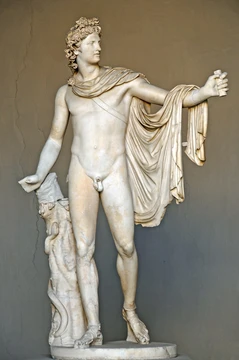
Apollonian and Dionysian
A duality from Greek myth popularized by Nietzsche.
The Apollonian and the Dionysian are philosophical and literary concepts drawn from the figures of Apollo and Dionysus in Greek mythology. Their popularization is widely attributed to Friedrich Nietzsche's work The Birth of Tragedy, though the terms had been used earlier by figures such as Friedrich Hölderlin and Johann Joachim Winckelmann. In Greek myth, Apollo is the god of sun, art, rational thinking, and order, while Dionysus is the god of wine, dance, irrationality, and passion, though the ancient Greeks did not view them as opposites.
Quick Facts
- Key popularizer
- Friedrich Nietzsche
- Nietzsche's work
- The Birth of Tragedy
- Earlier users
- Friedrich Hölderlin, Johann Joachim Winckelmann
- Mythological parents
- Apollo son of Leto, Dionysus son of Semele
Facts from the source article.
Later usage
Nietzsche's idea has been interpreted as an expression of fragmented consciousness or existential instability by writers including Martin Heidegger, Michel Foucault, and Gilles Deleuze. According to Peter Sloterdijk, the Apollonian and Dionysian form a dialectic; they are contrasting, but Nietzsche does not mean one to be valued more than the other. Truth being primordial pain, our existential being is determined by this dialectic. Extending the concept to city form, Abraham Akkerman has pointed to masculine and feminine features of city form.
Anthropologist Ruth Benedict used the terms to characterize cultures that value restraint and modesty (Apollonian) and ostentatiousness and excess (Dionysian), citing the Zuñi people as Apollonian and the Kwakiutl as Dionysian in her work Patterns of Culture. Albert Szent-Györgyi divided scientists into Apollonians and Dionysians, calling scientific dissenters who explore the fringes of knowledge Dionysians; he argued that grant distribution unduly favors the Apollonian.
American humanities scholar Camille Paglia writes about the Apollonian and Dionysian in her 1990 book Sexual Personae, with roots in Nietzschean discourse, though her ideas diverge significantly.
More in Apollo
Spotted an error? Know more?
Reader corrections go straight into our review queue. Suggest an edit · How this site is sourced