
Tersk horse
Russian light riding horse of Arab type, bred for endurance.
Last updated

Елена Морева · CC BY-SA 3.0
The Tersk or Tersky is a Russian breed of light riding horse of Arab type, developed at the Tersk Stud in Stavropol Krai in the North Caucasus between about 1925 and 1940. It was created by crossing Arab stallions with cross-bred mares carrying Strelets, Don, Kabardin, and Arab blood, with the aim of producing a larger, hardier riding horse suited to extensive management in the taboon system.
Background
The Tersk Stud was established by Semyon Budyonny in 1921 to rebuild Russia's horse population after the Russian Revolution of 1917. In 1925, two stallions and a few mares of the now-extinct Ukrainian Strelets breed were brought to the stud.
The Strelets was a part-bred Arab with Orlov Trotter, Don, and Kabardin influence. The two stallions, Tsenitel and Tsilindr, were bred to cross-bred mares with Arab, Don, Kabardin, and Strelets blood. The resulting mares were then put to Arab stallions—Koheilan IV, Marosh, and Nasim—to create the Tersk breed.
Origins and the Founding Vision
The story of the Tersk horse begins in the aftermath of a national catastrophe. Following the upheaval of the 1917 Russian Revolution, the country's equine population had been severely diminished. In 1921, Semyon Budyonny founded the Tersk Stud in Stavropol Krai, in the North Caucasus region, with the explicit mission of rebuilding Russia's horse stock. The foundational breeding work took shape around 1925, when two stallions—Tsenitel and Tsilindr—along with a small number of mares of the Ukrainian Strelets breed arrived at the stud.
The Strelets, now extinct, carried part-Arab blood alongside influences from the Orlov Trotter, Don, and Kabardin lines. These animals were crossed with mares bearing Arab, Don, Kabardin, and Strelets ancestry.
The resulting daughters were then bred to distinguished Arab stallions, including Koheilan IV, Marosh, and Nasim. The guiding vision was to produce a riding horse that retained the elegance of the Arab type while being larger in stature and better suited to the extensive, free-ranging taboon management system. The breed was formally recognised in 1948, capping a period of development that spanned roughly 1925 to 1940.
Conformation and Physical Distinctiveness
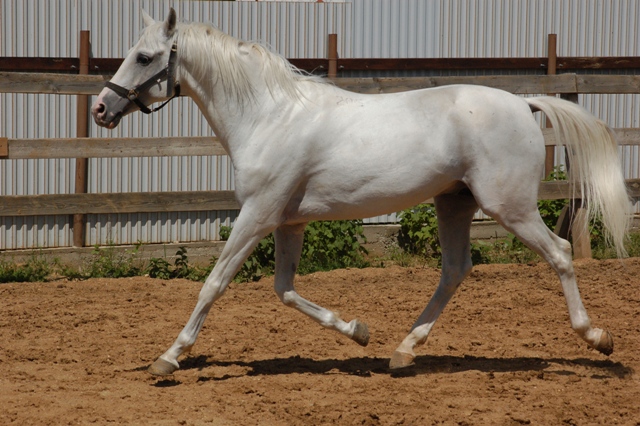
The Tersk presents a silhouette that is unmistakably Arab in its overall architecture, yet refined by deliberate selection for a slightly larger frame. The head is light and carries a straight profile, giving the animal an alert, expressive look. Shoulders slope gracefully into a broad chest, while the back remains straight and the croup is rounded—features that together suggest both power and suppleness. The legs are slender in appearance yet built with genuine strength, and the tail is carried high, adding to the breed's distinctive carriage.
What sets the Tersk apart in finer detail is the quality of its skin and hair: the coat, mane, and tail all possess a notably fine texture. In terms of colour, the most frequently encountered coat is a striking silvery grey, though bays and chestnuts also appear within the population. The overall impression is one of a light, elegant riding horse whose conformation echoes the classic Arab type while carrying the robustness needed for the extensive grazing conditions of the North Caucasus steppe.
Athletic Prowess and Versatility in Sport
In the competitive arena, the Tersk has proven remarkably versatile across a wide spectrum of equestrian disciplines. The breed is well suited to eventing and cross-country riding, where its combination of stamina and agility shines. It performs competently in dressage and show-jumping as well, demonstrating the scope and suppleness that its conformation suggests. Perhaps most impressively, the Tersk excels in endurance riding.
In one notable competition covering a grueling 310-kilometre (190-mile) course, every Tersk horse that entered the race completed the full distance without difficulty—a testament to the breed's exceptional cardiovascular capacity and resilience over long distances. Beyond the show ring and the race track, Tersk horses are frequently employed in circus performances, where their light build, expressive movement, and trainability make them natural entertainers.
This breadth of capability, spanning from the precision of dressage to the raw endurance of a multi-day ride, underscores the breed's adaptability and athletic depth.
Conservation Challenges and Broader Legacy
Despite its distinguished pedigree and proven athletic ability, the Tersk faces an uncertain future. In 2007, the Food and Agriculture Organization of the United Nations classified the breed's conservation status in Europe as 'endangered,' a designation that underscores how narrowly the population has been maintained since the breed's formal recognition in 1948. The original breeding program at the Tersk Stud in Stavropol Krai, which ran from approximately 1925 to 1940, produced a relatively small gene pool, and the loss of source breeds such as the now-extinct Ukrainian Strelets has further narrowed the genetic base.
Nevertheless, the Tersk's influence extends well beyond its own stud book. Stallions of the breed have been deliberately used in cross-breeding programs with the Lokai and Deliboz, two other light horse types, in an effort to improve their quality and performance. In this way, the Tersk continues to shape the equine landscape of the region even as its own numbers remain a cause for concern among breeders and conservationists.
More in Animal breeds originating in the Soviet Union
Sources
Compiled from Wikipedia and the sources listed below. Text from Wikipedia is available under CC BY-SA 4.0; this entry is adapted from it.
- Wikipedia: Tersk horse (CC BY-SA 4.0).
Spotted an error? Know more?
Reader corrections go straight into our review queue. Suggest an edit · How this site is sourced