
Soviet Heavy Draft
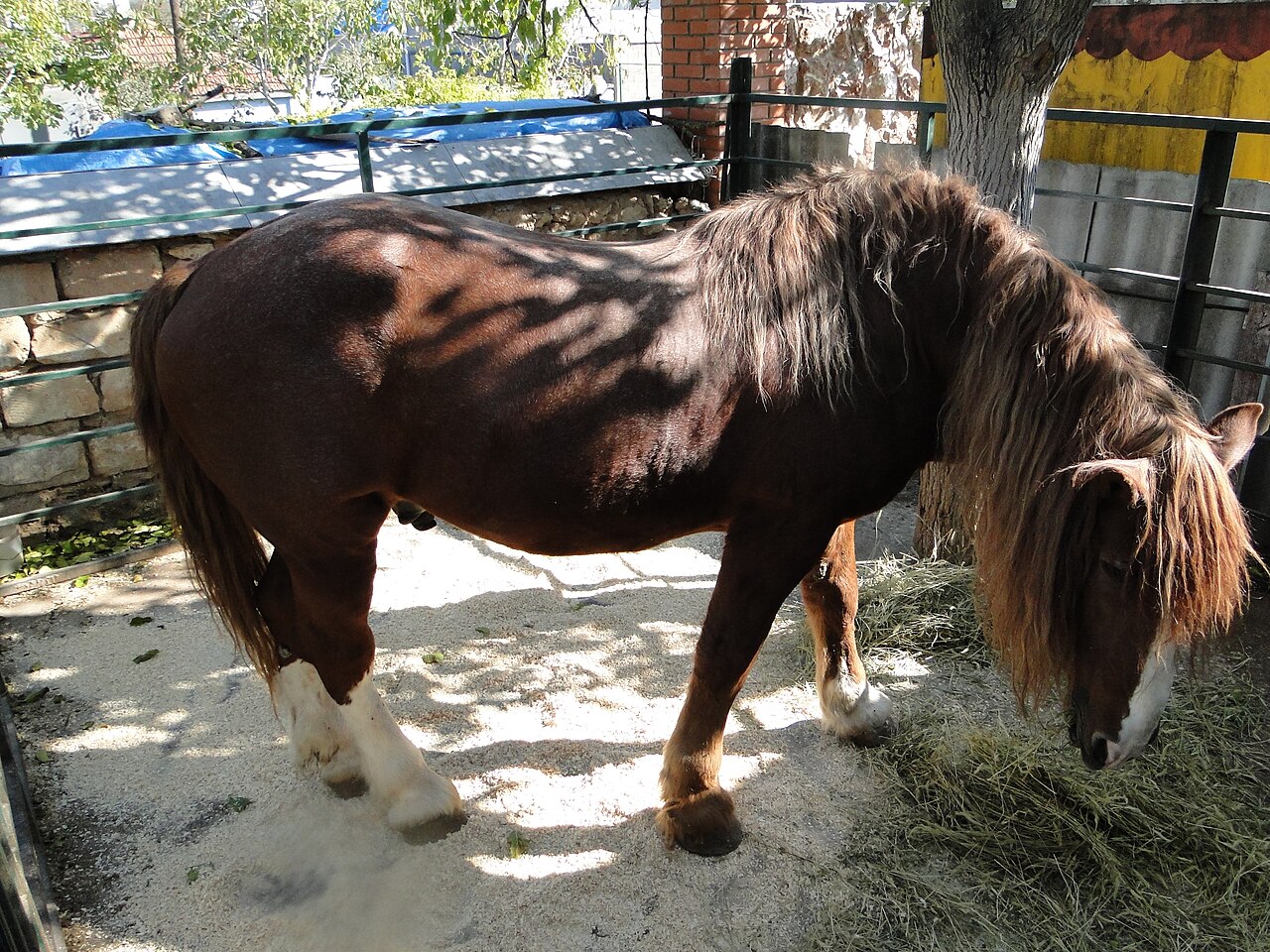
A Russian heavy draft horse bred from the Belgian Brabant.
Last updated

SSSR · Public domain
The Soviet Heavy Draft is a Russian breed of heavy draft horse, developed in the former Soviet Union for agricultural draft work. It derives from the Belgian Brabant heavy draft breed and was officially recognized as a breed in 1952, becoming one of several heavy draft breeds created in the Soviet Union during the twentieth century.
Background
The origins of the Soviet Heavy Draft date to the late nineteenth century at the Khrenovski stud farm in Voronezh Oblast. Imported Brabant draft stallions from Belgium were cross-bred with mares of various types, including Ardennais, Jutland, Percheron, Suffolk Punch, and riding horses. Breeding later transferred to the Pochinki Stud Farm in Nizhny Novgorod Oblast, with additional centers in Gavrilov Posad and Mordovia.
From Belgian Roots to Soviet Fields
The Russian Empire entered the modern era without a single indigenous breed of heavy draft horse, a gap that would take decades of deliberate cross-breeding to close. The story of the Soviet Heavy Draft begins in the late nineteenth century at the Khrenovski stud farm in Voronezh Oblast, where Belgian Brabant stallions were first mated to local mares. Those mares were not a uniform group: some carried the bloodlines of Ardennais, Jutland, Percheron, or Suffolk Punch draft types, while others were simply riding horses.
As demand for powerful agricultural horses grew, the breeding program expanded to the Pochinki Stud Farm in Nizhny Novgorod Oblast, the Gavrilov Posad stud in Ivanovo Oblast, and a center in Mordovia. The geographic footprint stretched across central-southern Russia. The numbers tell the story of that expansion: three Brabant stallions in 1885 became fifty-eight by 1895, nearly nine hundred by 1945, and almost four hundred by 1950. The breed received its official name and recognition in 1952.
A Frame Built for Power
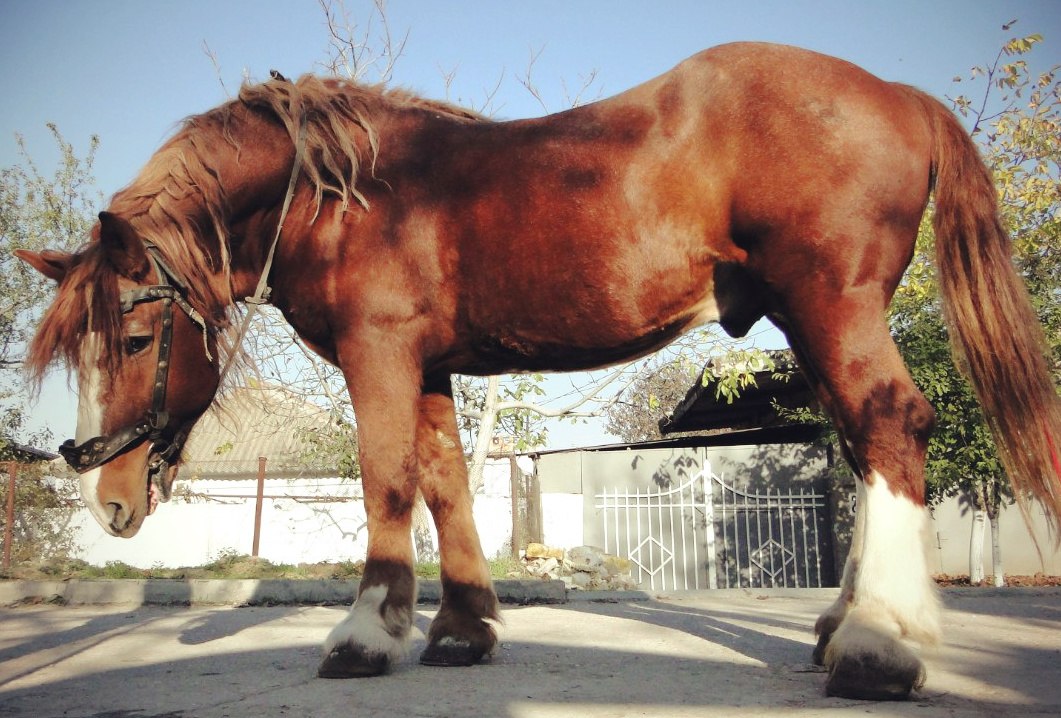
Decades of selective breeding in the Soviet Union produced a horse whose very silhouette speaks of raw pulling power. The Soviet Heavy Draft is a massively built animal that nonetheless moves with free, fluid gaits, a combination that sets it apart from many heavier contemporaries. The head presents a straight or convex profile, and the neck is notably short, giving the impression of a low, broad topline. The torso is wide and heavily muscled, with a strong, broad back leading into a muscular sloping croup.
The abdomen is rounded, adding to the overall impression of depth and substance. Below the body, the legs are short and sturdy, anchored by solid joints and capped with broad, rounded hooves. Every element of the conformation—the compact frame, the dense musculature, the robust lower limbs—was shaped by the singular purpose of hauling heavy loads across fields and through industrial yards.
Beyond the Plough: Productive Versatility
Although the breed was conceived as a working animal for agriculture and industry, its productive value extended well beyond the plough line. Mares of the Soviet Heavy Draft are moderately fertile, with foaling rates in the range of sixty-five to seventy-five percent. The foals themselves grow rapidly, typically reaching between three hundred fifty and four hundred kilograms at weaning—a remarkable rate for a heavy breed. The breed also contributed to food production in a more direct sense: it was used for meat, and its mares were milked.
The highest recorded milk yield for a single lactation stands at six thousand three hundred and twenty kilograms, a figure that underscores the animal's sheer physical capacity. By 1980 the total population of the breed numbered approximately thirty-five thousand head, of which nearly four thousand were classified as pure-bred. This combination of draft strength, rapid foal growth, and notable milk output made the Soviet Heavy Draft a multifaceted asset on Soviet farms.
A Lineage That Reached Beyond Borders
The Soviet Heavy Draft did not exist in isolation. It was one of several heavy draft breeds deliberately created within the Soviet Union during the twentieth century, alongside the Russian Heavy Draft, which drew mainly on Ardennais blood, and the Vladimir Heavy Draft, rooted principally in the Clydesdale. The Brabant stallions that seeded the Soviet Heavy Draft program also left a wider genetic imprint. Their influence spread beyond the borders of the Russian heartland, contributing to the formation of the Estonian and Lithuanian Heavy Draft breeds.
In the later twentieth century, the Soviet Heavy Draft itself was among the breeds tapped for the development of the Bulgarian Heavy Draft. This web of cross-border genetic exchange illustrates how a single breeding initiative in central-southern Russia rippled outward, shaping equine populations across the former Eastern Bloc. The breed's story is thus inseparable from a broader twentieth-century effort to build a network of powerful, purpose-bred draft horses across the region.
More in Animal breeds originating in the Soviet Union
Sources
Compiled from Wikipedia and the sources listed below. Text from Wikipedia is available under CC BY-SA 4.0; this entry is adapted from it.
- Wikipedia: Soviet Heavy Draft (CC BY-SA 4.0).
Spotted an error? Know more?
Reader corrections go straight into our review queue. Suggest an edit · How this site is sourced