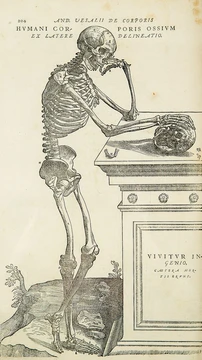
Bone
Bones are rigid organs forming the vertebrate skeleton.

Donvikro · CC BY-SA 4.0
Bone tissue is a form of hard, specialized connective tissue that is mineralized and has an intercellular honeycomb-like matrix.[1] In most vertebrate animals, the skeleton includes a rigid organ known as a bone.[2]
Quick Facts
- Latin
- os, ossis
- Greek
- ὀστέον (ostéon)
Facts from the source article.
Key facts and history
Five types of bones are found in the human body: long, short, flat, irregular, and sesamoid.[3] Bone is not uniformly solid, but consists of a flexible matrix (about 30%) and bound minerals (about 70%).[4] A newborn human's body contains roughly 300 bones.[5] As a person matures, many of those bones fuse, resulting in 206 distinct bones in an adult, excluding the many small sesamoid bones.[5]
Internal organs are shielded by bones; for instance, the brain is protected by the skull, and the heart and lungs are protected by the ribs.[6] Bone marrow is located within the cancellous portion of bones.[7] Hematopoiesis is the process by which bone marrow generates blood cells.[7]
References
- Wikipedia, "Bone" (CC BY-SA 4.0), which cites: "Forensic Anthropology: A Comprehensive Approach", CRC Press, 2017, p. 82 (original not read by us) en.wikipedia.org
- Wikipedia, "Bone" (CC BY-SA 4.0), which cites: "The Bone Organ System: Form and Function", Academic Press, January 2001, p. 3–20 (original not read by us) en.wikipedia.org
- Wikipedia, "Bone" (CC BY-SA 4.0), which cites: "Types of bone", mananatomy.com (original not read by us) en.wikipedia.org
- Wikipedia, "Bone" (CC BY-SA 4.0), which cites: "Ossein", The Free Dictionary; "Textbook of Medical Physiology", Elsevier, 2011, p. 957–960; "Scaling: Why Is Animal Size So Important?", Cambridge University Press, 1984, p. 6; "A mineralogical perspective on the apatite in bone", Materials Science and Engineering: C, 2005, p. 131–143; "Bone Apatite Nanocrystal: Crystalline Structure, Chemical Composition, and Architecture", Biomimetics, February 2023, p. 90 (we also read that source) en.wikipedia.org
- Wikipedia, "Bone" (CC BY-SA 4.0), which cites: "The Anatomy and Biology of the Human Skeleton", Texas A&M University Press, 1988, p. 4; "Mammal anatomy: an illustrated guide", Marshall Cavendish, 2010, p. 129 (original not read by us) en.wikipedia.org
- Wikipedia, "Bone" (CC BY-SA 4.0), which cites: "Scaling: Why Is Animal Size So Important?", Cambridge University Press, 1984, p. 6; "BENG 112A Biomechanics, Winter Quarter, 2013", Department of Bioengineering, University of California; "Shear strength and fatigue properties of human cortical bone determined from pure shear tests", Calcified Tissue International, December 2001, p. 373–378 (we also read that source) en.wikipedia.org
- Wikipedia, "Bone" (CC BY-SA 4.0), which cites: "Development of the hematopoietic system and disorders of hematopoiesis that present during infancy and early childhood", Pediatric Clinics of North America, December 2013, p. 1273–1289; Young 2006, p. 60–61 (original not read by us) en.wikipedia.org
Each numbered sentence above was checked against the source it cites before publication. Sentences citing Wikipedia adapt text from the English Wikipedia article Bone (contributors), used under CC BY-SA 4.0; this entry is available under the same licence. Other sources were used for facts only; no text or images are copied from them.
More in Animal Anatomy
Spotted an error? Know more?
Reader corrections go straight into our review queue. Suggest an edit · How this site is sourced