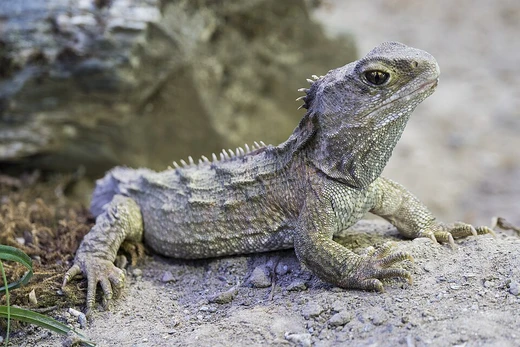
Dinocephalia
Large-bodied therapsids of the Middle Permian with thickened skulls.

Dinocephalia, whose name comes from the Ancient Greek for "terrible head," were a group of generally large-bodied therapsids that thrived during the Middle Permian, roughly between 275 and 260 million years ago. They died out during the Capitanian mass extinction. This clade included both meat-eaters (the Anteosauria) and plant-eaters or omnivores (the Tapinocephalia), making them the top predators and dominant large herbivores of their time. Many species had thickened skulls covered in knobs and bony bumps. Dinocephalians were the first non-mammalian therapsids to be formally described by science, and their fossils have been found in Russia, China, Brazil, South Africa, Zimbabwe, and Tanzania.
In terms of size, dinocephalians were often huge, with some being the largest animals of the Permian and the first synapsids to reach a body mass of around one tonne. The herbivorous or omnivorous *Jonkeria* may have weighed about 989 kilograms, while the big carnivore *Anteosaurus* is estimated at around 400 kilograms based on scaled 3D models.
Their skulls and lower jaws share several key features. The vomerine process of the premaxilla is lost, so the vomer bone borders the main part of the premaxilla. The transverse flange of the pterygoid bone sits in front of the eye socket. There are no depressions or ridges on the outer surface of the reflected lamina of the angular bone, and a foramen is present between the prearticular and angular bones on the inner side of the lower jaw. The temporal fenestra at the back of the skull is relatively large, and the quadrate and quadratojugal bones are also enlarged. Unusually for therapsids, the premaxillae have a long, backward-pointing spur that sits between the paired nasal bones; in some species, this spur reaches the frontal bones, preventing the nasals from touching. The septomaxilla usually has only a small exposure on the skull surface, and there is no preparietal bone. The prefrontal and lacrimal bones are generally large and help form the eye socket’s border, while the tabular bone at the back of the skull is also large. The zygomatic arch is made of the squamosal bone. The single temporal fenestra varies in size and shape, from small and slit-like to large. The quadratojugal is elongated and supports the quadrate, which itself is large and stretches forward and downward. The stapes are short and thick. Most dinocephalians also developed a thickened, ornamented skull roof and braincase, sometimes with horn-like projections, making their skulls very strong and resistant to fracture.
All dinocephalians have interlocking incisor teeth, though this trait is also seen in biarmosuchians. In tapinocephalids, all teeth interlock, not just the front incisors, though the back teeth interlock less tightly. Ancestrally, dinocephalians had a pair of enlarged canine teeth in both the upper and lower jaws, but many tapinocephalids lack these. The teeth generally have a pointed "talon" and a "heel" that cuts or crushes food; this shape is most developed in tapinocephalines, especially tapinocephalids, where precise interlocking allows effective shearing. Some tapinocephalines, like titanosuchids and estemmenosuchids, have leaf-shaped postcanine teeth. In anteosaurs and titanosuchids, which have distinct incisors and canines, there are usually 4–5 pairs of incisors and one pair of canines in each jaw, with postcanine numbers ranging from 8–11 in anteosaurs to 19 in the upper jaw and 18–21 in the lower jaw of titanosuchids. In tapinocephalids, teeth show little differentiation, often lacking distinct canines, with 3–5 teeth in the premaxilla, 8–17 in the maxilla, and 14–19 in the lower jaw. Ancestrally, dinocephalians had palatal teeth on the pterygoid and palatine bones (and *Estemmenosuchus* uniquely also had them on the vomer), but these were completely lost in advanced tapinocephalids. The coronoid bones and the corresponding coronoid process on the lower jaw were lost in dinocephalians.
In the postcranial skeleton, a proatlas bone between the atlas vertebra and the skull was probably present. The vertebrae are concave on both faces (amphicoelous). The neck usually has seven or eight cervical vertebrae, with about 33 vertebrae total in front of the sacrum. Tail length and the number of caudal vertebrae vary widely, from seven in the tapinocephalid *Tapinocaninus* to over 60 in some anteosaurs. The tail vertebrae get progressively shorter toward the tip. The caudal, atlas, and axis vertebrae had associated intercentra, but these were not present between the remaining cervical or dorsal vertebrae. The cleithrum is reduced in size, and the dorsal process of the coracoid is lost. Dinocephalian limb bones are generally built for strength.
- Extinction event
- Capitanian mass extinction
- Diet
- Carnivorous, herbivorous, and omnivorous
- Known for
- First non-mammalian therapsids described; thickened, ornamented skulls; large body size up to ~1 tonne
- Fossil locations
- Russia, China, Brazil, South Africa, Zimbabwe, Tanzania
Quick Facts
- Taxon
- Dinocephalia
- Subdivision
- Anteosauria / Tapinocephalia / Estemmenosuchidae / Styracocephalidae / Tapinocephalidae / Titanosuchidae / For others, see internal classification
Facts from the source article.
Lore & Background
Dinocephalians were generally large in size, and some were the largest animals of the Permian period, and the first synapsids to reach a body size around one tonne. Their skulls and lower jaws are unified by several characters, including loss of the vomerine process of the premaxilla, enlarged temporal fenestra, and a long posteriorly directed spur-like process of the premaxilla between the nasal bones. Most dinocephalians also developed a thickened and ornamented skull roof and braincase, sometimes with horn-like projections, making their skulls highly strong and resistant to fracture. All dinocephalians are characterized by interlocking incisor teeth, and in tapinocephalids all teeth interlock. Dinocephalians ancestrally have a pair of enlarged 'canine' teeth, though in some these are absent. The teeth generally have a pointed 'talon' and a 'heel' morphology, best developed in tapinocephalids.
Reader's Guide
Dinocephalians were the first non-mammalian synapsids to be scientifically described, with remains first reported in the 19th century from Russia and South Africa. They occupied a range of ecologies, with anteosaurs being carnivores and tapinocephalians including herbivores and omnivores. During the Middle Permian, they were dominant megaherbivores and apex predators. It has been disputed whether some dinocephalians were semi-aquatic like hippopotamuses. It has been widely suggested that tapinocephalids engaged in head-butting, and other dinocephalians may have also engaged in head butting, biting, and/or head interlocking or swiping combat. Many dinocephalians appear to have had an enlarged brain cavity, which may have hosted thick protective tissue surrounding the brain, possibly helping absorb blows from head-on combat. This has led authors to suggest at least some dinocephalians, particularly tapinocephalids, had complex, gregarious social behavior, though others may have been solitary. Their fossils provide key insights into the evolution of therapsids and the ecosystems of the Middle Permian.
Did You Know?
- Dinocephalians were the first non-mammalian therapsids to be scientifically described, with remains first reported in the 19th century from Russia and South Africa.
- The dinocephalian Estemmenosuchus is one of the few non-mammalian therapsids with preserved skin impressions, showing scaleless skin covered in small tubercles.
- Some dinocephalians, like the tapinocephalid Tapinocaninus, had as few as seven caudal vertebrae, while some anteosaurs had over 60.
Frequently Asked Questions
What did Dinocephalia eat?
The group split into carnivorous anteosaurs and herbivorous or omnivorous tapinocephalians, so they filled both apex-predator and megaherbivore niches. Some species reached body masses near one tonne.
What is Dinocephalia known for?
They are recognized as the first non-mammalian therapsids ever described by scientists. Their thickened, knob-studded skulls and large size make them among the most distinctive Permian land vertebrates.
How did Dinocephalia go extinct?
The entire clade was eliminated during the Capitanian mass extinction event at the close of the Middle Permian. No surviving lineages carried past that boundary.
Where have Dinocephalia fossils been found?
Fossil material has been recovered from Russia, China, Brazil, South Africa, Zimbabwe, and Tanzania, reflecting the group's widespread distribution across Permian landmasses.
More in Ancient Reptiles 1-24
Spotted an error? Know more?
This is a living reference — every entry is fact-audited, and reader corrections feed straight into our audit queue. Suggest an edit · See this site's audit record