Mount Lykaion
Sacred Arcadian mountain of Zeus Lykaios and the Lykaia games.
Last updated

via Wikipedia: Mount Lykaion · see source
Where it is
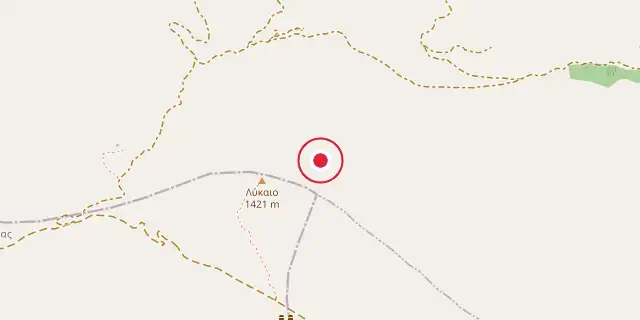
Coordinates: 37°27′25″N 21°58′30″E (37.4570, 21.9750) · Open in OpenStreetMap
Coordinates and connected clubs: the infobox of Wikipedia: Mount Lykaion (CC BY-SA 4.0). Map: drawn by Codexery from OpenStreetMap tiles.
Mount Lykaion (Λύκαιον ὄρος, Lýkaion Óros; Mons Lycaeus) is a mountain in Arcadia, Greece. Lykaion has two peaks: Stefani to the north and St. Ilias (Άγιος Ηλίας, Agios Īlías) to the south where the ancient altar of Zeus is located.
The northern peak is higher, 1,421 m, than the southern, 1,382 m. Mount Lykaion was sacred to the god Zeus Lykaios, who was said to have been born and raised there. The mountain was also thought to be the home of the mythical Pelasgus and his son Lycaon, who were said to have founded the ritual of Zeus practiced on its summit.
History
The mountain and its quadrennial Lykaian games appear in ancient sources from Plato to Virgil, with the 2nd-century AD writer Pausanias providing the most detailed account. According to Pausanias, the Arcadians claimed Mt. Lykaion as the birthplace of Zeus, though other traditions placed his birth elsewhere. Lycaon, son of Pelasgus, was said to have instituted the worship of Zeus Lykaios and established the games. The Bibliotheca recounts that Lycaon tested Zeus by serving him a sacrifice mixed with human flesh, for which Zeus slew Lycaon and his fifty sons; other sources, such as Ovid, instead describe Lycaon's transformation into a wolf.
During the Second Messenian War, an inscribed stele near the altar commemorated the execution of Aristocrates of Arcadia for betraying the hero Aristomenes. The Spartan king Pleistoanax lived on the mountain in exile from the mid-440s BC until 427, building a house straddling the sacred temenos. In 294 BC, the Battle of Mount Lykion occurred between Spartans and Demetrius of Macedon, with Demetrius winning. A later battle in 227 BC between the Achaean League and Spartans resulted in an Achaean defeat.
The site
Recent excavations have uncovered the Ash Altar and temenos, two fountains including the Hagno fountain mentioned by Pausanias, the hippodrome, the stadium, a probable bathhouse, a xenon (hotel), a stoa, several rows of seats, and a group of statue bases. Many structures appear intentionally aligned: the baths at the northern end of the stadium, the stoa, the xenon, the lower fountain, and the rows of seats share a similar orientation. North of the stoa, four rows of seats were excavated near stelae and statue bases, bordering the stadium's southern edge; most spectators would have sat on the surrounding hills.
The stadium lies on a terrace 2–3 m above and west of the hippodrome. Seven stone starting line blocks were found at the northern edge of the racetrack. A fountain building likely supplied water for athletes, and a corridor southwest of the stadium probably connected the sanctuary to it. Two inscriptions give names of winning athletes.
The hippodrome, located in a valley northeast of the altar, is the only extant hippodrome from Greek antiquity, measuring 250 x 50 m, with a north-south orientation and a retaining wall curving around the northern end. A circular altar of blackened earth, about 1.5 m high and 30 m in diameter, consists of burned ash from victims dedicated to Zeus.
Modern study
Beulé described the hippodrome and large stones he thought were judges' seats, as well as a building he called a temple to Pan, likely the stoa. The German writer Ross noted the bathhouse and its cisterns, which locals called Skaphidia. The Greek Archaeological Service first excavated the site in 1897 under K. Kontopoulos, who dug trial trenches near the hippodrome and altar, and again in 1902 under K. Kourouniotes, whose excavations of the altar revealed a raised mound of blackened earth containing burnt stones, small animal bones, pottery fragments, iron knives, clay figures, coins from Aegina, a clay bird figure, and two small bronze tripods.
Trenches in the temenos yielded bronze figures, iron objects, and roof tiles. In 1909, Kourouniotes excavated the hippodrome, stadium, and bathhouse area. No further systematic investigation occurred until 1996, when Dr. David Gilman Romano of the University of Pennsylvania conducted a topographical and architectural survey. This work continued with the Mt. Lykaion Excavation and Survey Project, a joint effort of the University of Pennsylvania and the University of Arizona, beginning with cleaning and surveying in 2004–2005 and a five-year excavation program from June 2006.
Did You Know?
- It was said that no shadows fell within the precincts of the altar and that any who entered it died within the year.
- An excavation in 2007 revealed pottery fragments and signs of activity in the ash altar from as early as 3000 BC.
More in Ancient Greek Religion
Sources
Compiled from Wikipedia and the sources listed below. Text from Wikipedia is available under CC BY-SA 4.0; this entry is adapted from it.
- Wikipedia: Mount Lykaion (CC BY-SA 4.0).
Spotted an error? Know more?
Reader corrections go straight into our review queue. Suggest an edit · How this site is sourced