Mu-qed
Ancient Red Sea trade route linking Egypt and Punt.
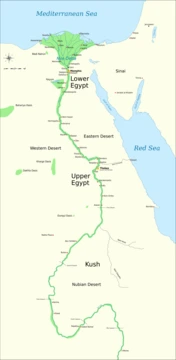
Mu-Qed was an ancient maritime trade route along the northeast African coast of the Red Sea. The term, in use since the Eighteenth Dynasty of Egypt, referred to trade between ancient Egyptians and Puntites. It specifically denoted the Red Sea waters starting from Qosair, the port serving the canal of Ro-henu (Wadi Hammamat).
Quick Facts
- First attested
- Eighteenth Dynasty of Egypt
- Route start
- Qosair (port of the Ro-henu canal)
- Route end
- Punt (along the African coast of the Red Sea and Gulf of Aden)
- Related sea
- Muqedian Sea (Red Sea and Gulf of Aden)
Facts from the source article.
Geography
Onshore of the Mu-Qed route from southeast Egypt and eastern Sudan lies the Atbai, an arid terrain forming the easternmost extremity of the Sahara. This hyper-arid plateau, between the Nubian desert and the Red Sea, has Precambrian rock formations and is primarily inhabited by the Beja. According to the Periplus of the Erythraean Sea, trading stations along the Muqedian Sea extended from Berenice Troglodytica south to Opone (modern Hafun). The Muqedian Sea, spanning from the Suez Canal to the Guardafui Channel, is a major intercontinental waterway and a biodiversity hotspot for coral ecosystems.
Culture
The region of ancient Punt was located on the African side of the Red Sea and the Gulf of Aden. A theory, first proposed around 1970 and later promoted by Ivan Van Sertima in the 1980s, suggested that the main cultural exchanges between ancient Egypt and other areas happened along the Nile Valley. This idea was taken up by some supporters of Afrocentrism and Pan-Africanism and appeared in many Afrocentric works during the 1990s. A Muqedian or Muqedite is a person living on the coast between the Wadi Hammamat canal and the tip of the Horn of Africa. Genetic research indicates that people along the old Mu-Qed trade route share a common paternal lineage. Both Upper Egyptian men and coastal Cushitic men carry the E-V12 subclade of the E1b1b haplogroup at rates of 74.5% and 70.6% respectively. Some individuals, such as Egyptian Imaan Hammam, have identified with a transnational northeast African identity, calling herself Afro-Arab.
More in Ancient Egypt
Spotted an error? Know more?
Reader corrections go straight into our review queue. Suggest an edit · How this site is sourced