History of ancient Egypt
Ancient Egypt's history spans from prehistoric settlements to Roman conquest.
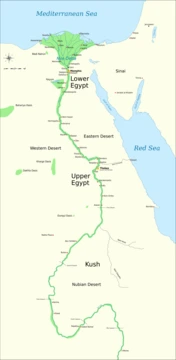
The history of ancient Egypt spans from early prehistoric settlements along the northern Nile valley to the Roman conquest in 30 BC. The pharaonic period, marked by rule under a pharaoh, began with the unification of Upper and Lower Egypt in the 32nd century BC and ended with Macedonian rule in 332 BC.
Quick Facts
- Unification of egypt
- circa 3150 BC
- Pharaonic period start
- 32nd century BC
- Pharaonic period end
- 332 BC
- Roman conquest
- 30 BC
- First pharaoh (tradition)
- Menes
- Old kingdom period
- 2686–2181 BCE
Facts from the source article.
Chronology
Egyptian history is divided into periods based on ruling dynasties, with dating still under research. The conventional chronology lists: Prehistoric Egypt (prior to 3100 BC), Naqada III (protodynastic, circa 3100–3000 BC), Early Dynastic Period, Old Kingdom, First Intermediate Period, Middle Kingdom, Second Intermediate Period, New Kingdom, Third Intermediate Period (Libyan Period), Late Period, and Ptolemaic Egypt (305–30 BC).
Neolithic Egypt
The Nile was central to Egyptian culture since nomadic hunter-gatherers lived along it during the Pleistocene, leaving artefacts and rock carvings. By the 12th millennium BC, an Upper Paleolithic grain-grinding culture using early sickle blades replaced earlier hunting and gathering. Evidence of human habitation and cattle herding near the Sudan border before the 8th millennium BC exists, but independent bovine domestication in Africa is not corroborated. Settlements in Nubia occurred from the Late Pleistocene and from the 5th millennium BC, while the Egyptian Nile valley shows little evidence from these periods, possibly due to preservation issues. The oldest known domesticated cattle in Africa are from the Faiyum circa 4400 BC. Climate changes around the 8th millennium BC began desiccating North Africa, forming the Sahara by the 25th century BC. This forced early Egyptians to settle permanently along the Nile. The period from the 9th to 6th millennium BC has little archaeological evidence. Mainstream scholars place predynastic southern Egypt's origins in northeast Africa, including Sudan, tropical Africa, and the Sahara, with population variability in pharaonic times: Upper Egyptians shared more biological affinities with Sudanese and southern African populations, while Lower Egyptians had closer genetic links with Levantine and Mediterranean populations. The Nile valley became habitable after clearing and irrigation, largely underway by the 6th millennium, when organized agriculture and large building construction began.
Dynastic Egypt
Historical records begin with Egypt as a unified state around 3150 BC. Egyptian tradition holds Menes as the first king, who unified Upper and Lower Egypt. Egyptian chronology, involving regnal years, began around this time; the conventional chronology was accepted in the twentieth century but excludes major revision proposals. Egyptologists typically divide pharaonic history using Manetho's Aegyptiaca from the third century BC. Before unification, the land had autonomous villages; afterward, the country became known as the Two Lands, with pharaohs establishing national administration and royal governors. Archaeological findings suggest Narmer, final king of Naqada III, was the first to claim unification, known from the Narmer Palette. Menes is now thought to be a title of Hor-Aha, second pharaoh of the First Dynasty. Elite funeral practices led to mastabas, later models for Old Kingdom constructions like the step pyramid, originating in the Third Dynasty. The Old Kingdom (Third through Sixth Dynasties, 2686–2181 BCE) had its capital at Memphis, where Djoser (2630–2611 BCE) established his court.
More in Ancient Egypt
Spotted an error? Know more?
Reader corrections go straight into our review queue. Suggest an edit · How this site is sourced