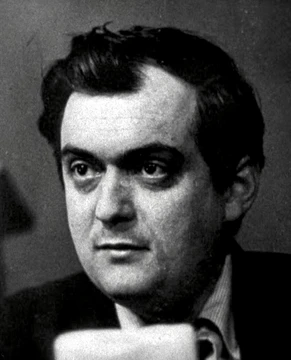
Byron Haskin
Director of The War of the Worlds and effects pioneer.
Byron Haskin worked as a director, cinematographer, and special effects artist in American film and television. His most famous credit is the 1953 science-fiction film The War of the Worlds, which he directed as part of a frequent collaboration with producer George Pal.
Quick Facts
- Birth name
- Byron Conrad Haskin
- Born
- 22 April 1899
- Birthplace
- Portland, Oregon, U.S.
- Died
- 16 April 1984
- Place of death
- Montecito, California, U.S.
- Occupation
- Film director
- television director
- cinematographer
- producer
- special effects artist
- Years active
- 1922–1968
- Spouse
- Terry Gates
Facts from the source article.
Career
Haskin was born in Portland, Oregon, where his father worked as a schoolteacher; both parents were California natives, and he was raised mainly in San Francisco. During World War I he served in the U.S. Naval Reserve Force, then graduated from the University of California. He went to Hollywood in 1917 and became apprentice to cameraman H. Lyman Broening, and in 1922 was hired as cinematographer for Hurricane's Gal. Early in his career he also worked as a special effects artist on Warner Bros. films, eventually becoming head of the studio's special effects department from 1937 to 1945.
In that role he earned four Oscar nominations for effects work shared with Nathan Levinson: The Private Lives of Elizabeth and Essex (1939), The Sea Hawk (1940), The Sea Wolf (1941), and Desperate Journey (1942). In 1938 he and the Warner Bros. special effects department received an Academy Award for Technical Achievement for developing a rear-projection system useful in effects photography. After directing four films in 1927, he returned to directing in the late 1940s, helming the film-noir thrillers I Walk Alone (1947) with Burt Lancaster, Lizabeth Scott, and Kirk Douglas, and Too Late for Tears (1949) with Lizabeth Scott.
Hal B. Wallis had earlier sent the then-unknown Lancaster to audition for Haskin, which led to Lancaster being signed by Wallis and cast as the male lead in The Killers (1946), the role that made him a star. Another significant film is the science fiction adventure Robinson Crusoe on Mars (1964). Haskin also worked as a cinematographer and producer, and occasionally as a visual effects artist; for Robinson Crusoe on Mars he animated photos of ships patterned after the Martian ships in War of the Worlds.
He directed the treasure-hunt thriller September Storm, one of the only films produced in Stereo-Vision, a short-lived process combining widescreen and 3D, and one of the first to do so with underwater sequences.
More in American Science Fiction Film Directors
Spotted an error? Know more?
Reader corrections go straight into our review queue. Suggest an edit · How this site is sourced