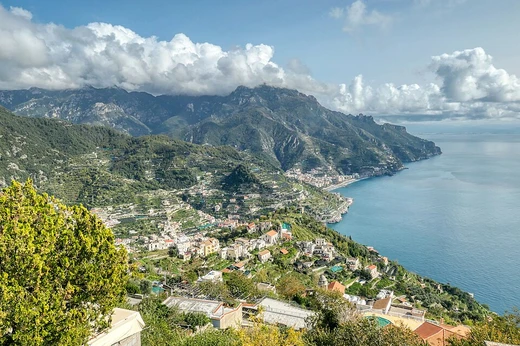
Amalfi
Medieval maritime republic and UNESCO-listed coastal town.
Amalfi is a town and comune in the province of Salerno, Campania, Italy, situated at the mouth of a deep ravine beneath Monte Cerreto on the Gulf of Salerno. It was the capital of the maritime republic known as the Duchy of Amalfi, a major Mediterranean trading power from 839 until around 1200. The town is a UNESCO World Heritage Site and became a popular seaside resort for the British upper class during the Edwardian era.
Quick Facts
- Region
- Campania
- Province
- Salerno (SA)
- Mayor
- Daniele Milano
- Area (km²)
- 5.7
- Elevation (m)
- 6
- Population
- 4611
- Demonym
- Amalfitani
- Saint
- Saint Andrew
Facts from the source article.
Did You Know?
- The nearest airport is Salerno-Pontecagnano Airport, 45 km away.
- The port of Amalfi has passenger connections to Capri, Positano, Maiori, Minori, Cetara, and Salerno.
- Amalfi can be reached via the SS163 Amalfitana state road, the SR366 regional road, and the SP252 provincial road.
History
Amalfi began as a maritime power, trading grain, salt from Sardinia, slaves, and timber for gold dinars from Egypt and Syria, which were used to buy Byzantine silks for resale in the West. Amalfi traders held privileged positions in Islamic ports, and the Amalfi tables provided a widely used maritime code for Christian port cities. By the 9th century, Amalfi merchants used gold coins for land purchases while most of Italy operated on barter. Long-distance trade with Byzantium revived in the late 9th century, and Karl Marx credited Amalfi with a role in the beginning of European mercantile capitalism.
An independent republic from the 7th century until 1073, Amalfi broke from Byzantine vassalage in 839 and first elected a duke in 958. It rivaled Pisa and Genoa in prosperity before Venice's rise, reaching a population of 70,000–80,000 around the turn of the millennium under Duke Manso (966–1004). In 1073, the republic fell to the Norman countship of Apulia but retained many rights. In 1131, Roger II of Sicily reduced it after being refused its citadel's keys.
The Holy Roman Emperor Lothair, aided by forty-six Pisan ships, took Roger prisoner in 1133, and the Pisans sacked the city, taking a copy of the Pandects of Justinian. Amalfi was taken by the Pisans again in 1135 and 1137, and declined rapidly, though its laws were recognized in the Mediterranean until 1570. A tsunami in 1343 destroyed the port and lower town, and Amalfi never regained more than local importance. The town was known for its schools of law and mathematics, and Flavio Gioia, traditionally credited with introducing the mariner's compass to Europe, is said to have been a native.
Main sights
Amalfi's medieval architecture is represented by the Cathedral of Sant'Andrea (11th century), its campanile, and the convent of the Cappuccini, founded by Cardinal Pietro Capuano, blending Byzantine style with northern forms. The cathedral overlooks Piazza Duomo from the top of a flight of steps. Its interior is late Baroque, with a nave and two aisles divided by 20 columns, and a Byzantine-style façade adorned with paintings of saints, including a large fresco of Saint Andrew.
The gold caisson ceiling features four paintings by Andrea dell'Asta depicting scenes from Saint Andrew's life. A flight of stairs from the left nave, built in 1203 for Cardinal Pietro Capuano, leads to the crypt. The cathedral's bronze statue of Saint Andrew was sculpted by Michelangelo Naccherino, a pupil of Michelangelo, and marble sculptures of St. Stephen and St. Lawrence by Pietro Bernini are also present. The crypt contains a tomb said to hold a portion of the apostle's relics, and a golden reliquary that originally housed his skull is displayed.
Culture
The Amalfi coast is known for producing Limoncello liqueur and cultivating lemons called "sfusato amalfitano," which are long, at least double the size of other lemons, with thick wrinkled skin and sweet juicy flesh. Lemons grow in terraced gardens along the coast from February to October. Amalfi also produces a handmade thick paper called "bambagina," exported to Europe and America and used for wedding invitations and writing paper. Three traditional events draw visitors: the feast days of Saint Andrew (25–27 June and 30 November), Byzantine New Year's Eve (31 August), and the Historical Regatta (first Sunday in June), a rowing competition among Amalfi, Genoa, Pisa, and Venice, hosted by a different city each year.
More in Amalfi Coast
Spotted an error? Know more?
Reader corrections go straight into our review queue. Suggest an edit · How this site is sourced