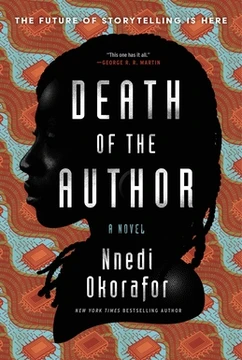
Who Fears Death
A post-apocalyptic fantasy of oppression, magic, and resistance.

Who Fears Death is a science fantasy novel by Nigerian-American writer Nnedi Okorafor, published in 2010 by DAW, then an imprint of Penguin Group (USA). It won the 2011 World Fantasy Award for Best Novel and the 2010 Carl Brandon Kindred Award for an outstanding work of speculative fiction dealing with race and ethnicity. The novel is set in a post-apocalyptic Africa where the light-skinned Nuru oppress the dark-skinned Okeke, and follows Onyesonwu, an Ewu sorceress who narrates her tale before her execution.
Quick Facts
- Author
- Nnedi Okorafor
- Cover Artist
- Greg Ruth
- Country
- Nigeria
- Language
- English
- Genre
- Science fantasy, Africanfuturism
- Publisher
- DAW/Penguin
- Pub Date
- 1 June 2010
- Media Type
- Print, e-book, audio book
- Pages
- 304
- Isbn
- 9780756406691
- Oclc
- 1269240111
- Preceded By
- The Book of Phoenix
Facts from the source article.
Lore & Background
The novel opens with the death of Onyesonwu's stepfather when she is sixteen, then shifts to her childhood. Onyesonwu was conceived when her mother Najeeba was raped by a Nuru man. She and her mother lived in the desert before moving to the village of Jwahir, where Onyesonwu is ostracized as an Ewu. At age eleven, she undergoes female circumcision to gain acceptance, which scars her physically and magically, alerting her biological father, a sorcerer named Daib, who begins hunting her through the spirit world. She bonds with three other girls—Binta, Diti, and Luyu—and later befriends Mwita, an Ewu boy who becomes her lover. After an initiation into sorcery reveals her fate to die by stoning, she leaves Jwahir to help the Okeke facing genocide, accompanied by Mwita, Binta, Diti, Luyu, and Diti's fiancé Fanasi. Onyesonwu discovers she is prophesied to rewrite the Great Book, a religious text justifying Okeke oppression. She regrows the clitorises of the circumcised girls, but the journey is harsh: Binta is killed, and Onyesonwu blinds an entire town. They encounter the Vah, a tribe hidden by a magical sandstorm, and Onyesonwu learns her mother Najeeba has become a dragon-like Kponyungo. Her spirit is poisoned by Daib, who is also Mwita's former master, but she is healed by a Vah sorceress. In Durfa, Onyesonwu attacks Daib; he kills Mwita but is gravely injured. Onyesonwu and Luyu flee to an island where Onyesonwu rewrites the Great Book using Nsibidi script. The Nuru capture and kill Luyu, and Onyesonwu is taken prisoner. The epilogue, narrated by a Nuru journalist, states she was stoned to death, but an alternate ending shows her escaping by transforming into a Kponyungo and flying east to meet Mwita.
Reader's Guide
Who Fears Death is significant for its unflinching exploration of race, gender, and systemic violence through a speculative fiction lens. The novel directly addresses weaponized rape and genocide, inspired by the Darfur conflict, and critiques patriarchal practices like female genital mutilation. Okorafor's use of Igbo mysticism and the Nsibidi script grounds the story in African traditions, while the post-apocalyptic setting allows for a reimagining of power dynamics. The novel's awards—the World Fantasy Award and the Carl Brandon Kindred Award—highlight its impact on both genre fiction and discussions of race. Its legacy includes a prequel, The Book of Phoenix (2015), and a planned novella trilogy focusing on Najeeba, beginning with She Who Knows (2024). A television adaptation was announced in 2017, with George R. R. Martin as executive producer and later Tessa Thompson's production company joining. The novel's graphic depiction of FGM sparked debate, which Okorafor addressed by defending her critique of problematic cultural practices while affirming her Igbo identity. Time magazine ranked it among the 100 Best Fantasy Books of All Time.
Did You Know?
- The novel was inspired by a 2004 Washington Post article about weaponized rape in the Darfur conflict.
- Okorafor started writing the novel after her father's death; the first scene was inspired by moments at his wake.
- The mythological Vah people were inspired by two red-skinned Nigerian women Okorafor saw during a visit to Nigeria.
- The novel includes an alternate ending where Onyesonwu escapes execution by transforming into a dragon-like Kponyungo.
More in Africanfuturist novels 1-21
Spotted an error? Know more?
Reader corrections go straight into our review queue. Suggest an edit · How this site is sourced