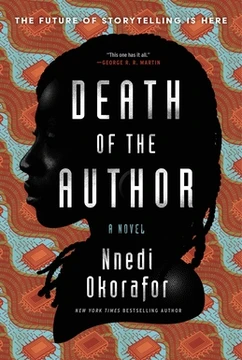
Death of the Author (novel)
Africanfuturist novel exploring authorship, AI, and disability.

Death of the Author is a 2024 Africanfuturist novel by Nigerian American writer Nnedi Okorafor. It centers on Zelunjo Onyenezi-Onyedele, a Nigerian American author whose science fiction book *Rusted Robots* brings her critical and commercial success. The novel has been praised for examining authorship, narrative, artificial intelligence, disability, and diasporic identity.
The main plot follows Zelu, who became paraplegic at age twelve after an accident. She goes from a struggling adjunct writing professor in Chicago to a best-selling author. After being fired at her sister’s wedding, she returns to her parents’ home and writes *Rusted Robots*, which becomes an instant hit and is adapted into a film. Her family’s reaction to her success is mixed. Later, University of Ibadan researcher Hugo Wagner offers her an exoskeleton that lets her walk, a choice criticized by her family and disability activists. Preston Aerospace founder Jack Preston then invites her on a commercial space mission. Despite family opposition, she agrees, discovering she is pregnant just before departure.
*Rusted Robots* is a story-within-the-story, set in a future where most humans are dead except an Igbo woman named Ngozi. Two machine factions conflict: Humes, robots with human-like bodies that collect stories, and NoBodies, AIs that reject physical forms and seek to destroy Humes. The story follows Ankara (a Hume) and Ijele (a NoBody). After the NoBodies destroy most Humes via a protocol called Rusted Robots, Ngozi repairs Ankara by placing Ijele inside her. Though initially horrified, they become close friends. Together, they defeat an extraterrestrial robot enemy called Trippers by telling the story of Zelu’s life.
Okorafor explores the author’s relationship with their creations through Africanfuturism. The novel also addresses disability, identity, diasporic culture, social media, colonialism, and AI. Gary K. Wolfe noted that family dynamics recall Okorafor’s earlier work *Akata Witch*, and the book examines navigating relationships with high-achieving relatives and “Naijamerican” identity. Bernabé S. Mendoza observed that classic sci-fi often pairs humans with machines or animals, with cyborgs seen as progress and human-animal hybrids as regression. Cartesian dualism, which values pure mind over body, underlies this.
Quick Facts
- Author
- Nnedi Okorafor
- Language
- English
- Genre
- Science fiction, Africanfuturism
- Publisher
- William Morrow
- Country
- United States
- Pub Date
- January 14, 2025
- Pages
- 448
- Isbn
- 978-0063445789
Facts from the source article.
Lore & Background
The book centers on the main character, Zelunjo Onyenezi-Onyedele (Zelu), a Nigerian-American writer who became paraplegic at the age of 12 following an accident. The story follows Zelu as she transforms from a struggling writer to best-selling author. At her sister's wedding, Zelu learns that she has been fired from her position as an adjunct writing professor in Chicago. Following this, she returns to her parents' house where she ultimately writes her block-buster debut novel, Rusted Robots. The book becomes an instant success and is quickly adapted into a movie. The book brings Zelu instant fame and wealth. Zelu has a complicated relationship with her family, and their reaction to her success is mixed.
After the publication of Rusted Robots, Zelu is approached by a University of Ibadan researcher, Hugo Wagner, who offers her an experimental exoskeleton that allows her to walk. This offer sparks controversy among her family and disability activists. Later, Jack Preston, founder of the space tourism company Preston Aerospace, invites Zelu on a commercial space mission. Despite family opposition, she accepts, discovering she is pregnant just before departure.
Reader's Guide
Death of the Author explores the relationship between the author and their creations through the lens of Africanfuturism, a term Okorafor coined to describe her work. The novel also examines a range of issues, such as disability, identity, diasporic culture, social media and influence, colonialism, as well as the rise of AI-driven technologies. Gary K. Wolfe noted that the family dynamics in Death of the Author recall elements of Okorafor's earlier works, including Akata Witch. Death of the Author explores the challenge of navigating relationships with high-achieving family members, including physicians and lawyers, as well as the concept of 'Naijamerican' identity.
Bernabé S. Mendoza wrote that classic science fiction novels often 'stretch' the concept of humanity by combining humans with either machines or animals. The story-within-a-story of Rusted Robots pits the NoBodies (representing Cartesian minds) against the Humes (representing embodiment). The episode in which Ijele is moved inside Ankara's body eventually leads to the unification of all automation, or the posthuman. This combination eventually allows Ankara to write an original story, leading to the thematic climax of the novel: 'Stories, the text insists, unify the mind and body, spirit and flesh. And through unification, stories also heal.' Key to the work is also an exploration of the relationship between AI and the creation of art.
Did You Know?
- The novel's title draws from the 1967 essay 'The Death of the Author' by Roland Barthes, though Okorafor disagrees with Barthes's conclusion.
- Okorafor described the family dynamics in the novel as 'near autobiographical'; she was paralyzed from the waist down at age nineteen.
- The character Ngozi in the subplot Rusted Robots is named after Okorafor's sister, and Okorafor began writing the novel two days after her sister's death.
- Death of the Author represented Okorafor's first NAACP Image Award and her second nomination; in 2008, The Shadow Speaker was nominated in the Youth/Teen category.
Narrative Architecture & The Story Within
The novel employs a layered structure in which Zelu's near-future Chicago life forms the outer frame, while more than a fifth of the text is devoted to excerpts from her fictional debut, Rusted Robots, delivered across thirteen interspersed chapters. Gary K. Wolfe observed that Ankara's narrative serves as a valuable counterpoint to Zelu's own journey. The inner story imagines a future in which humanity has nearly perished, leaving only an Igbo woman named Ngozi. Two machine factions clash: Humes, embodied robots whose purpose is to gather human narratives, and NoBodies, disembodied AIs that seek to annihilate the Humes. After a devastating protocol destroys most Humes, the last human repairs a damaged Hume named Ankara by implanting the NoBody Ijele into its body. Their unlikely friendship ultimately leads them to defeat an extraterrestrial threat called Trippers by telling the story of Zelu's life as learned from Ngozi. This nested structure makes the act of storytelling itself the novel's central mechanism.
Philosophical & Thematic Terrain
Okorafor, who coined the term Africanfuturism to describe her body of work, uses it as the lens through which she interrogates authorship, embodiment, and the relationship between creator and creation. The novel confronts disability head-on through Zelu's paraplegia and her decision to use an experimental exoskeleton, a choice that draws criticism from both family members and disability activists. Diasporic identity threads through the "Naijamerican" experience of navigating Nigerian communal values against American individualism. Bernabé S. Mendoza situated the Hume-NoBody conflict within a broader Western philosophical tradition of Cartesian dualism, where pure mind is privileged over flesh. The moment Ijele inhabits Ankara's body, Mendoza argued, points toward a posthuman unification. The novel insists that stories unify mind and body, spirit and flesh, and that through this unification, healing becomes possible. AI's role in artistic creation further complicates these questions.
Authorial Backstory & Personal Resonance
Okorafor has described the family dynamics in Death of the Author as "near autobiographical." She was paralyzed from the waist down at nineteen, and the novel's protagonist Zelu becomes paraplegic at twelve following an accident. Okorafor began writing the book just two days after the death of her sister, and she named the character Ngozi in her sister's honor. The novel's title draws from Roland Barthes's 1967 essay "The Death of the Author," yet Okorafor explicitly rejects Barthes's conclusion that the author must die so the reader can live. In a CBC interview with Mattea Roach, she argued that an author and their work cannot be untangled, calling the separation neither possible nor necessary. The book was originally sold under the title The Africanfuturist before being renamed. Okorafor wanted to explore the tension between community-based Nigerian ethos and individuality-based American ethos, and the complicated interplay of being both Nigerian and American.
Critical Reception & Literary Positioning
Death of the Author has earned critical acclaim for its multifaceted exploration of authorship, artificial intelligence, disability, and diasporic identity. Gary K. Wolfe noted that the family dynamics recall elements of Okorafor's earlier works, including Akata Witch, and that the novel examines the challenge of navigating relationships with high-achieving family members such as physicians and lawyers. The book's positioning within Africanfuturism distinguishes it from more conventional science fiction. Bernabé S. Mendoza observed that classic SF often "stretches" humanity by combining it with machines or animals, with human-machine hybrids framed as advancement and human-animal hybrids as regression. Okorafor's novel subverts these Western assumptions through its Africanfuturist framework. The story-within-a-story structure, with Rusted Robots occupying more than a fifth of the text, gives the novel a distinctive architecture that sets it apart in contemporary speculative fiction.
Frequently Asked Questions
What is Death of the Author?
It is a 2024 speculative fiction novel by Nnedi Okorafor, a writer of Nigerian and American heritage. The book tells the story of a Nigerian American novelist whose science fiction work, *Rusted Robots*, catapults her from obscurity to fame.
Who is the main character in Death of the Author?
The protagonist is Zelunjo Onyenezi-Onyedele, known as Zelu, a woman who lost the use of her legs in a childhood accident and later works as a low-paid writing instructor in Chicago. Her life shifts dramatically when her novel becomes a bestseller, thrusting her into the spotlight of the publishing world.
What major themes does Death of the Author address?
The novel interrogates what it means to be a creator, how artificial intelligence reshapes storytelling, and the lived experience of disability. It also weaves in questions of diasporic belonging and the politics of narrative control.
What genre or tradition does Death of the Author belong to?
It is classified as an Africanfuturist novel, a subgenre that reimagines speculative and science-fiction tropes through African and African-diasporic lenses. The story pairs tech-forward ideas like AI and robotics with a deeply personal, grounded character arc.
Why do fans consider Death of the Author a notable addition to the genre?
Critics and readers praise it for placing a disabled, Black woman writer at the center of a conversation about who gets to tell stories and who profits from them. It broadens the Africanfuturist canon by folding in disability justice and the economics of publishing alongside its speculative elements.
More in Africanfuturist novels 1-21
Spotted an error? Know more?
Reader corrections go straight into our review queue. Suggest an edit · How this site is sourced