Gabriele Faerno
Renaissance scholar and poet of Aesop's fables.

via Wikipedia: Gabriele Faerno · see source
Gabriele Faerno, also known by his Latin name Faernus Cremonensis, was a humanist scholar born in Cremona about 1510 who died in Rome on 17 November 1561. He worked as a scrupulous textual editor in the Vatican Library and was an elegant Latin poet. Today he is best known for his collection of Aesop's Fables in Latin verse, the Centum Fabulae, which Pope Pius IV commissioned to teach children both morals and linguistic purity.
Quick Facts
- Born
- Cremona, about 1510
- Died
- Rome, 17 November 1561
- Father
- Francis Faerno
- Patron
- Pope Pius IV
Facts from the source article.
Life
Gabriele Faerno, born in Cremona around 1510 to Francis Faerno, a lawyer and scholar, began his career in 1528 at the local Collegium Notariorum before serving the Bishop of Cremona. In 1538, he accompanied his master on a trip to Barcelona. Within the next decade, sponsors recommended him to Rome, where his presence is first recorded in an October 1548 letter from Carlo Gualteruzzi to Giovanni Della Casa. By early 1549, he was working in the Vatican Library, connecting with the scholars and philologists there.
His literary work earned him the friendship of Cardinal Giovanni Angelo de Medici (later Pope Pius IV) and Cardinal Charles Borromeo. Skilled in Latin, Faerno showed strong judgment in correcting Roman classics and collating ancient manuscripts. After Pius IV became pope, Faerno was encouraged to publish his findings and was offered a bishopric, which he declined. Illness prevented him from seeing his works through the press, and he died at Cardinal Giovanni Morone’s home in late 1561. A rare bust of Faerno by Michelangelo sits in the Capitoline Museum’s Philosophers Room.
Faerno’s scholarship included a valuable edition of Terence’s Comoediae, completed after his death by Piero Vettori, which restored many passages and became the basis for later editions. He also edited Cicero’s Philippicae, praised by Graevius, and worked on Livy’s manuscripts with scrupulous care, as noted by Latino Latini. He likewise worked on Ennius, Horace, Plautus, Suetonius, and Tacitus. As a poet, Faerno is known for his Centum Fabulae, a collection of one hundred fables in Latin verse, completed by 1558 but published in 1563. Some accused him of hiding a Phaedrus manuscript, but Charles Perrault defended him, noting only five fables overlap with Phaedrus. The work included medieval tales like The miller, his son and the donkey, and went through about forty European editions, with translations into Italian, English, German, Dutch, and French.
Scholarship
Faerno died in the prime of life. His works include: 1. Terentii Comoediae, Florence 1565, 2 vols. 8vo, a valuable and rare edition, completed after his death by his friend Piero Vettori. There is no ancient editor to whom Terence is more indebted than to Faerno; who, by a judicious collation of ancient manuscripts and editions, has restored the true reading of his author in many important passages. Faerno's edition became the basis of almost every subsequent one, and Dr. Richard Bentley had such an opinion of his notes that he reprinted them entire in his edition. 2. Ciceronis Orationes Philippicae, Rome 1563, 8vo, very highly praised by Graevius. 3.
He also worked on the conflicting manuscripts of the historian Livy and Faerno's contemporary, Latino Latini, has left a note on the scrupulous care with which he approached the subject: 'As for Livy, I would not want you to believe that [Faerno] is so bold and presumptuous as to add or change anything without the evidence of the ancient codices, unless obviously corrupt. If he cannot avoid mistakes at times, he does everything scrupulously, giving exact reasons for any opinion or conjecture of his, so as to leave anyone free to judge for himself.' Other Latin authors to whom Faerno dedicated his efforts include Ennius, Horace, Plautus, Suetonius, and Tacitus.
Poetry
Faerno is counted one of the foremost of the Renaissance Latin poets, largely on account of his '100 Fables' (Centum Fabulae ex antiquis autoribus delectae, et carminibus explicatae). Though not published until 1563, there is evidence that the work was completed as early as 1558. So excellent were his versions that one scholar went so far as to accuse him of concealing an undiscovered manuscript of Phaedrus for fear of lessening the value of his own versions.
But Charles Perrault, who published a translation of Faerno's work into French verse (Paris 1699), defended the author from this imputation in his preface. Pope Pius IV, convinced that reading the fables of Aesop was of great use in forming the morals of young children, commissioned Gabriel Faerno, whom he knew as an excellent poet as well as a man with a taste for elegant and beautiful Latinity, to versify these fables so that children might learn, at the same time and from the same book, both moral and linguistic purity.
Faerno has been called a second Phaedrus, by reason of the excellent style of his Fables, though he never saw Phaedrus, who did not come to our knowledge till above thirty years after his death; for Pithoeus, having found that manuscript in the dust of an old library, published it in the beginning of this century. Thuanus, who makes very honourable mention of our author in his history, pretends that Phaedrus was not unknown to him; and even blames him for having suppressed that author, to conceal what he had stolen from him.
But there is no ground for what he says; and it is only the effect of the strong persuasion of all those who are so great admirers of antiquity as to think that a modern author can do nothing that is excellent, unless he has an ancient author for his model. Out of the hundred fables which Faerno published in Latin verse, there are but five that had been treated by Phaedrus, and out of those five there are but one or two that have been managed nearly in the same manner: which happened only because it is impossible that two men, who treat on the same subject, should not agree sometimes in the same thoughts, or in the same expressions.
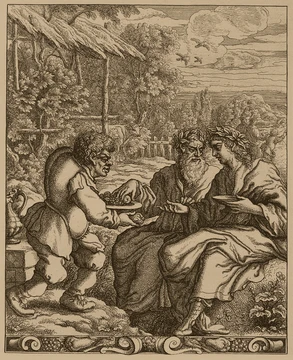
Besides fables collected 'from ancient authors', Mediaeval folk tales such as The miller, his son and the donkey and The Mice in Council were included in the work as well. It was to go through some forty European editions, including translations into Italian, English, German, Dutch and French. In England the 1741 edition, which included Perrault's French translations and an English translation, was to serve as a school textbook. The illustrations by Pirro Ligorio which accompanied each fable were also esteemed.
Poems attributed to Faerno were also printed in some later editions. They include his attack on Protestantism as a 'Germanic sect', In Lutheranos, sectam Germanicam; verses accompanying illustrations of artistic works; complimentary addresses and other occasional verse. He was also the author of sonnets in Italian.
Titles
The title of Faerno's celebrated work translates as 'One hundred delightful fables, poetically interpreted from ancient authors'. The following is a list of the fables occurring there, with links to those that have a separate article devoted to them: 1. Ollae duae - The Two Pots, 2. Iupiter et Minerva, 3.
Leo, asinus et vulpes - The Lion's Share, 4. asinus et lupus, 5. leo mente captus et caprea, 6. asini duo, 7. Formica et cicada - The Ant and the Grasshopper, 8. turdi, 9. sus et canis, 10. Senex et mors - The Old Man and Death, 11. mergus, rubus et vespertilio, 12. cornix et canis, 13. Corvus et mater - The Sick Kite, 14.
Musca - The Fly in the Soup, 15. rusticus et eques, 16. Equus et asinus - The Horse and the Donkey, 17. Vulpes et erinaceus - The Fox, the Flies and the Hedgehog, 18. Leo et vulpes - The Lion and the Fox, 19.
Vulpes et uva - The Fox and the Grapes, 20. Corvus et vulpes - The Fox and the Crow (Aesop), 21. dies festus et profestus, 22. pavo et monedula, 23. cervus et hinnulus, 24. Cervus et serpens - The Crow and the Snake, 25. Cygnus et anser - The Swan and the Goose, 26. puer et scorpius, 27.
Anguilla et serpens - The Eel and the Snake, 28. canis et lupus, 29. Canis, gallus et vulpes - The Cock, the Dog and the Fox, 30. mulus, 31. iuvenes duo et coquus, 32. cochleae, 33. cornix et hirundo, 34. Mercurius et statuarius - The Statue of Hermes, 35. Pater et filii - The Farmer and his Sons, 36.
Simius et delphus - The Ape and the Dolphin, 37. ranae duae sitientes, 38. ranae duae vicinae, 39. Auceps et cassita - The Bird-catcher and the Blackbird, 40. deceptor et Apollo, 41. Uxor submersa et vir - The drowned woman and her husband, 42. Feles et gallus - noticed under The Wolf and the Lamb, 43. asinus simius et talpa, 44. vulpes vota mutans, 45.
Musca et quadrigae - The fly on the chariot wheel, 46. pica et aves, 47. Mures - The Mice in Council, 48. Avarus - The Miser and his Gold, 49. vulpes et lupus, 50. Canna et oliva - The Oak and the Reed, 51. asini et Iupiter, 52. herus et canis, 53.
Canis et caro - The Dog and Its Reflection, 54. asinus et aper, 55. pullus asini et lupus, 56. Lupus et grus - The Wolf and the Crane, 57. Iupiter et cochlea - mentioned under Zeus and the Tortoise, 58. Satyr.
More in Aesop's Fables
Spotted an error? Know more?
Reader corrections go straight into our review queue. Suggest an edit · How this site is sourced