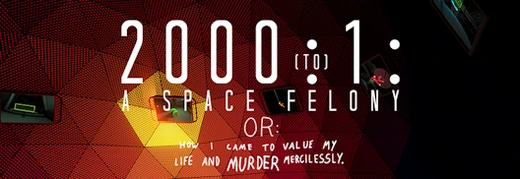
2000:1: A Space Felony
A 2017 adventure game parodying 2001: A Space Odyssey.

2000:1: A Space Felony is a 2017 adventure game from British developer National Insecurities. It parodies the film 2001: A Space Odyssey and was the studio’s first commercially released title, following years of failed attempts to publish an earlier project they had started in university.
In the game, players take the role of a detective investigating a suspicious incident aboard a spaceship. The crime scene mirrors that of 2001: A Space Odyssey. The human crew are dead, and the only witness is the ship’s artificial intelligence, named MAL. The game is played in first person. Players photograph evidence—such as corpses found while exploring—and question MAL about them. They must then find proof that either confirms or contradicts MAL’s statements.
National Insecurities had been pursuing publication for a university-era game, but several promising deals fell through. During that process, they began work on 2000:1: A Space Felony. When Humble Bundle agreed to fund it, they shifted focus entirely. One major technical challenge was recreating a famous centrifuge scene from 2001, which seemed impossible with the game’s simple physics. The team solved it by rotating the outside world around the centrifuge while the player was inside it. The game was released in July 2017 as a Humble Original. After Humble’s exclusivity period ended, the game was also released on Steam, and later sold on itch.io.
PC Gamer noted that the game is “better at being a homage than a parody,” and that exploring the ship recaptured the feel of a Kubrick film, though they found the gameplay less compelling. Eurogamer called the ship “a joy to explore,” praised the art direction, and recommended it to fans of Kubrick and narrative-driven games.
Quick Facts
- Title
- 2000:1: A Space Felony
- Developer
- National Insecurities
- Publisher
- Humble Games
- Engine
- Unreal Engine
- Platforms
- Windows
- Released
- WW · July 2017
- Genre
- Adventure
- Modes
- Single-player
Facts from the source article.
Lore & Background
2000:1: A Space Felony was developed by British studio National Insecurities as their first published game. The team had previously spent years trying to publish a game dating from their university days, but despite several promising leads, the deals fell through. During that time, they began development on 2000:1: A Space Felony. When Humble Bundle agreed to fund the project, they refocused entirely on it.
Players control a detective investigating a suspicious incident on a spaceship where the human crew are dead and the artificial intelligence MAL is the only witness. The game is played in first-person, and players photograph crime scene evidence—such as corpses—and question MAL to determine if the AI is lying or truthful. A major development challenge was replicating a famous centrifuge scene from 2001: A Space Odyssey; the team solved it by rotating the outside world around the centrifuge while players were inside it.
The game was released in July 2017 as a Humble Original. After the exclusivity period ended, the game was released on Steam and later made available on itch.io.
Reader's Guide
2000:1: A Space Felony holds significance as the debut published title of National Insecurities, a British developer that overcame years of failed publishing attempts to release a game funded by Humble Bundle. Its direct parody of 2001: A Space Odyssey—particularly its setting, AI named MAL, and recreation of iconic scenes—distinguishes it within the adventure game genre. The game's reception highlighted its strength as a homage: PC Gamer noted it was 'better at being a homage than a parody' and that exploring the ship recreated the feeling of watching a Kubrick film, though the gameplay itself was less compelling. Eurogamer praised the art direction and called the ship 'a joy to explore,' recommending it to fans of Kubrick and narrative games. The development team's creative solution to simulating the centrifuge scene—rotating the external world rather than the player—demonstrates a resourceful approach to technical limitations. The game's distribution path, bypassing Steam for itch.io to avoid the Christmas season, reflects a strategic decision by a small studio. Its legacy lies in its faithful atmospheric recreation of a classic film and its role as a stepping stone for a previously unpublished developer.
Did You Know?
- The game's AI is named MAL, a parody of the HAL 9000 from 2001: A Space Odyssey.
- Despite initial plans to skip Steam, the game was eventually released on the platform after the Humble exclusivity period ended.
Gameplay & Core Investigation Loop
Players step into the shoes of a detective dispatched to investigate a suspicious incident aboard a spaceship, with the entire crime scene deliberately mirroring the iconic setting of 2001: A Space Odyssey. The human crew has perished, leaving only the ship's artificial intelligence, MAL, as a surviving witness. Structured as a first-person adventure, the core loop revolves around exploring the vessel's corridors, photographing physical evidence such as the bodies of the deceased crew members, and then interrogating MAL about what she knows. The central puzzle of the game hinges on determining whether MAL is telling the truth or concealing something, and players must gather corroborating or contradicting evidence to reach a verdict. The first-person perspective amplifies the sense of isolation and tension as players navigate the silent ship, piecing together what went wrong while relying on a potentially unreliable AI for answers.
Development & the Centrifuge Challenge
National Insecurities, a British studio, released 2000:1: A Space Felony as their very first published title. The path to that milestone was anything but straightforward. The team had been attempting to get a game published since their university days, and although they secured several promising leads, every deal ultimately collapsed. It was during the long stretches of waiting and following those dead-end negotiations that the team began work on 2000:1. When Humble Bundle came forward to fund the project, the developers made the decisive choice to refocus all their energy on it rather than continue chasing the older title. One of the most technically demanding challenges they encountered was recreating the famous centrifuge sequence from 2001, in which astronauts experience artificial gravity. Their game's simpler physics engine made this seem nearly impossible, but they ultimately found an elegant workaround: instead of simulating the centrifuge's spin, they rotated the entire outside world around the player while the player remained stationary inside the ring.
Release Timing & Distribution Choices
2000:1: A Space Felony launched in July 2017 as a Humble Original, marking a deliberate distribution choice by National Insecurities. After the exclusivity window required by Humble Games expired, the team faced a strategic decision about where to take the game next. The natural move would have been a direct Steam release, but the timing would have landed squarely in the crowded Christmas season, a period when visibility for a small indie title would likely be minimal. Rather than risk getting lost among holiday releases, National Insecurities opted to sell the game on itch.io, a platform that offered a more organic, community-driven audience. This decision reflected a studio that was still finding its footing in the industry, having just shipped its first published game, and was willing to prioritize a smaller, more attentive audience over the sheer volume of a major storefront during the most competitive sales period of the year.
Critical Reception & Kubrick's Shadow
Critical response to 2000:1: A Space Felony was generally warm, with reviewers consistently highlighting its atmospheric strengths. PC Gamer observed that the game was "better at being a homage than a parody," noting that walking through the ship successfully evoked the sensation of watching a Kubrick film unfold on screen. However, the same review found the underlying gameplay mechanics less compelling than the presentation. Eurogamer echoed the enthusiasm for the environment, calling the ship "a joy to explore" and singling out the art direction as a particular highlight. The publication specifically recommended the title to fans of Kubrick's work and to players who gravitate toward narrative-driven games. Across both reviews, a clear consensus emerged: the game's greatest strength lay in its mood, its faithful recreation of a beloved cinematic setting, and its thoughtful visual design, even if the investigative gameplay loop did not quite match the ambition of the world it inhabited.
Frequently Asked Questions
What is 2000:1: A Space Felony?
It is a 2017 first-person adventure game created by the British studio National Insecurities. The title is a tongue-in-cheek riff on Kubrick's 2001: A Space Odyssey, which the game directly parodies throughout its short runtime.
What do you actually do as the player in 2000:1: A Space Felony?
You play as a detective investigating a suspicious incident aboard a spaceship where every human crew member is found dead. The ship's artificial intelligence, MAL, is your sole witness, and you work the scene in first person by photographing evidence and piecing together what went wrong.
Who published 2000:1: A Space Felony and where can I play it?
The game first appeared as a Humble Original before National Insecurities took over self-publishing. It is available on PC through Steam, itch.io, and the Humble Original storefront.
Why is 2000:1: A Space Felony a big deal for its developer?
It was National Insecurities' first commercially released title after years of failed attempts to get an earlier university-era project into the hands of players. The release gave the small British team its first real foothold in the industry.
What sets 2000:1: A Space Felony apart from other space-themed adventure games?
Instead of exploring planets or piloting starships, the entire experience unfolds in a single crime scene that mirrors the HAL 9000 sequence from 2001: A Space Odyssey. The tone is comedic and self-aware, reframing an iconic sci-fi moment as a lighthearted whodunit.
More in Adventure games set in outer space 1-24
Spotted an error? Know more?
Reader corrections go straight into our review queue. Suggest an edit · How this site is sourced