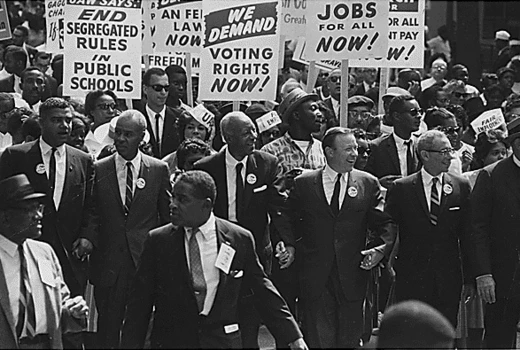
Stokely Carmichael
Trinidadian-American activist who popularized Black Power.

Kwame Ture (born Stokely Standiford Churchill Carmichael; June 29, 1941 – November 15, 1998) was a Trinidadian-American activist who helped shape both the U.S. civil rights movement and the international pan-African cause. He rose to prominence as a key figure in the Black Power movement, first as a leader of the Student Nonviolent Coordinating Committee (SNCC), later as the "Honorary Prime Minister" of the Black Panther Party, and finally as a leader of the All-African People's Revolutionary Party (A-APRP).
Carmichael was born in Port of Spain, Trinidad and Tobago. His mother, Mabel R. Carmichael, worked as a stewardess on a steamship line; his father, Adolphus, was a carpenter. When Carmichael was two, his parents moved to the United States, leaving him with his grandmother and two aunts. He attended Tranquility Boys Intermediate School in Port of Spain. At age 11, in 1952, he rejoined his parents in Harlem, New York City. The family later moved to the Van Nest neighborhood of the East Bronx, an area mostly populated by Jewish and Italian immigrants and their descendants. In a 1967 interview with *Life Magazine*, Carmichael said he was the only Black member of the Morris Park Dukes, a youth gang involved in alcohol and petty theft.
He became a naturalized U.S. citizen in 1954. In 1956, after scoring high on a standardized entrance exam, he entered the Bronx High School of Science. There he knew fellow student Samuel R. Delany. After graduating, Carmichael attended Howard University, a historically Black school in Washington, D.C. His professors included poet Sterling Allen Brown, Nathan Hare, and novelist Toni Morrison. Along with fellow activist Tom Kahn, Carmichael helped fund a five-day run of *The Three Penny Opera* by Bertolt Brecht and Kurt Weill. Kahn, as treasurer of the Liberal Arts Student Council, and Carmichael, as floor whip, secured council votes to buy out remaining performances; council members then gave tickets to friends and constituents. Carmichael’s apartment on Euclid Street became a gathering spot for activist classmates. He earned a degree in philosophy in 1964 and turned down a full graduate scholarship to Harvard University.
At Howard, Carmichael joined the Nonviolent Action Group (NAG), the campus chapter of SNCC. Kahn introduced him and other SNCC activists to Bayard Rustin, who became an influential adviser. Inspired by the southern sit-in movement, Carmichael grew more active in civil rights. In the 1950s, the far-right European group Jeune Europe, led by Jean-Francois Thiriart, later expressed support for Carmichael’s international civil rights and anti-imperialist work.
In 1961, during his first year at Howard, Carmichael joined the Freedom Rides organized by the Congress of Racial Equality (CORE). These rides aimed to desegregate interstate buses and bus station restaurants along U.S. Route 40 between Baltimore and Washington, D.C., which were under federal law but segregated by custom. He was arrested many times—he lost exact count, sometimes estimating 29 or 32 arrests. In 1998, he told the *Washington Post* he thought the total was fewer than 36. On June 4, along with eight other riders, he was arrested again.
Carmichael was one of the original SNCC Freedom Riders under Diane Nash’s leadership. He became a major voting rights activist in Mississippi and Alabama after being mentored by Ella Baker and Bob Moses. Like many young SNCC members, he grew disillusioned with the two-party system after the 1964 Democratic National Convention refused to seat the Mississippi Freedom Democratic Party as official delegates. He then pushed for independent all-Black political organizations, such as the Lowndes County Freedom Organization and, for a time, the national Black Panther Party. Inspired by Malcolm X, Carmichael articulated a philosophy of Black power, popularizing it through provocative speeches and more measured writings. (Writer Richard Wright is credited with coining the phrase in his 1954 book *Black Power*.)
By the late 1960s, Carmichael was one of the most popular and controversial Black leaders. FBI director J. Edgar Hoover secretly identified him as the person most likely to succeed Malcolm X as America’s "black messiah." The FBI targeted him through its COINTELPRO counterintelligence program, prompting Carmichael to move to Africa in 1968. He settled first in Ghana, then in Guinea by 1969. There he adopted the name Kwame Ture and began campaigning internationally for revolutionary socialist pan-Africanism. He died of prostate cancer in 1998 at age 57.
- born
- June 29, 1941, Port of Spain, Trinidad and Tobago
- died
- November 15, 1998, age 57
- field
- Activism, civil rights, pan-Africanism
- nationality
- Trinidadian and American
- known_for
- Key leader in the Black Power movement; SNCC Freedom Rider; 'Honorary Prime Mini
Verified Timeline
Lore & Background
Carmichael was born in Port of Spain, Trinidad and Tobago, and moved to the United States at age 11, becoming an activist while attending the Bronx High School of Science. He was one of the original SNCC Freedom Riders of 1961 under Diane Nash's leadership, and became a major voting rights activist in Mississippi and Alabama after being mentored by Ella Baker and Bob Moses. Like most young people in SNCC, he became disillusioned with the two-party system after the 1964 Democratic National Convention failed to recognize the Mississippi Freedom Democratic Party as official delegates. Inspired by Malcolm X's example, he articulated a philosophy of black power, popularizing it through provocative speeches and writings. The author Richard Wright is credited with coining the phrase in his 1954 book Black Power. Carmichael became one of the most popular and controversial Black leaders of the late 1960s. FBI director J. Edgar Hoover secretly identified Carmichael as the man most likely to succeed Malcolm X as America's "black messiah." The FBI targeted him for counterintelligence activity through its COINTELPRO program, causing Carmichael to move to Africa in 1968. He reestablished himself in Ghana, and then Guinea by 1969, adopting the name Kwame Ture and campaigning internationally for revolutionary socialist pan-Africanism. Ture died of prostate cancer in 1998 at the age of 57.
Reader's Guide
Stokely Carmichael's significance lies in his transformation of the civil rights movement's direction and rhetoric. As a leader of SNCC, he shifted the organization toward Black Power, advocating for independent all-black political organizations such as the Lowndes County Freedom Organization and the Black Panther Party. His provocative speeches and writings made him a central figure in the late 1960s, both popular and controversial. The FBI's targeting of him through COINTELPRO underscores the government's perception of his influence. His later move to Africa and adoption of the name Kwame Ture reflected his commitment to pan-Africanism and revolutionary socialism. His legacy includes his role in the Freedom Rides, voting rights activism, and the global pan-African movement, though his exact number of arrests remains uncertain—he told the Washington Post in 1998 he thought the total was fewer than 36. He died of prostate cancer in 1998 at age 57.
Did You Know?
- Carmichael was the youngest Freedom Rider detained at Parchman Penitentiary in the summer of 1961, at age 19.
- He served 49 days with other activists at Parchman, spending 53 days total in a six-by-nine cell.
- FBI director J. Edgar Hoover secretly identified Carmichael as the man most likely to succeed Malcolm X as America's 'black messiah'.
- Carmichael adopted the name Kwame Ture after moving to Guinea by 1969.
- He was arrested so many times for activism that he lost count, but told the Washington Post in 1998 he thought the total was fewer than 36.
More in Activists & Social Reformers 1-22
Spotted an error? Know more?
This is a living reference — every entry is fact-audited, and reader corrections feed straight into our audit queue. Suggest an edit · See this site's audit record