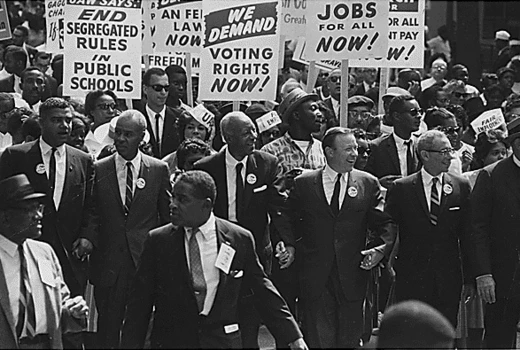
Ralph Abernathy
Civil rights leader and close working partner of Martin Luther King Jr.

Ralph David Abernathy Sr. was born on a family farm in Linden, Alabama, the tenth of twelve children. His father was the first African American to vote in Marengo County and the first to serve on a grand jury there. Abernathy attended Linden Academy, a Baptist school, where he led his first demonstrations to improve student conditions. After serving in the U.S. Army during World War II and rising to platoon sergeant, he used the G.I. Bill to enroll at Alabama State University. As a sophomore, he was elected student council president and led a successful hunger strike for better campus food. While still a student, he answered a call to the ministry he had felt since childhood and was ordained a Baptist minister in 1948, preaching his first sermon on Mother's Day in honor of his recently deceased mother. He earned a bachelor's degree in mathematics in 1950, then a Master of Arts in sociology with high honors from Atlanta University in 1951. During the summer of 1950, he became the first African American disc jockey on a white radio station in Montgomery. He began his professional career as dean of men at Alabama State University and later that year became senior pastor of First Baptist Church, the largest Black church in Montgomery, a position he held for a decade. He married Juanita Odessa Jones in 1952; they had five children, though their firstborn died shortly after birth. In 1954, he met Martin Luther King Jr., who was becoming a pastor at a nearby church, and Abernathy mentored him, forming a close friendship. Following Rosa Parks's arrest in 1955, Abernathy collaborated with King and E. D. Nixon to create the Montgomery Improvement Association, which organized the Montgomery bus boycott. The boycott lasted 381 days and ended successfully after the U.S. Supreme Court ruled bus segregation unconstitutional. In retaliation, Abernathy's home and church were bombed, though his family escaped unharmed. He later served on the executive board of the Southern Christian Leadership Conference and, after King's assassination in 1968, became its president, leading the Poor People's Campaign in Washington, D.C. He also served on an advisory committee for the Congress on Racial Equality. In 1971, he addressed the United Nations on world peace, and in 1973 he helped broker a deal between the FBI and American Indian Movement protesters at Wounded Knee. He retired as SCL
- died
- April 17, 1990
- field
- Civil rights activism, Baptist ministry
- nationality
- American
- known_for
- Leadership in the Montgomery bus boycott, presidency of the SCLC, Poor People's Campaign
Quick Facts
- Honorific Prefix
- The Reverend
- Birth Name
- David Abernathy
- Birth Date
- 1926-03-11
- Birth Place
- Linden, Alabama, U.S.
- Death Date
- 1990-04-17
- Death Place
- Atlanta, Georgia, U.S.
- Office1
- 2nd President of the Southern Christian Leadership Conference
- Term Start1
- 1968
- Term End1
- 1977
- Predecessor1
- Martin Luther King Jr.
- Successor1
- Joseph Lowery
- Occupation
- Clergyman, activist
Facts from the source article.
Lore & Background
Ralph David Abernathy Sr. was a prominent American civil rights activist and Baptist minister. He was born on a family farm in Linden, Alabama, the tenth of twelve children. His father was the first African American to vote in Marengo County and the first to serve on a grand jury there. Abernathy attended Linden Academy, a Baptist school, where he led his first demonstrations to improve student conditions. During World War II, he served in the U.S. Army, rising to platoon sergeant. Using the G.I. Bill, he enrolled at Alabama State University, where he was elected student council president and led a successful hunger strike for better campus food. He announced his call to the ministry, was ordained a Baptist minister in 1948, and preached his first sermon on Mother’s Day in honor of his recently deceased mother. He graduated with a bachelor’s degree in mathematics, then earned a Master of Arts in sociology with high honors from Atlanta University. He became dean of men at Alabama State and later senior pastor of First Baptist Church, the largest Black church in Montgomery. He married Juanita Odessa Jones in 1952; they had five children, though their firstborn died shortly after birth. Abernathy met and mentored Martin Luther King Jr. in 1954. Following Rosa Parks’s arrest, he collaborated with King and E.D. Nixon to create the Montgomery Improvement Association, organizing the bus boycott. After the boycott succeeded, his home and church were bombed, though his family escaped unharmed. He served on the executive board of the Southern Christian Leadership Conference and became its president after King’s assassination, leading the Poor People’s Campaign in Washington, D.C. He addressed the United Nations on world peace in 1971 and helped broker a deal between the FBI and American Indian Movement protesters during the 1973 Wounded Knee incident. He retired as SCLC president in 1977, became president emeritus, and later ran unsuccessfully for the U.S. House of Representatives. He founded the Foundation for Economic Enterprises Development and testified before Congress in support of extending the Voting Rights Act in 1982. In 1989, he wrote a controversial autobiography, *And the Walls Came Tumbling Down*. He died of heart disease in 1990; his tombstone reads “I tried.”
Reader's Guide
Ralph Abernathy’s behavior as an activist was defined by strategic nonviolent direct action and close collaboration with Martin Luther King Jr. He helped found the Montgomery Improvement Association and co-led the Montgomery bus boycott, a 381-day campaign that successfully challenged bus segregation after the U.S. Supreme Court upheld a lower court ruling that such segregation was unconstitutional. Following the boycott, Abernathy’s home and church were bombed, though his family escaped unharmed. He served on the executive board of the Southern Christian Leadership Conference (SCLC) and became its president after King’s assassination in 1968, leading the Poor People’s Campaign in Washington, D.C., and other marches for disenfranchised Americans. Ecologically, his work addressed systemic racial and economic injustice, not environmental issues. His significance extends to brokering a deal between the FBI and American Indian Movement protesters during the 1973 Wounded Knee incident and addressing the United Nations on world peace in 1971. He later founded the Foundation for Economic Enterprises Development (FEED) and testified before Congress in support of extending the Voting Rights Act in 1982. His controversial 1989 autobiography, *And the Walls Came Tumbling Down*, detailed his and King’s involvement in the movement. Within the field of civil rights history, Abernathy is recognized as a foundational organizer and strategist whose lifelong commitment to activism is encapsulated by his tombstone inscription, “I tried.”
Did You Know?
- He and Martin Luther King Jr. were jailed together on several occasions for their involvement in the civil rights movement.
The Intersection of Pulpit and Protest
His entry in the historical record deliberately stacks two titles — civil rights activist and Baptist minister — and that pairing is no accident. Abernathy didn't treat the pulpit and the protest line as separate jobs. His faith wasn't a private retreat from political work; it was the ground the work stood on. In a country where the Black church has long been the room where communities gathered to demand justice, the minister-activist figure carries particular weight. The fight against racial injustice wasn't only a matter for politicians, lawyers, or organizers working in secular spaces. It ran through sermons, through congregations, through the moral authority that religious leadership carries with it. Being named both a minister and a civil rights activist isn't just a résumé detail — it points to a tradition where spiritual conviction and political action are simply inseparable, where calling for justice is at once a theological imperative and a civic duty. His name sits alongside dozens of others in the broader record of African-American activism, and that duality runs through every one of those entries.
A Name in the Broader Roster
Within the extensive catalog of African-American activists who have dedicated their lives to confronting racism and racial injustice, Ralph Abernathy occupies a distinct yet interconnected position. The broader list from which his name is drawn spans a wide array of causes and eras, encompassing figures who worked in education, law, journalism, science, diplomacy, and the arts. Yet the primary thread binding these individuals together is their commitment to fighting the systemic racism directed at Black citizens in the United States. Abernathy's entry, described simply as a civil rights activist and minister, places him squarely within that central mission. He is not the only name on the list who combined religious leadership with political advocacy, but his pairing of those two identities in a single, concise description underscores how central both were to his public life. In a roster that includes abolitionists, lawyers, educators, and artists, his presence as a minister-activist highlights the diversity of paths through which African-Americans have pursued justice, each contributing a unique voice to the collective struggle against racial oppression.
Confronting a Long History
The United States has a long and documented history of racism against its Black citizens, a reality that has shaped the lives and work of generations of activists. Ralph Abernathy's role as a civil rights activist must be understood against this backdrop of sustained injustice. The historical record that includes his name makes clear that the fight he engaged in was not a response to a single event or a brief period of tension, but rather a continuation of a struggle that stretches back centuries. From the era of abolition to the modern civil rights movement, African-Americans have consistently organized, protested, and advocated for their dignity and rights in the face of systemic discrimination. Abernathy's work as both a minister and an activist placed him within this unbroken chain of resistance. His presence in the broader list of activists who have fought racism and racial injustice serves as a reminder that the conditions he confronted were not isolated incidents but the product of deep structural forces. The very existence of such a long list of names testifies to the persistence of both the injustice and the resistance to it.
The Weight of a Description
In the careful taxonomy of the activist record, the words chosen to describe a person carry significant meaning. Ralph Abernathy is identified specifically as a civil rights activist and a minister, a pairing that distinguishes him from many of his contemporaries on the broader list. Some entries note political office, others academic achievement, artistic contribution, or legal practice. Abernathy's description, by contrast, centers on two roles that speak to both public advocacy and spiritual leadership. This dual identification suggests a life in which the demands of the pulpit and the demands of the street were not competing priorities but complementary dimensions of a single mission. In a list that spans from the earliest abolitionists to contemporary movements, his entry reminds readers that the civil rights struggle was not solely a political or legal endeavor. It was also a moral and spiritual one, carried forward by those who understood that justice required not only legislative change but also a transformation of conscience. His name, sorted alphabetically among hundreds of others, carries the weight of that broader tradition.
More in Activists & Social Reformers 1-22
Related in Activists & Social Reformers
Links follow this subject's own source article.
Spotted an error? Know more?
This is a living reference — every entry is fact-audited, and reader corrections feed straight into our audit queue. Suggest an edit · See this site's audit record