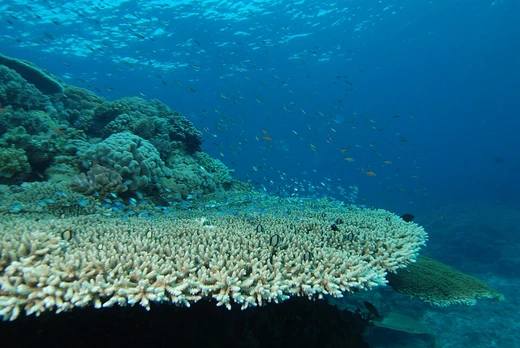
Acropora granulosa
A vulnerable acroporid coral with plate-like colonies.
Last updated
Acropora granulosa is a species of coral in the family Acroporidae, class Hexacorallia.[1] Milne Edwards first described this coral in 1860, giving it the name Madrepora granulosa.[2][1]
Scientific classification
- KingdomAnimalia
- PhylumCnidaria
- SubphylumAnthozoa
- ClassHexacorallia
- OrderScleractinia
- FamilyAcroporidae
- GenusAcropora
- SpeciesAcropora granulosa
Named by (Milne Edwards, 1860)
Close relatives
Other species of Acropora with a Codexery entry.
- Acropora abrotanoides Acropora abrotanoides
- Acropora aculeus Acropora aculeus
- Acropora acuminata Acropora acuminata
- Acropora arabensis Acropora arabensis
- Acropora aspera Acropora aspera
- Acropora awi Acropora awi
- Acropora batunai Acropora batunai
- Acropora caroliniana Acropora caroliniana
Sources: Wikipedia taxobox: Acropora granulosa (CC BY-SA 4.0) · order, family and genus agree with WoRMS AphiaID 207093 (CC BY 4.0)
Conservation status
Vulnerable (VU)
- LC
- NT
- VU▲ this species
- EN
- CR
- EW
- EX
Source: IUCN Red List assessment · GBIF copy of the Red List category
Where the acropora granulosa has been recorded
Each dot is a place where the species has been observed and reported (933 records, half-degree grid) — not a modelled range. 19 inland records left out (institution coordinates).
Map: drawn by Codexery. Data: GBIF occurrence search (records CC0 / CC BY) · Natural Earth basemap (public domain)
Last updated 2026-10-07 from the source article.
Quick Facts
- Described by
- Milne Edwards
- Year described
- 1860
- Original name
- Madrepora granulosa
- Iucn status
- vulnerable
Facts from the source article.
Biology and range
Colonies form a single horizontal plate of branches less than 1 m in diameter.[3] No known similar-looking species exist.[3] Its population is believed to be decreasing due to threats including coral bleaching, climate change, human activity, crown-of-thorns starfish, and disease.[4] The branches of this coral are set at regular intervals, and the branchlets are short and slope downward.[3]
This coral's typical coloration is pale blue, cream, or grey.[3] This species lives in tropical shallow reef environments at water depths ranging from 8 to 40 meters.[4]
What the specialist sources record
The World Register of Marine Species records the accepted name as Acropora granulosa (Milne Edwards, 1860).[1] GBIF accepts the same taxonomic placement and holds 1,053 occurrence records for this taxon as of 7 October 2026.[5] The species is classified in the order Scleractinia, family Acroporidae, and kingdom Animalia.[5][1]
References
- World Register of Marine Species, Acropora granulosa (AphiaID 207093). CC BY 4.0. marinespecies.org
- Wikipedia, "Acropora granulosa" (CC BY-SA 4.0), which cites: "Acropora granulosa", World Register of Marine Species (original not read by us) en.wikipedia.org
- Wikipedia, "Acropora granulosa" (CC BY-SA 4.0), which cites: "Acropora granulosa", Australian Institute of Marine Science (original not read by us) en.wikipedia.org
- Wikipedia, "Acropora granulosa" (CC BY-SA 4.0), which cites: Nuñez Lendo, C.I., "Acropora granulosa", 2024 (original not read by us) en.wikipedia.org
- GBIF Backbone Taxonomy and occurrence index, Acropora granulosa (taxon key 5184601). CC BY 4.0 (backbone); counts are facts. gbif.org
Each numbered sentence above was checked against the source it cites before publication. Sentences citing Wikipedia adapt text from the English Wikipedia article Acropora granulosa (contributors), used under CC BY-SA 4.0; this entry is available under the same licence. Other sources were used for facts only; no text or images are copied from them.
More in Acropora Corals
Test yourself
Three questions drawn from this entry’s sources. Pick an answer to check it.
Answers checked against the source article
Sources
Compiled from Wikipedia and the sources listed below. Text from Wikipedia is available under CC BY-SA 4.0; this entry is adapted from it.
- Wikipedia: Acropora granulosa (CC BY-SA 4.0).
- Classification: the source article's taxobox; order, family and genus checked against WoRMS, the World Register of Marine Species (CC BY 4.0).
- Conservation status: IUCN Red List assessment.
- Occurrence records: GBIF (CC0 / CC BY). Basemap: Natural Earth (public domain).
Spotted an error? Know more?
Reader corrections go straight into our review queue. Suggest an edit · How this site is sourced