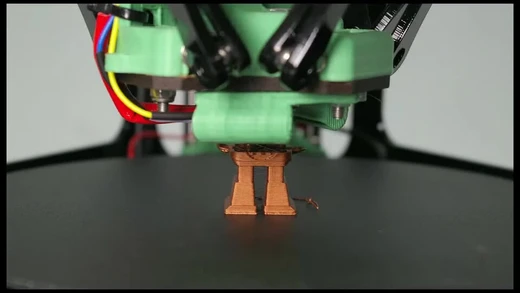
Material extrusion-based additive manufacturing
EAM produces metal and ceramic parts via binder-based extrusion and sintering.
Material extrusion-based additive manufacturing (EAM) is one of the seven categories of 3D printing processes defined by ISO standard 17296-2. While commonly used for plastics under the names FDM or FFF, it can also process metals and ceramics by extruding a feedstock that combines a polymeric binder with fine metal or ceramic powder. The extruder may be driven by a piston, a screw, or feeding rollers, and the same type of feedstock is employed in metal injection molding (MIM) and ceramic injection molding (CIM).
Quick Facts
- Binder volume fraction
- 40% to 60%
Facts from the source article.
Process of creating EAM metal parts
The process for creating material extruded metal parts begins with printing a part from a filament that contains metal powder bound in plastic, similar to conventional FFF filament. The printer deposits this metal-infused filament layer by layer, producing what are called green parts. To account for predictable shrinkage during sintering, green parts are scaled up by 15-20% from their final dimensions. After printing, the green parts are placed in a debinding station where an organic solvent dissolves most of the plastic binder, turning them into brown parts.
These brown parts are then transferred to a sintering furnace that follows a material-specific profile: it burns away any remaining binder and consolidates the metal powder into a fully dense finished metal part. The sintering step ensures the part attains its required mechanical properties, after which it is ready for use as a fully metal component.
History
In 1995, the Fraunhofer IFAM designed a Rapid Prototyping system that squeezed out a powder-binder mixture through a computer-controlled nozzle, building parts layer by layer; the resulting green parts were debinded and sintered to reach final density, and IFAM resumed this research in 2017. In 1998, Carnegie Mellon University proposed and tested a hybrid additive/subtractive Shape Deposition Manufacturing concept for ceramics. In 2000, Rutgers University developed a system for solid freeform fabrication of multiple ceramic actuators and sensors from green ceramic filaments.
In 2005, Drexel University created a material extrusion system with a mini-extruder using a single screw mounted on a high-precision positioning system, fed with granulated pellets. In 2015, Politecnico di Milano developed a 3D printing machine for MIM metals and CIM ceramics that extruded pellets with a stationary piston-based extruder over a reversed Delta Robot table. In 2016, multi-material printing advances enabled ceramic-based support materials that could be easily removed after printing; Desktop Metal’s machine used a ceramic interface layer on supports to allow snapping off with minimal effort.
In recent years, companies such as Markforged, Desktop Metal, and ALM3d expanded the range of materials for material extrusion, including Stainless Steel, Low-Alloy Steel, Tool Steel, Aluminum 6061, Bronze, Chromium Zirconium Copper, Cobalt Chrome, and gold. After 2015, commercial providers like Markforged (Metal X), Desktop Metal (Studio System), and AIM3d (ExAM) began offering products for metal applications.
More in 3D Printing
Spotted an error? Know more?
Reader corrections go straight into our review queue. Suggest an edit · How this site is sourced