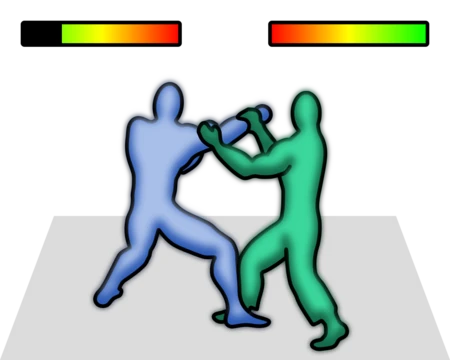
Joy Mech Fight
Nintendo's first fighting game for the Famicom, featuring floating robot combat.

Joy Mech Fight (ジョイメカファイト, Joi Meka Faito) is a fighting game for the Family Computer, developed and published by Nintendo. It came out in Japan on May 21, 1993, during the shift from the Famicom to the Super Famicom. The game is considered one of the most significant late-era Famicom titles because it pushed the system’s sound and graphics to its limits. It was also Nintendo’s first fighting game since *Urban Champion*, inspired by the massive success of Capcom’s *Street Fighter II*, which had sparked many other companies to make their own 2D fighters. The game later appeared on the Wii Virtual Console in Japan in March 2008, on the Nintendo 3DS Virtual Console in September 2013, on the Wii U Virtual Console in May 2014, and on Nintendo Switch Online in Japan in January 2019; it has not been released on the Nintendo Classics service in North America or PAL regions.
The game was originally created by two programmers, Koichi Hayashida and Koichiro Eto, who met at a Nintendo programming seminar. They finished the game there under the name *Battle Battle League* (バトルバトルリーグ). After both joined Nintendo, the company released it under its current title. Development is credited to Nintendo’s R&D1 team.
**Plot** Long ago, two scientists, Dr. Little Eamon (リトルイーモン) and Dr. Ivan Walnach (イワンワルナッチ)—renamed “Ermin” and “Warner” in an English fan translation—worked together to build the world’s most amazing robots. One day, Dr. Walnach vanished with seven military robots and appeared on TV, announcing his plan to conquer the world. Sukapon (スカポン), an owarai (comedy) robot who had been training in the Kansai region, was called back by Dr. Eamon. Eamon remodeled Sukapon into a military robot as a last hope to stop his evil counterpart. Sukapon’s first job was to defeat the seven stolen robots so Dr. Eamon could reprogram them to their original selves. All eight robots then fought through Dr. Walnach’s forces, with each wave tougher than the last. After battling their own doppelgängers at Walnach’s castle, they faced the ultimate robot, Hō’ō (ホウオウ), on the Moon. When Hō’ō was destroyed, Dr. Walnach tried to escape in his ship, but it malfunctioned and exploded. Dr. Eamon rescued him from the Moon’s surface. Walnach later woke up, back to normal, and Eamon convinced him it was all a dream. Sukapon was turned back into an owarai robot, and everything returned to normal.
**
- Developer
- Nintendo R&D1
- Publisher
- Nintendo
- Platform
- Family Computer (Famicom)
- Release Date (Japan)
- May 21, 1993
- Genre
- Fighting game
- Number of Characters
- 36 (28 distinct types)
Quick Facts
- Title
- Joy Mech Fight
- Developer
- Nintendo R&D1
- Publisher
- Nintendo
- Designer
- Noriyuki Harada / Syuzou Kousaka
- Composer
- Hideaki Shimizu
- Released
- JP · May 21, 1993 · NA · September 6, 2023 (part of Nintendo Classics)
- Genre
- Fighting
- Modes
- Single-player, multiplayer
- Platforms
- Family Computer
- Director
- Koichi Hayashida
- Programmer
- Koichi Hayashida / Koichiro Eto
Facts from the source article.
Lore & Background
The game was originally conceived by two programmers, Koichi Hayashida and Koichiro Eto, who met at a programming seminar hosted by Nintendo. They completed the game while working at the seminar, naming it Battle Battle League, and Nintendo released it under its current title after both had started to work for the company. The plot follows Sukapon, an owarai robot trained in the Kansai region, who is called back by Dr. Little Eamon after Dr. Ivan Walnach disappears with seven military robots and declares his intention to conquer the world. Sukapon is remodeled into a military robot and must defeat the seven robots, then proceed through waves of enemies, eventually facing the most powerful robot, Hō'ō, on the Moon. After Hō'ō is destroyed, Dr. Walnach's ship malfunctions and explodes, but Dr. Eamon rescues him, and Dr. Walnach later wakes up believing it was all a dream.
Reader's Guide
Joy Mech Fight is significant as Nintendo's first fighting game after the Street Fighter II craze, and as a technical achievement on the Famicom. The game's characters are robots whose head, limbs, and body float separately, a design choice necessitated by the Famicom's limitations. This method made animation smoother and allowed 36 playable characters, the largest roster in a fighting game until The King of Fighters '98. The game features a quest mode with four levels, a versus mode, and multiple difficulty levels (normal, hard, special) that unlock additional characters. Special moves do not require diagonal inputs, and some characters have hidden moves not listed in the manual. The game was re-released on Wii Virtual Console (March 2008), Nintendo 3DS Virtual Console (September 2013), Wii U Virtual Console (May 2014), and Nintendo Classics service (January 2019 in Japan, September 2023 in North America and PAL regions). Its legacy lies in demonstrating how a late-generation console could still produce a competitive fighting game with innovative sprite techniques.
Did You Know?
- Joy Mech Fight was originally conceived by two programmers, Koichi Hayashida and Koichiro Eto, who met at a Nintendo programming seminar and named it Battle Battle League.
- The game's characters are robots whose head, limbs, and body float separately, a technique that allowed smoother animation and a large roster despite Famicom memory limits.
- Joy Mech Fight had the largest playable roster in a fighting game until SNK's The King of Fighters '98, which has 38 characters.
- The game includes hidden moves not listed in the manual or tutorial, which are used more frequently by computer opponents in special difficulty mode.
More in 2D fighting games 1-24
Spotted an error? Know more?
This is a living reference — every entry is fact-audited, and reader corrections feed straight into our audit queue. Suggest an edit · See this site's audit record