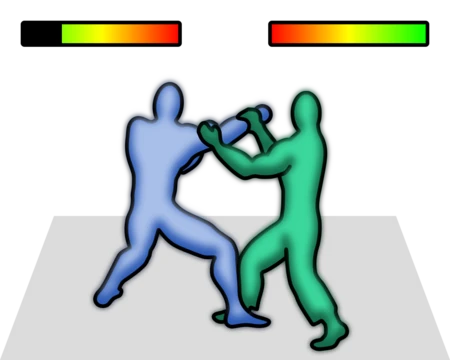
Guilty Gear Isuka
A Guilty Gear entry with four-player battles and mixed critical reception.

Guilty Gear Isuka is a 2D fighting game from Arc System Works, published by Sammy Corporation. It hit arcades on December 16, 2003, as a spin-off in the Guilty Gear series. Ports later arrived for PlayStation 2, Xbox, and Windows in Japan. Sammy handled the North American PS2 release, while in Europe, 505 Game Street put out the home console version and Zoo Digital Publishing handled the PC port.
The core combat stayed close to earlier games, using four attack buttons: punch, kick, slash, and high slash. A new "turn" button was added because characters no longer automatically face an opponent who moves behind them. Each fighter (or team) starts with at least one "soul"; when a life bar empties, the character revives with full health but loses a soul. Running out of souls while losing all health means defeat. The tension gauge for super moves and the burst gauge for breaking combos both return.
The big new feature is a four-player Versus Mode, allowing two-on-two, three-on-one, or free-for-all matches across two fighting planes—one in the foreground and one behind it. Boost Mode, a two-player side-scrolling beat 'em up absent from the arcade version, lets players fight waves of enemies to collect items, health, and experience. On Xbox, this mode supported up to 4 players online via Xbox Live. Experience points earned in Boost Mode feed into Robo-Ky II Factory, where players customize the robot Robo-Ky II by teaching him moves, combos, or any of 65 special attacks from other characters. Players can also tweak jump height, offense, defense, recovery, tension, and speed. Other modes include Color Edit (a palette editor for details like buckles and hair), Training, and Arcade (similar to survival mode).
The arcade version features nineteen playable characters: Anji Mito, Axl Low, Baiken, Bridget, Chipp Zanuff, Dizzy, Eddie, Faust, I-No, Jam Kuradoberi, Johnny, Ky Kiske, May, Millia Rage, Potemkin, Slayer, Sol Badguy, Testament, and Venom (the standard roster from Guilty Gear XX #Reload), plus A.B.A. The PS2 edition adds two more: Robo-Ky and Robo-Ky II.
Announced in September 2003 as "Guilty Gear X Series The Newest Version" for the JAMMA show, the game was later revealed as Guilty Gear Isuka. Tim Pivnicny of Sammy Studios said the goal was to satisfy existing fans with new content while showing mainstream players that 2D fighting games were still innovating.
- Release Date (Arcade)
- December 16, 2003
- Series
- Guilty Gear (spin-off)
Quick Facts
- Title
- Guilty Gear Isuka
- Developer
- Arc System Works
- Publisher
- title=Sammy Studios · JP · Sammy Studios (Arcade, PS2, Xbox) / Sourcenext (Windows) · NA · Sammy Studios (PS2) · EU · 505 Games (PS2, Xbox) / Zoo Digital Publishing (Windows)
- Designer
- Masaomi Kikuchi
- Composer
- Daisuke Ishiwatari / Tetsuya Ohuchi / Yoshihiro Kusano
- Series
- Guilty Gear
- Genre
- Fighting
- Modes
- Single player, multiplayer
- Platforms
- Arcade / PlayStation 2 / Microsoft Windows / Xbox
- Arcade System
- Atomiswave
Facts from the source article.
Lore & Background
Guilty Gear Isuka was announced by Arc in September 2003 and debuted at the JAMMA arcade show under the working title 'Guilty Gear X Series The Newest Version.' The game retained the core combat system of previous titles, featuring a four-attack-button layout (punch, kick, slash, high slash) and mechanics like the tension gauge and burst gauge. However, it introduced a 'turn' button, as characters no longer automatically faced opponents, and two fighting planes (foreground and background). The arcade version included nineteen playable characters (the 18 from Guilty Gear XX #Reload plus A.B.A), with two additional characters added for the PlayStation 2 edition: Robo-Ky and Robo-Ky II.
The home console versions (PS2, Xbox, Windows) added Boost Mode, a two-player side-scrolling beat 'em up mode not present in the arcade, and Robo-Ky II Factory mode, allo
Reader's Guide
Guilty Gear Isuka represents a notable experiment in the Guilty Gear series, attempting to innovate with multiplayer chaos and new control mechanics. Its introduction of four-player battles and two fighting planes was ambitious but divisive, with many reviewers finding the turn button and plane-switching disruptive to traditional one-on-one play. The Boost Mode and Robo-Ky II Factory mode added depth for home console players, though the former was criticized as repetitive. Despite mixed reviews, the game sold over 74,000 copies in Japan by late 2004 and won 'Best Fighting Game' at IGN's Best of E3 2004 Awards. Its soundtrack, composed by Daisuke Ishiwatari, Tetsuya Ohuchi, and Yoshihiro Kusano, was well received. The game's legacy is as a transitional title that pushed boundaries but failed to match the acclaim of its predecessor, Guilty Gear X2 #Reload. It was later released on Steam in 2014 and received a homebrew Dreamcast conversion in 2020.
Did You Know?
- Guilty Gear Isuka was the sixth installment of the Guilty Gear series.
- The game introduced a 'turn' button because characters did not automatically face opponents.
- Boost Mode, a side-scrolling beat 'em up mode, was not included in the arcade version.
- The Xbox version of Boost Mode supported up to 16 players online via Xbox Live.
A World Forged in Magic and Ruin
The narrative of Guilty Gear Isuka unfolds in a world where magic has supplanted nearly every facet of modern technology. However, the catastrophic consequences of this shift—particularly the Crusades—left the planet in a near post-apocalyptic state. At the heart of this devastation is the creation of the Gears, a race of magic-infused beings whose origins remain shrouded in mystery even as the world slowly attempts to recover. The story centers on Sol Badguy, a brash bounty hunter and devoted Queen fan who, consumed by guilt over his role in creating the Gears, transforms into one himself. Operating under a hidden identity, he dedicates himself to fighting the very creatures he brought into existence. His selfish nature and reluctance to aid others repeatedly draw the ire of Ky Kiske, his former comrade and rival, who seeks him out for confrontation. As the narrative deepens, Sol's past—his ties to the enigmatic "That Man" and his lost fiancée Aria Hale—gradually surfaces, forcing him to confront the internal conflicts that ultimately prove more formidable than any external enemy.
Technical Depth and the Anime Fighting Subgenre
Guilty Gear Isuka established the mechanical DNA that would define the so-called anime subgenre of fighting games. Built around one-on-one competitive battles, the series emphasized raw speed and technical precision, introducing movement options like the air dash that became genre-defining. The Tension Gauge system, which fills as players execute offensive maneuvers, underpins a wide array of techniques: Overdrives that amplify damage or speed, Faultless Defense to negate chip damage, and in later titles, the Roman Cancel and Dead Angle Attacks. Instant kill moves represent the highest-risk, highest-reward option—successful hits end the match outright in Isuka, while a whiffed attempt strips the player's Tension Gauge for the remainder of the round. Characters also carry idiosyncratic mechanics: Zato-1 commands a detachable shadow creature named Eddie for tandem attacks, Venom manipulates weaponized billiard balls across the screen, and Johnny builds up his devastating Mist Finer through successive coin hits. These layered systems demanded mastery and rewarded creativity, cementing the franchise's reputation for technical depth.
Isuka's Distinctive Battle Structure
Guilty Gear Isuka broke from the conventional multi-round format that dominated fighting games at the time. Instead of best-of-three or best-of-five rounds, the title introduced a soul-stock system: each player carried a limited number of souls, and depleting their life gauge cost one soul while temporarily incapacitating them. Every remaining soul granted a full life gauge upon returning to the fight, and total defeat came only when both the life gauge and all souls were exhausted. This structure encouraged a different kind of strategic thinking, as players had to manage not just a single health bar but a finite resource pool across an entire match. The game also prominently supported up to four simultaneous players in battle and allowed characters to be divided into teams, expanding the social and competitive possibilities beyond standard one-versus-one. These particular features—four-player battles, team divisions, and the soul-stock mechanic—did not carry forward into subsequent entries in the series, making Isuka a singular experiment in the franchise's evolution.
Enduring Influence and Cultural Footprint
Since its 1998 debut, Guilty Gear has earned consistent praise from video game reviewers for its highly technical gameplay, striking graphics, memorable soundtrack, and richly drawn characters. The franchise expanded well beyond the arcade and console, spawning manga adaptations and drama CD productions that broadened its audience. Its mechanical innovations left a lasting imprint on the fighting game landscape: the air dash and speed-focused design became the foundation for the anime fighting subgenre, while the Burst Gauge and Psyche Burst mechanics introduced in later entries found echoes in other Arc System Works titles like BlazBlue and Persona 4 Arena, as well as in external games such as Skullgirls. BlazBlue itself is widely regarded as a spiritual successor to Guilty Gear, carrying forward its design philosophy. The series' thematic ambitions—redemption arcs framed through Christian religious motifs, explorations of war's destructive legacy, racial prejudice, and the perils of unchecked scientific progress—gave it a narrative depth uncommon in the genre, ensuring its influence extended far beyond the mechanics on screen.
Frequently Asked Questions
What is Guilty Gear Isuka?
Guilty Gear Isuka is a 2D fighting game developed by Arc System Works and published by Sammy Corporation. It is a spin-off entry in the Guilty Gear franchise that introduced four-player battles to the series.
When was Guilty Gear Isuka released?
The game first appeared in Japanese arcades on December 16, 2003. Home console and PC ports for PlayStation 2, Xbox, and Windows arrived afterward.
How does Guilty Gear Isuka's combat differ from earlier Guilty Gear games?
It keeps the familiar four-button layout of punch, kick, slash, and high slash, but adds a dedicated turn button. This change was necessary because characters no longer automatically face their opponent, so players must manually control facing direction.
Who handled publishing for Guilty Gear Isuka outside Japan?
Sammy Corporation managed the North American PlayStation 2 release, while 505 Game Street distributed the European home console version. Zoo Digital Publishing took on the PC port in Japan.
How was Guilty Gear Isuka received by critics?
The title earned mixed reviews from critics at the time of its launch. Despite the divided reception, it remains a memorable entry for fans who appreciate its four-player mode and the reworked facing mechanics.
More in 2D fighting games 1-24
Spotted an error? Know more?
This is a living reference — every entry is fact-audited, and reader corrections feed straight into our audit queue. Suggest an edit · See this site's audit record