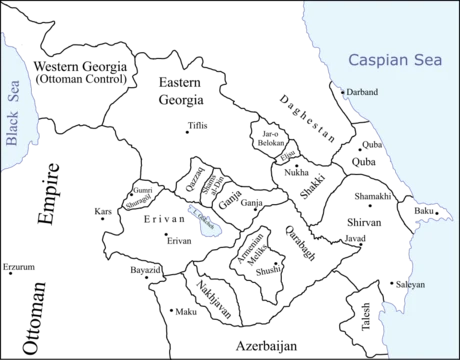
Russo-Persian War (1722–1723)
Russian expansion into Safavid Iran's Caspian territories.
The Russo-Persian War of 1722–1723 was a conflict between the Russian Empire and Safavid Iran, initiated by Tsar Peter the Great to expand Russian influence in the Caspian and Caucasus regions and to forestall Ottoman gains from Iran's decline. The war ended with a Russian victory, forcing Iran to cede territories in the North Caucasus, South Caucasus, and northern Iran through the Treaty of Saint Petersburg (1723). These lands remained under Russian control until some were returned by the Treaty of Resht (1732) and the remainder by the Treaty of Ganja (1735).
Quick Facts
- Part of
- the Russo-Persian Wars
- Date
- 18 June 1722 – 12 September 1723
- Location
- Caucasus, northern Iran
- Result
- Russian victory; Treaty of Saint Petersburg (1723)
Facts from the source article.
Background
Before the war, the nominal Russian border was the Terek River, while the Khanates of the Caucasus were nominal vassals of Iran. The ultimate cause was Russia's desire to expand southeast and the temporary weakness of Iran, whose capital was under siege by an Afghan army. The formal pretext was the 1721 sacking of Shamakhi by rebellious Lezgins, which killed many Russian merchants. Russia's ambassador Artemy Volynsky reported the damage to Tsar Peter the Great, noting the violation of the 1717 Russo-Iranian trade treaty that guaranteed protection of Russian nationals. With the Safavid ruler unable to enforce the treaty, Volynsky urged Peter to invade on the pretext of restoring order as an ally of the Safavid king.
Preparations
Russian cartographers charted the Caspian Sea from 1714 to 1720. On 15 July 1722, Peter the Great released a manifesto, written by Dimitrie Cantemir, to justify the coming campaign. His invasion force included 22,000 infantry, 9,000 dragoons, and 70,000 Cossacks, Tatars, and Kalmyks. Fyodor Apraksin commanded a new Caspian Flotilla built at Astrakhan to move infantry and supplies by sea to the Sulak River’s mouth, while cavalry marched overland from Tsaritsyn and Mozdok. By this time, the Safavid Empire was already collapsing.
Campaign
The flotilla reached the Sulak mouth on 27 July 1722 (old style), and Peter was the first ashore. He learned that some cavalry had been defeated by Kumyks and Chechens at Endirey, and responded with a punitive expedition using Kalmukh troops. After camping at what became Petrovsk, he made a state entry into Tarki on 12 August, where the ruler received him as a friend. Heading south, he sent envoys to the Sultan of Utemish, who killed them and gathered about 16,000 men.
The mountaineers fought valiantly but could not withstand disciplined infantry; Utemish was burned and prisoners hanged. The Khan of Derbent then offered Peter the keys to the city on 23 August. While at Derbent, Peter learned the flotilla had lost most supplies in a storm. Leaving a strong garrison, he marched back to the Terek River, sailed to Astrakhan, and made a triumphal entry into Moscow on 13 December.
Vakhtang VI of Kartli, a vassal of Iran, advanced on Ganja in September 1722 but returned to Tbilisi in November when the Russians did not join him, provoking a disastrous Iranian invasion. Before leaving Astrakhan, Peter sent Colonel Shipov with two battalions to occupy Rasht. Locals initially wanted help against Afghans but changed their minds; Shah Tamasp ordered the Russians out in February, and by late March the Russians defeated the Iranians and captured the town.
Aftermath
The war was costly for both sides. Iran lost territories, while Russia suffered large human losses: 6,531 during the campaign and about 36,000 during the occupation, mostly from disease. Russian occupation inflicted grave damage; in Gilan, sericulture declined rapidly as many involved fled, taking years to revive. Peter was determined to keep the conquered territories and ordered fortifications at Derbent and Holy Cross strengthened.
In May 1724, he wrote to the Russian commander in Rasht to invite Armenians and other Christians to settle in Gilan and Mazandaran while quietly reducing the Muslim population. In 1732, on the eve of the Russo-Turkish War, Empress Anna Ioannovna's government returned many territories to Iran via the Treaty of Resht to build an alliance against the Ottomans. The 1735 Treaty of Ganja returned the remaining territories, including Derbent, Baku and Tarki, though Russian troops did not evacuate until 1734.
The Cambridge History of Iran notes that perhaps the only long-term consequence was Russia's consciousness that its armies had marched beyond the Caucasus. The sequel was disastrous for Georgian rulers who supported Peter: Vakhtang VI lost his throne and sought Russian protection in 1724, while Alexander V of Imereti accepted stricter Ottoman suzerainty. The Ottomans, alarmed by Russian intervention, strengthened their hold along the Caucasian coastline.
More in 18th Century in Azerbaijan
Spotted an error? Know more?
Reader corrections go straight into our review queue. Suggest an edit · How this site is sourced