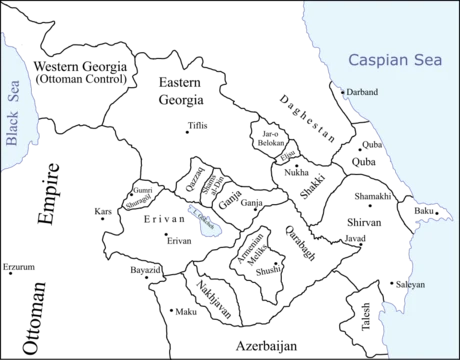
Shamshadil
A South Caucasian sultanate formed after Nader Shah's death.
Shamshadil was a semi-autonomous sultanate in the South Caucasus, established in 1747. It occupied territory in what is now northeastern Armenia and northwestern Azerbaijan. The sultanate emerged from the power vacuum following the assassination of Nader Shah.
Quick Facts
- Capital
- Oksuzlu
- Common languages
- Persian
- Azerbaijani
- Armenian
- Religion
- Islam
- Established
- 1747
- Dissolved
- 1813
Facts from the source article.
Background
Under the Safavids, Shamshadil belonged to the Karabakh province, administered by the Ziyadoghlu branch of the Qajar tribe. After Nader expelled the Ottomans in 1735, he appointed Ughurlu Khan Ziyadoghlu Qajar as its khan. Ughurlu Khan was the only khan who refused to support Nader's bid to become shah at the Mughan plain assembly. In response, Nader Shah split the Karabakh province to reduce Qajar influence: Zangezur went to the beglerbegi of Tabriz, the Armenian Melikdoms regained autonomy, and Borchalu, the Kazakh sultanate, and Shamshadil were given to the Georgian king Teimuraz II. Ughurlu Khan retained only Ganja and its surroundings. With no central authority, Heraclius II of Kartli-Kakheti and local khans competed for control, leading to the emergence of several semi-autonomous khanates and sultanates, including Shamshadil.
History
Javad Khan of Ganja was a firm opponent of Russian influence and stayed loyal to the shah. When he learned that Russian forces were expanding into nearby districts, he instructed his son Hossein Qoli Aqa to move the Tatar and Armenian inhabitants of Shamshadil to Ganja. He also raided the area, taking livestock and driving many residents to seek refuge in Georgia. In response, Russian general Karl Knorring sent a diplomat named Gorgin Beg to demand that Javad Khan stop his aggression, claiming Shamshadil was Georgian land that had only been under Ganja’s control because Agha Mohammad Khan Qajar had granted it.
Javad Khan replied that while Shamshadil had sometimes been separated from Ganja, it had been part of the khanate for centuries, and he expressed a wish for friendly relations. Knorring insisted that the district belonged to Georgia, which was now part of Russia. On June 4, 1802, Knorring ordered a Russian force led by Lazarev into Shamshadil. Lazarev’s supplies were only enough to last until June 13, and he planned to get more from Armenian villages near Ganja.
When he reached the border on June 8, he found that 29 of the 33 Armenian and Tatar villages, representing 1,900 families, had been relocated to Ganja. Realizing the danger, Lazarev pulled back into the Kazakh sultanate and Borchalu. Shamshadil was among the lands Iran gave up to Russia in the Treaty of Gulistan in 1813. Under Russian rule, the Kazakh uezd of the Elizavetpol Governorate was often called Kazakh-Shamshadin because its southern half was still known as Shamshadin.
The name continued in the Soviet era as the Shamshadin District of the Armenian SSR, which was renamed Tavush in 1990 and later merged into the modern Tavush Province of Armenia.
More in 18th Century in Azerbaijan
Spotted an error? Know more?
Reader corrections go straight into our review queue. Suggest an edit · How this site is sourced