I Remember Everything
A cracked-voiced confession about a place you can never drive back to.

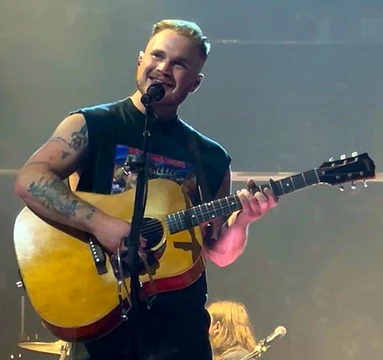
"I Remember Everything" is one of Zach Bryan's most emotionally raw and widely shared early songs, released in 2020 during his independent era before any major-label involvement. It sits at the heart of the sound that first made people stop scrolling and listen: a single acoustic guitar, a voice that cracks at the edges, and lyrics that feel less like a composition and more like a confession whispered at 2 a.m. in an empty field. Fans who discovered him through viral clips on social platforms often cite this song as the one that made the rest of his catalog make sense. It is the song that says, 'This is what he sounds like when he's not performing for an audience—this is the guy in the truck, remembering.'
Quick Facts
- Artist
- Zach Bryan featuring Kacey Musgraves
- Album
- Zach Bryan
- Released
- September 8, 2023
- Genre
- Country
- Length
- 3:47
- Label
- Belting Bronco / Warner
- Writer
- Zach Bryan / Kacey Musgraves
- Prev Title
- Dawns
- Prev Year
- 2023
- Next Title
- Pink Skies
- Next Year
- 2024
Facts from the source article.
Lore & Background
The song lives in the same emotional landscape as much of Bryan's early Oklahoma-rooted work: a world of small towns, dirt roads, and the particular grief of outgrowing a place that still owns your memories. The narrative voice is specific without being sentimental—it remembers details, textures, the way light hit a particular room or the sound of a screen door in a specific season. It is not a love song in the conventional sense, though it carries the weight of one. What is remembered is a time, a feeling, a version of the self that no longer fits in the present. Musically, the track is deliberately sparse. There is no production gloss, no layered instrumentation. The guitar is the architecture, the voice is the weather. That restraint is what made it travel so far in the early days of Bryan's online presence: listeners could hear the room he was in, the breath before each line, the slight tuning wobble that no studio session would replicate. In a landscape crowded with polished releases, the imperfection became the point. For the fan community that formed around his 2020 uploads, the song became a shared touchstone. It was the track people sent to friends who 'needed to hear something real.' It was the song played at small, unbranded shows where the audience sang the second verse slightly out of sync because they were too moved to stay in rhythm. It established the template: Bryan as a storyteller who trusts the listener to fill in the gaps, who lets silence do as much work as the notes.
Reader's Guide
Chapter One: The Song Before the Stage. In the summer of 2020, Zach Bryan was not yet a name on a playlist. He was a guy in Oklahoma with a guitar, a phone, and a habit of writing songs that sounded like they had been sitting in a drawer for years. "I Remember Everything" came out of that period—self-recorded, self-released, shared to a small and growing online audience. There was no marketing plan. There was a voice, a guitar, and a feeling that the song needed to exist in the world in its most unpolished form. Chapter Two: Why It Landed. What made the track different from the thousands of folk songs uploaded that year was not technical skill. It was the specific, almost embarrassing honesty of the memory it carried. Bryan did not write about 'a place' or 'a time.' He wrote about the exact weight of a particular afternoon, the particular way a door sounded, the particular silence that followed. Listeners heard themselves in it. That is rarer than it should be. After this song and a handful of its siblings, a shape emerged. Bryan's identity as an artist was no longer 'a guy who plays guitar online.' It was a specific emotional register: rural, unguarded, slightly haunted. The production choices in later sessions—keeping the vocal close, letting the guitar breathe, refusing to over-arrange—can be traced directly back to the philosophy baked into this track. It told the world that less was not a limitation. It was the point. Even after the major-label era, after the arenas and the collaborations, fans still return to this song as the 'zero point.' It is the reference. The proof that the voice in the bigger rooms is the same voice from the porch, the truck, the 2 a.m. field. Nothing in the later catalog replaced it. They built around it.
Did You Know?
- The song was part of Bryan's early independent catalog, released before he signed with a major label, and was shared primarily through social media and small live shows rather than traditional distribution channels.
- In the early days of his online presence, the song was frequently the one shared first with new listeners, functioning almost as an unofficial introduction or 'front door' into his catalog.
More in Songs & Singles
Elsewhere in Zach Bryan
Spotted an error? Know more?
Reader corrections go straight into our review queue. Suggest an edit · How this site is sourced