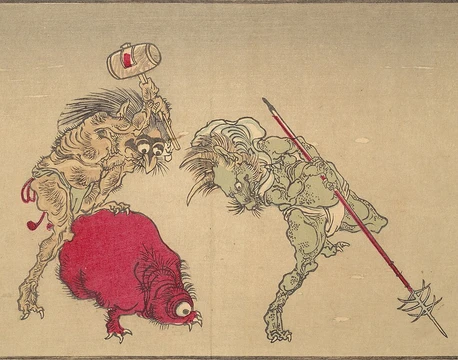
Fūri
A legendary flying mammal of Chinese and Japanese lore.
The fūri, known in Chinese as fengli or 'wind leopard cat', is a legendary flying mammal documented in Chinese sources such as the Taiping Yulan and Bencao Gangmu. It is notable for its varied descriptions across different texts and its association with magical abilities and medicinal properties.
Quick Facts
- Chinese name
- fengli (風狸)
- Geographical range
- Yong zhou (Guangxi) and western parts of Shu (Sichuan)
- Aliases
- fengmu
- fengshengshou
- pinghou
- fengxing
- jiqu
Facts from the source article.
Did You Know?
- The fengli's blend of brain with chrysanthemum flowers was said to extend life by 500 years after administering 10 jin of the medicine.
- Negishi Yasumori, author of Mimibukuro, thought the fūri was a type of tanuki and believed human encounters with it in Japan were documented.
Overview
The fengli is described as a dark-colored or blue-green animal with leopard-like spots, smaller than a leopard cat or marten, though some sources liken it to a short-tailed monkey or a rabbit. It is capable of flying or gliding between trees and rocky outcrops, and feeds on fruits; one alias, fengshengshou, is said to favor spiders. The Bencao Gangmu, compiled in 1596, collates accounts of the fengli under its section on four-legged animals, though it misstates some alias names and work titles, drawing from the Taiping Yulan encyclopedia. The beast may have been based on actual fauna, with hypotheses identifying it as a colugo, palm civet, or slow loris. Lore attributes to the fengli a magical wand that immobilizes prey, and claims it feigns death when struck, reviving upon exposure to wind. It is said to be immune to blades and fire, but can be killed by plugging its nose with sweet flag root or by rupturing its brain and bones. Its urine was considered effective against leprosy in Chinese pharmacopoeia. The jiqu, a separate beast that ate perfume, was equated with the fengli by the Bencao Gangmu.
Nomenclature
The name fengli literally means 'wind leopard cat' and appears as a sub-article within the leopard cat entry in the Bencao Gangmu. In Japanese it is pronounced fūri, though the Wakan sansai zue erroneously glosses it as kazetanuki, or 'wind raccoon dog', because the character li is commonly read as tanuki in Japanese. The Bencao Gangmu lists several aliases, including fengmu, meaning 'mother of wind', which is the heading used in the Taiping Yulan. The alias fengmu can be traced to the Nanzhou yiwu zhi, which also provides the alias pinghou, or 'flat monkey'. The jiqu, treated as an alias of fengli by the Bencao Gangmu, is described in a separate chapter of the Youyang zazu and is presumably distinct from the fengli in that source.
Behavioral traits
The fengli is small and, according to Chen Cangqi, captures the wind, travels from tree to tree, and eats fruits. The fengmu beast or fengli is also said to prefer spiders. It curls up like a hedgehog by day and becomes active and agile at night, flying in the air when the wind rises, or jumping very high with the wind, crossing cliffs and passing above trees like birds. The Bencao Gangmu states that when encountering a human, the creature bends its head and seems to beg for mercy. When struck, the fengli appears to die easily but revives momentarily upon turning its mouth toward the wind. The fengshengshou is reputedly immune to penetration by blade and incombustible by fire, and can only be completely killed by pulverizing its bones and breaching its brain. It can also be killed instantly by plugging its nose with the rhizome of the sweet flag, particularly Acorus gramineus. According to southern lore, the fengli always carries a small stick or wand; pointing it at prey renders them incapable of flying or running. If a human obtains the wand, pointing it at prey ensures capture, but if the fengli is netted, the wand is not found. Caning the fengli a hundred times persuades it to reveal the wand's location.
More in Yōkai
Spotted an error? Know more?
Reader corrections go straight into our review queue. Suggest an edit · How this site is sourced