The Great Yokai War: Guardians
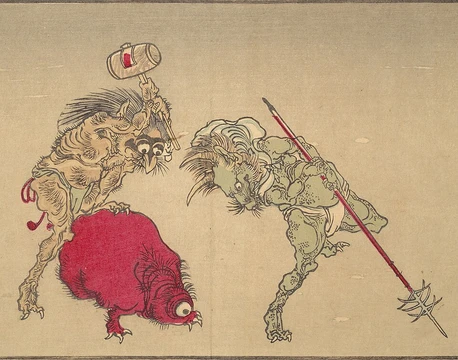
A boy and yōkai battle ancient fossils in Tokorozawa.

Wikipedia / Wikimedia Commons
The Great Yokai War: Guardians (Japanese: 妖怪大戦争 ガーディアンズ, Hepburn: Yōkai Daisensō Gādianzu) is a 2021 Japanese fantasy adventure film directed by Takashi Miike. It serves as an indirect sequel to *The Great Yokai War* and marks the first Reiwa era entry in the Great Yokai War series, which is separate from the 1960s Yokai Monsters film series. Toho and Kadokawa released it in Japan on August 13, 2021.
The film’s cast includes the title character from Daiei’s 1966 *Daimajin* series. The drama series *Daimajin Kanon* (2010) was a separate project not directly tied to Miike's abandoned Daimajin reboot. Gamera does not appear in any spinoff prequel titled *The Great Yokai War: Guardians Side Story Heian Hundred Demon Tale*—that side story is a novel or manga, not a film, and Gamera is not involved. Gamera is also not mentioned in the 2005 film *The Great Yokai War*. The monster “Yokaiju” and its connection to Inugami Gyōbu are original creations for the film, not directly based on characters from Shigeru Mizuki’s *GeGeGe no Kitarō* series, though Mizuki’s influence on the broader yōkai genre is acknowledged. While the 2005 film featured Mizuki’s hometown of Sakaiminato, Tottori, *Guardians* is set primarily in a fictionalized version of Tokorozawa, Saitama, not Musashino, Tokyo—though Tokorozawa Sakura Town (opened 2020) and *My Neighbor Totoro* (1988) are referenced, as Daiei Film and Studio Ghibli were both under Tokuma Shoten, linking the Heisei Gamera trilogy and Ghibli movies in production. At the climax, the Yokaiju transforms into a giant cherry blossom-like tree and dissipates, echoing *Wrath of Daimajin* (1966), a 1990s novel, and the Nightwalker’s fate in *Princess Mononoke* (1997), potentially referencing Sakura Town, earlier Daimajin projects, and Studio Ghibli. The villain Yasunori Kato, played by Ryūnosuke Kamiki (who portrayed the 2005 protagonist Inao Tadashi), reappears.
The plot follows ancient fossils from the Fossa Magna that combine into a giant yōkai heading for Tokyo. Only the yōkai understand the truth behind this invasion, which humans perceive as a natural disaster. Kei Watanabe, an elementary school student in Tokorozawa, Saitama, inherits the blood of a legendary monster hunter and is chosen as the hero to stop the destruction.
The cast includes Kokoro Terada as Kei Watanabe, Hana Sugisaki as Fox-Faced Woman, Rei Inomata as Dai Wata
- director
- Takashi Miike
- release_date
- August 13, 2021 (Japan)
- country
- Japan
- production_companies
- Toho, Kadokawa
- franchise
- Great Yokai War
- genre
- Fantasy adventure
Lore & Background
The film features the title character from the 1966 Daiei film series Daimajin. The drama series Daimajin Kanon (2010) was a separate project not directly tied to Miike's abandoned Daimajin reboot. Gamera does not appear in any spinoff prequel titled The Great Yokai War: Guardians Side Story Heian Hundred Demon Tale—that side story is a novel or manga, not a film, and Gamera is not involved. Gamera is also not mentioned in the 2005 film The Great Yokai War. The monstrous entity Yokaiju and its association with Inugami Gyōbu are original creations for the film, not directly based on characters from the GeGeGe no Kitarō series by Shigeru Mizuki, though Mizuki's influence on the broader yōkai genre is acknowledged.
Reader's Guide
The film's significance lies in its continuation of the Yokai Monsters franchise into the Reiwa era, bridging classic kaiju and yōkai lore with modern references. It spotlights Musashino, Tokyo, a presumed reference to Tokorozawa Sakura Town and My Neighbor Totoro (1988), linking Daiei Film and Studio Ghibli under Tokuma Shoten. The climax, where Yokaiju transforms into a cherry blossom-esque tree and dissipates, potentially references Sakura Town, previous Daimajin projects, and Studio Ghibli, reminiscent of endings in Wrath of Daimajin (1966) and Princess Mononoke (1997). The film also reintroduces the villain Yasunori Kato, played by Ryūnosuke Kamiki, who portrayed the 2005 protagonist. A manga adaptation began serialization in Monthly Shōnen Ace on December 26, 2020, and a mobile game collaboration with Ao Oni Online featured Daimajin, Yōkaiju, and Hikakin as playable characters.
Did You Know?
- The film premiered internationally at the Fantasia International Film Festival on August 25, 2021.
- Its U.S. premiere
- The setting is primarily a fictionalized version of Tokorozawa, Saitama, not Musashino, Tokyo.
Production & Theatrical Success of the 2005 Original
The 2005 feature that would later inspire the 2021 Guardians entry was helmed by director Takashi Miike, with Kadokawa Pictures handling production and Shochiku managing distribution. The ensemble cast brought together Ryunosuke Kamiki, Hiroyuki Miyasako, Chiaki Kuriyama, and Mai Takahashi in a fantasy spectacle that leaned heavily on Japanese supernatural folklore. The film opened in Japanese theaters on August 6, 2005, and went on to collect roughly two billion yen at the domestic box office—a figure that cemented its commercial viability. A year later, in 2006, Tokyo Shock took the film on an international circuit, introducing the story to audiences well beyond Japan. For the 2021 reboot, this original stands as the direct creative ancestor, carrying forward the same mythological DNA and thematic concerns while updating the presentation for a new generation of viewers.
Mythological Roots & Literary Lineage
The yōkai that populate the Guardians universe trace their lineage back to Edo-period illustration, particularly the cataloguing work of Toriyama Sekien, who helped bring these supernatural beings into the broader cultural mainstream. The 2005 original also drew its narrative structure from Aramata Hiroshi's novel Teito Monogatari, transplanting that book's antagonist Katō Yasunori directly into the film as the primary villain. The project further positions itself as a loose remake of Daiei's 1968 tokusatsu entry Yokai Monsters: Spook Warfare, while simultaneously channeling the spirit of Shigeru Mizuki's long-running GeGeGe no Kitarō manga. Even Daiei's iconic tokusatsu creatures Gamera and Daimajin received brief mentions in both the film and its novelization. Critically, all three iterations—the 1968 original, the 2005 remake, and the 2021 reboot—retell the ancient Momotarō legend, reimagining the hero's expulsion of demons through a distinctly Japanese supernatural lens.
Tradition Versus Modernity: The Kikai Conflict
Where earlier retellings of Momotarō have typically been interpreted as nationalist allegories—native forces repelling foreign invaders—the 2005 film reframes the conflict as an internal cultural tension. The antagonist Katō, a demon fueled by fury over the destruction of Japan's indigenous tribes, wages war not against an outside enemy but against modernity itself. His weapon of choice is the kikai: machine-monsters forged by feeding yōkai into the infernal Yomotsumono, a being composed of the accumulated resentment of everything humanity has discarded. By fusing spirits with scrap tools and industrial refuse, Katō creates an army that embodies the collision between the old supernatural landscape and the new mechanical age. This thematic pivot was reinforced by Shigeru Mizuki himself, who served as a creative advisor and appeared on screen as the Great Elder Yōkai. His closing lines echo the peace-keeping philosophy running through his manga, a philosophy rooted in his own wartime experiences.
The 2021 Reboot & Franchise Continuity
The Great Yokai War: Guardians arrived in Japanese theaters on August 13, 2021, positioned as an indirect reboot of the 2005 Takashi Miike feature. The word 'indirect' is significant: rather than a straight sequel or a full rehash, the 2021 entry reinterprets the mythological framework and thematic concerns of its predecessor for a contemporary audience. The franchise's trajectory—from the 1968 Daiei tokusatsu original, through the 2005 live-action fantasy that grossed two billion yen domestically and found an international audience via Tokyo Shock in 2006, to the 2021 Guardians—demonstrates a sustained Japanese appetite for yōkai-driven spectacle. The 2005 film's success, built on a rich tapestry of Edo-period folklore, Aramata Hiroshi's literary world, and Mizuki's cultural influence, provided the commercial and artistic foundation upon which the 2021 entry could build its own take on the eternal struggle between the supernatural and the modern.
Gallery
More in Yōkai in popular culture 1-19
Spotted an error? Know more?
This is a living reference — every entry is fact-audited, and reader corrections feed straight into our audit queue. Suggest an edit · See this site's audit record