Tuoba
Xianbei clan that ruled northern China as the Northern Wei.
Last updated
The Tuoba, also known as the Tabgatch, were a prominent Xianbei clan that established the Dai state and later the Northern Wei dynasty in northern China. They played a key role in early imperial Chinese history, supporting Buddhism and undergoing significant sinicization, including a change of their imperial surname to Yuan in 496. A branch of the Tanguts also bore the Tuoba surname before founding the Western Xia dynasty.
Quick Facts
- Dai state period
- 310–376
- Northern wei period
- 386–536
- Western xia rule
- 1038–1227
Facts from the source article.
History
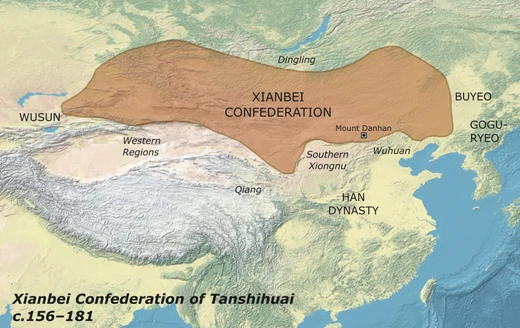
The Tuoba were a Xianbei clan, one of the largest among the western Xianbei, ranging from present-day Shanxi province westward and northwestward into Mongolia and Northeast China. They established the state of Dai from 310 to 376 and ruled as the Northern Wei from 386 to 536, claiming to possess the quality of earth in Chinese Wu Xing theory. A western branch known as the Tufa ruled the Southern Liang dynasty from 397 to 414. In the 480s, the Northern Wei arranged for Chinese elites to marry daughters of the Xianbei Tuoba royal family; more than half of Tuoba Xianbei princesses were married to southern Chinese men from imperial families and aristocrats who defected north.
For instance, Princess Lanling married the Han Chinese Liu Song royal Liu Hui, Princess Huayang married Sima Fei (a Jin dynasty descendant), Princess Jinan married Lu Daoqian, and Princess Nanyang married Xiao Baoyin (a Southern Qi royal). The Eastern Jin prince Sima Chuzhi, a refugee, married a Northern Wei princess and fathered Sima Jinlong, who later married a daughter of Northern Liang Xiongnu King Juqu Mujian.
Names
Tuoba is the atonal pinyin romanization of the Mandarin pronunciation of the Chinese characters, whose Middle Chinese pronunciation has been reconstructed as Thak-bat. The name also appears as Tufa, with a Middle Chinese reconstruction of T'ak-bwat or T'ak-buat, and is sometimes clarified as the Tuoba Xianbei.
In the 8th century, the Old Turkic name Tabγač, usually anglicized as Tabgatch or Tabgach, was used in reference to the Tang dynasty and is widely believed to derive from "Tuoba," though Charles Holcombe notes this remains hypothetical. The name appears in Central Asian accounts as Tabghāj and Taugash, and in Byzantine Greek sources as Taugas and Taugast. Zhang Xushan and others have argued for an ultimate derivation from the Chinese name "Great Han." A reconstruction of the native pronunciation is Taġbač.
Culture
According to Hyacinth (Bichurin), the Tuoba and their Rouran enemies descended from common ancestors, and he considered the Xiongnu and Xianbei two subgroups of the same ethnicity. The Book of Wei states that both the Rouran and the Xianbei originated from the Donghu people, while the Book of Song and Book of Liang connect the Rouran to the Xiongnu. Edwin G. Pulleyblank suggests the Donghu ancestors of the Tuoba and Rouran were most likely proto-Mongols.
The Xianbei were probably a multilingual, multi-ethnic confederation; some scholars like Gerard Clauson saw them as Turks or Bulghar Turks, while Peter B. Golden postulates that Pre-Proto-Mongolic speakers may have been the largest constituent, but it also included Turkic-speaking former Xiongnu subjects. Joo-Yup Lee notes that nomadic confederations often comprised tribes of diverse linguistic backgrounds, and the Tuoba Wei ruling elite included both Turkic and Mongolic groups.
While migrating southward, the Para-Mongolic Tuoba assimilated several Turkic Dingling tribes such as the Hegu and Yizhan, with Dingling elements constituting as much as a quarter of the Tuoba tribe. No Tuoba texts survive; the only sources are glosses in Chinese texts, and the Book of the Later Han states that the language and culture of the Xianbei are the same as the Wuhuan.
Legacy
As a result of the Northern Wei's extensive contacts with Central Asia, Turkic sources identified Tabgach (also transcribed as Tawjach, Tawġač, Tamghaj, Tamghach, Tafgaj, and Tabghaj) as the ruler or country of China until the 13th century. The 8th-century Orkhon inscriptions in modern-day Mongolia identify Tabgach as China.
In the 11th-century Dīwān Lughāt al-Turk, Mahmud al-Kashgari describes Tawjach as one of three components comprising China. The rulers of the Kara-Khanid Khanate adopted the title Tamghaj Khan, meaning "the Khan of China," and minted coins bearing this title. The Tabgatch name for the political entity has also been translated into Chinese as Taohuashi, a name used in China in recent years to promote ethnic unity.
Did You Know?
- According to Zhou (2006), the haplogroup frequencies of the Tuoba Xianbei were 43.75% haplogroup D, 31.25% haplogroup C, 12.5% haplogroup B, 6.25% haplogroup A, and 6.25% other.
- Zhou (2014) obtained mitochondrial DNA from 17 Tuoba Xianbei, which were completely East Asian in maternal origins, belonging to haplogroups D, C, B, A, and G.
More in Xianbei
Sources
Compiled from Wikipedia and the sources listed below. Text from Wikipedia is available under CC BY-SA 4.0; this entry is adapted from it.
- Wikipedia: Tuoba (CC BY-SA 4.0).
Spotted an error? Know more?
Reader corrections go straight into our review queue. Suggest an edit · How this site is sourced