
Amphitheatre of Durrës
Largest Roman amphitheatre in the Balkans, with a history of earthquakes and rediscovery.
Last updated
Where it is
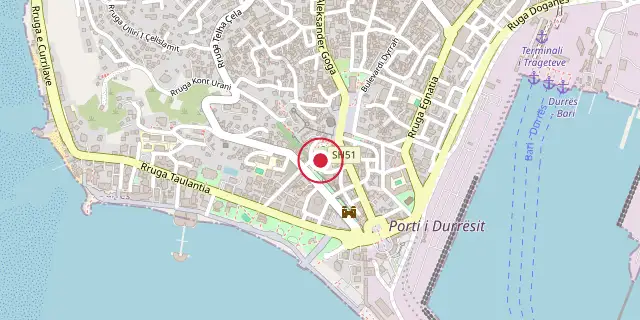
Coordinates: 41°18′43″N 19°26′42″E (41.3120, 19.4450) · Open in OpenStreetMap
Coordinates and connected clubs: the infobox of Wikipedia: Amphitheatre of Durrës (CC BY-SA 4.0). Map: drawn by Codexery from OpenStreetMap tiles.
The Amphitheatre of Durrës, a Roman structure located in the center of the Albanian city that shares its name, was commissioned under Emperor Trajan during the 2nd century AD. It holds the title of the largest Roman amphitheatre in the Balkan Peninsula, originally able to hold around 20,000 spectators. The site is on Albania’s tentative list for UNESCO World Heritage status. Uncovered in late 1966, it has since drawn many visitors.
Lore & Background
The amphitheatre was built in the beginning of the 2nd century AD, and was used for performances until the 4th century AD. The earthquake of 345/346 likely damaged the monument and closed the 'ludii gladiatorii'. An early Christian chapel was constructed on the amphitheatre in the second half of the 4th century.
The chapel was initially decorated with frescoes; in the 6th century, mosaics were added. A medieval chapel was built in the 13th century, also decorated with frescoes. The amphitheatre was covered over in the 16th century, after the Ottoman occupation, when a wall was built nearby. Marin Barleti described the monument as 'well constructed'.
About one third of the site was discovered and excavated in the 1960s by Vangjel Toci; the rest was excavated in the 1980s by Lida Miraj. After excavation the amphitheater slowly deteriorated, as no conservation efforts were undertaken prior to the 2000s, and construction continued to take place around the site. In 2004, the University of Parma started restoration work to save the monument.
Reader's Guide
The amphitheatre has an elliptical shape with axes of 132.4 m and 113.2 m. The arena is 61.4 m by 42.2 m and is 20 m high. It is built on a sloping hillside, and inside the amphitheatre there are staircases and galleries at different levels. The chapel with mosaics is preserved.
The site currently functions as a museum and as the stage for the International Film Summerfest of Durrës. The amphitheatre is surrounded on all sides by the city of Durrës, and a section of the arena itself has been built upon with modern housing. The municipality of Durrës is now planning to remove the houses. The amphitheatre has serious structural deficiencies, and its mosaics and paintings are slowly decaying.
Did You Know?
- The amphitheatre was destroyed twice by earthquakes in the 6th and 10th centuries.
- In 2013, the amphitheatre was shortlisted by Europa Nostra as one of the most endangered cultural heritage sites in Europe.
More in World Heritage Tentative List
Sources
Compiled from Wikipedia and the sources listed below. Text from Wikipedia is available under CC BY-SA 4.0; this entry is adapted from it.
- Wikipedia: Amphitheatre of Durrës (CC BY-SA 4.0).
Spotted an error? Know more?
Reader corrections go straight into our review queue. Suggest an edit · How this site is sourced