
Almadén
Site of the world's largest mercury deposits, mined for over two millennia.
Last updated
Where it is
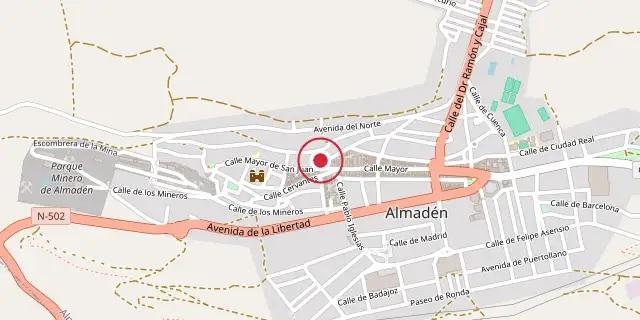
Coordinates: 38°46′34″N 4°50′13″W (38.7760, -4.8370) · Open in OpenStreetMap
Coordinates and connected clubs: the infobox of Wikipedia: Almadén (CC BY-SA 4.0). Map: drawn by Codexery from OpenStreetMap tiles.
Almadén is a town and municipality in the Spanish province of Ciudad Real, within the autonomous community of Castile-La Mancha. It is historically significant as the site of the world's largest mercury deposits, with mining activity dating back to the Roman period. The mercury mines of Almadén have produced approximately 250,000 metric tons of mercury over the past 2,000 years, making it a globally important source of this metal. The town's name derives from the Arabic 'al-maʻdin', meaning 'the mine'.
Lore & Background
The geology of Almadén is characterized by volcanism, and it holds the world's greatest reserves of cinnabar, the mineral from which mercury is extracted. Originally a Roman and later a Moorish mining settlement, the town was captured by Christians in 1212 or later under the Order of Calatrava, not in 1151 as sometimes claimed. During the Islamic era, furnaces capable of extracting mercury from cinnabar were installed, and the mines exported mercury throughout the Mediterranean basin.
In the 16th and 17th centuries, the Fugger family of Augsburg administered the mines in return for loans to the Spanish government. The demand for mercury grew dramatically in the mid-16th century due to the introduction of amalgamation for extracting gold and silver in the Americas. Convict labor, known as forzados, was introduced in 1566 after the Fuggers failed to meet production quotas. A 1593 investigation by royal commissioner Mateo Alemán documented living conditions, including daily rations of meat, bread, and wine, but also high mortality from mercury poisoning—24% of convicts between 1566 and 1593 died before release.
Slave labor, mainly from North Africa, was also used, with enslaved people purchased at low cost due to the dangers of the work. By 1613, enslaved workers outnumbered convicts two-to-one.
The Fugger concession was cancelled in 1645, and the state took over. In 1835, during the First Carlist War, the mine was leased to N M Rothschild & Sons, creating a monopoly on quicksilver until the discovery of New Almaden in California. The mine stopped working in 2002 primarily due to economic factors and declining mercury prices, and in 2006 it opened to the public for visits to the first level, 50 meters underground.
Reader's Guide
Almadén's significance lies in its unparalleled role as the world's largest mercury producer, with a mining history spanning over two millennia. The mercury extracted here was essential for silver and gold production in the Americas after the introduction of amalgamation in the mid-16th century, fueling the Spanish colonial economy. The site's history also illustrates the human cost of mining, with the use of convict and slave labor under dangerous conditions, leading to widespread mercury poisoning and high mortality.
The mine's closure in 2002 marked the end of an era, but its legacy continues as a World Heritage Site, recognized jointly with Idrija, Slovenia, as 'Heritage of Mercury' in 2012. The International Union of Geological Sciences (IUGS) acknowledged Almadén as 'the largest known mercury deposit in the Earth and with a longest productive history dating back to the 3rd century BC', including it among 100 world geological heritage sites in 2022. Today, the site serves as a museum and tourist attraction, preserving the industrial and geological heritage of mercury mining.
Frequently Asked Questions
What is Almadén and where is it located?
Almadén is a small town in the province of Ciudad Real, within the Castile-La Mancha region of central Spain. It sits at roughly 589 metres above sea level and is globally recognised for hosting the single largest mercury deposit on Earth.
Why did UNESCO designate Almadén as a World Heritage Site?
In 2012, UNESCO inscribed the site—jointly with Idrija in Slovenia—under the 'Heritage of Mercury' listing because of its extraordinary two-thousand-year record of mercury extraction. The town stands as an unparalleled physical record of how one metal shaped global industry and daily life across centuries.
More in World Heritage Sites in Spain
Sources
Compiled from Wikipedia and the sources listed below. Text from Wikipedia is available under CC BY-SA 4.0; this entry is adapted from it.
- Wikipedia: Almadén (CC BY-SA 4.0).
Spotted an error? Know more?
Reader corrections go straight into our review queue. Suggest an edit · How this site is sourced