Marmora's warbler
A grey warbler wintering in north Africa from Mediterranean islands.
Last updated
Marmora's warbler (Curruca sarda) is a passerine bird in the Sylviidae family. Its specific name sarda is a Latin feminine form for a person from Sardinia.
Scientific classification
- KingdomAnimalia
- PhylumChordata
- ClassAves
- OrderPasseriformes
- FamilySylviidae
- GenusCurruca
- SpeciesCurruca sarda
Named by (Temminck, 1820)
Close relatives
Other species of Curruca with a Codexery entry.
- Cyprus warbler Curruca melanothorax
- Eastern subalpine warbler Curruca cantillans
- Moltoni's warbler Curruca subalpina
- Barred warbler Curruca nisoria
- Menetries's warbler Curruca mystacea
- Sardinian warbler Curruca melanocephala
- Spectacled warbler Curruca conspicillata
- Curruca hortensis
Sources: Wikipedia taxobox: Marmora's warbler (CC BY-SA 4.0)
Conservation status
Least Concern (LC)
- LC▲ this species
- NT
- VU
- EN
- CR
- EW
- EX
Source: IUCN Red List assessment · GBIF copy of the Red List category
Where the marmora's warbler has been recorded
Each dot is a place where the species has been observed and reported (2,502 records, half-degree grid) — not a modelled range. 43 inland records left out (institution coordinates). 1 isolated far-off record not drawn.
Map: drawn by Codexery. Data: GBIF occurrence search (records CC0 / CC BY) · Natural Earth basemap (public domain) · place coordinates: Wikipedia (CC BY-SA 4.0)
Quick Facts
- Family
- Sylviidae
- Genus
- Curruca
- Species
- Curruca sarda
- Described by
- Coenraad Jacob Temminck
- Year described
- 1820
Facts from the source article.
Taxonomy
The Dutch zoologist Coenraad Jacob Temminck described Marmora's warbler in 1820 under the binomial name Sylvia sarda. His account relied on a manuscript by the Italian soldier and naturalist Alberto della Marmora, read at the Academy of Turin in August 1819. The species now belongs to the genus Curruca, introduced by Johann Matthäus Bechstein in 1802. It is monotypic, with no recognised subspecies.
Distribution and habitat
This small passerine bird lives in open, scrubby places with thorny bushes and heather. It nests in bushes, laying three to five eggs, and eats insects.
While mostly staying put, some head to north Africa for winter. It breeds on Mediterranean islands like Corsica and Sardinia, and is a rare visitor to northern and western Europe. The species forms a superspecies with Tristram's and Dartford warblers.
Description
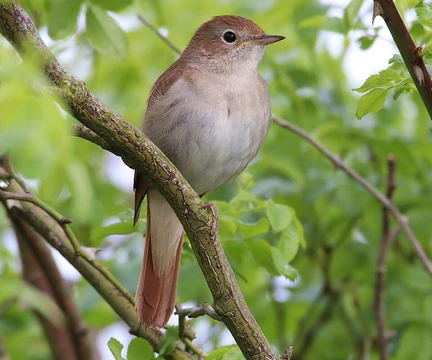
These birds are small, with a long tail and a large head, very similar to their Dartford warbler relatives. They are entirely grey, unlike the Dartford’s brick-red belly.
Adult males have dark patches on the forehead and between the eye and bill. Their legs and iris are red, and they sing a fast rattle. Young birds have a dark iris and a paler throat than young Dartford warblers, which can cause confusion.
More in Wintering Birds of Africa
Test yourself
Three questions drawn from this entry’s sources. Pick an answer to check it.
Answers checked against the source article
Sources
Compiled from Wikipedia and the sources listed below. Text from Wikipedia is available under CC BY-SA 4.0; this entry is adapted from it.
- Wikipedia: Marmora's warbler (CC BY-SA 4.0).
- Conservation status: IUCN Red List assessment.
- Occurrence records: GBIF (CC0 / CC BY). Basemap: Natural Earth (public domain).
- Word definitions: the , each quoted from its Wikipedia article.
Spotted an error? Know more?
Reader corrections go straight into our review queue. Suggest an edit · How this site is sourced