FC Bayern Munich
The most successful club in German football history.

Ank Kumar · CC BY-SA 4.0
Fußball-Club Bayern München e. V. (FCB), commonly known as Bayern Munich, FC Bayern or simply Bayern, is a professional sports club based in Munich, Germany. They are most known for their men's professional football team, who play in the Bundesliga, the top tier of the German football league system. Bayern are the most successful club in German football and are among the world's most decorated, having won a record 35 national titles, including eleven consecutive titles from 2013 to 2023 and a record 21 national cups, the DFB-Pokal, alongside one of the highest number of top European titles.
Quick Facts
- Rivalry designation
- Der Klassiker (Bundesliga top-of-table clash)
- Werder home ground
- Weserstadion, Bremen (on the banks of the River Weser, home since 1924)
- Rival home ground
- Allianz Arena, Munich
- Defining werder era
- 2003–04 season ('Wunder von Bremen') – Bundesliga champions & DFB-Pokal winners
- Colour contrast
- Green & White (Werder) vs Red & White (Bayern)
- Rival's title dominance
- Most Bundesliga titles in German football history (30+)
Lore & Background
Bayern Munich was founded in 1900 by eleven players, led by Franz John. Although Bayern won its first national championship in 1932, the club was not selected for the Bundesliga during its inception in 1963. The club found success in the mid/late-1960s, but the pinnacle came in the 1970s under the captaincy of Franz Beckenbauer, as they won the European Cup three consecutive times (1974–1976). Overall, Bayern have won six European Cup/UEFA Champions League titles (a German record), winning their sixth title in the 2020 final as part of the Treble, and it became the second European club to achieve this feat twice.
Furthermore, the club is one of five teams that have earned the right to keep the trophy and to wear a multiple-winner badge. The club has reached the final of the European Cup/UEFA Champions League 11 times, a joint second-most of any club in the history of the competition and is also second placed in numbers of semi-final appearances with 22. Bayern has also won one UEFA Cup, one European Cup Winners' Cup, two UEFA Super Cups, two FIFA Club World Cups and two Intercontinental Cups, making it one of the most successful European clubs internationally, and the only German club to have won both international titles.
Bayern players have accumulated five Ballon d'Or awards with multiple players coming in the second position in the award, two The Best FIFA Men's Player awards, six European Golden Shoe and three UEFA Men's Player of the Year awards, including UEFA Club Footballer of the Year. The club had at least one player in eleven consecutive FIFA World Cup finals from 1986 to 2022. By winning the 2020 FIFA Club World Cup, Bayern Munich became only the second club to win the 'sextuple' (winning the League, Cup, and Champions League in one season followed by the Domestic Supercup, UEFA Supercup and Club World Cup in the next season), or all trophies that a club can win in a calendar year.
Bayern Munich is one of five clubs to have won all three of UEFA's main club competitions and the only German club to achieve that. The club has traditional local rivalries with 1860 Munich and 1. FC Nürnberg. The rivalry it has with Borussia Dortmund is known as Der Klassiker.
Reader's Guide
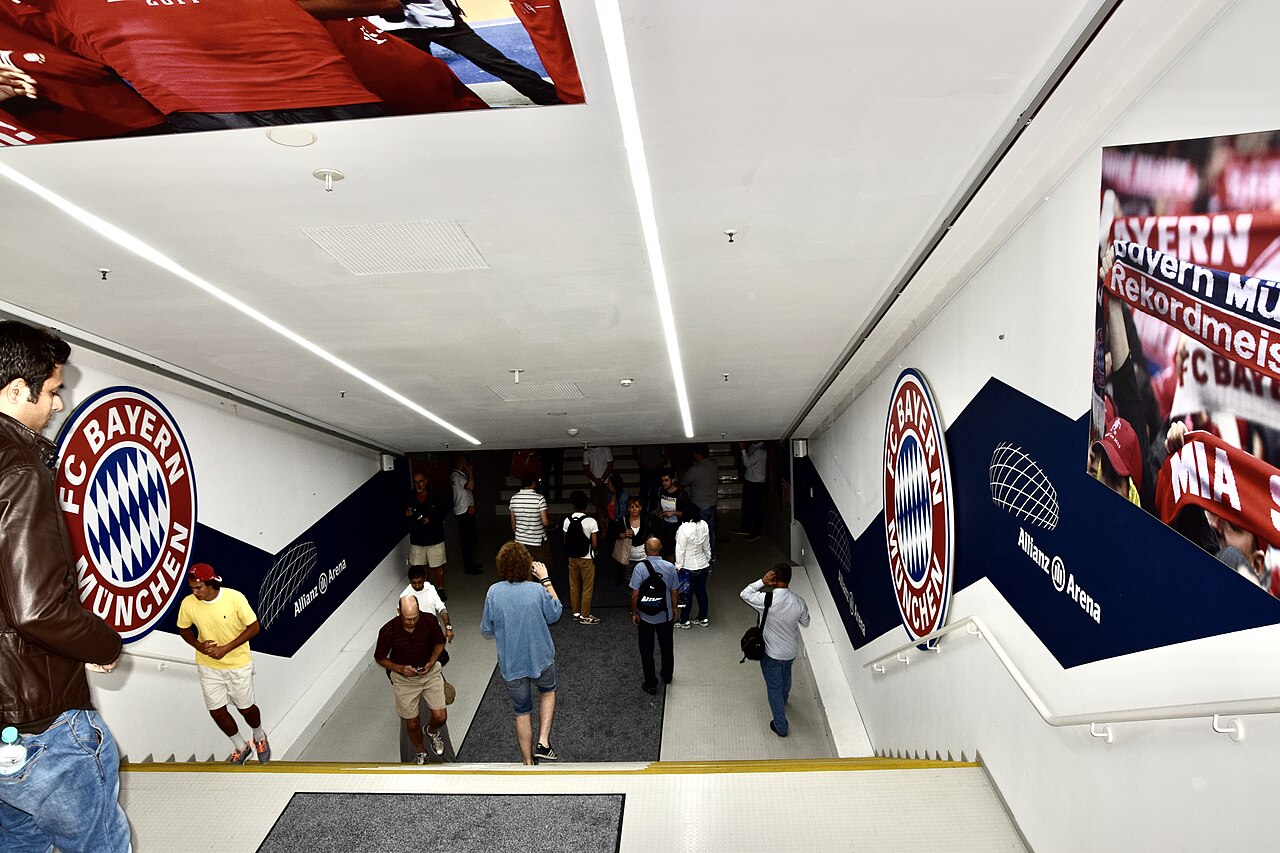
Bayern Munich is one of the most widely supported football clubs in the world, and in November 2025, Bayern had more than 432,500 official club members, and 4,425 officially registered fan clubs, with over 328,564 members, making the club the largest sports club in the world by membership. The club has other departments for chess, handball, basketball, gymnastics, bowling, table tennis and senior football, with more than 1,500 active members. Since the beginning of the 2005–06 season, Bayern has played its home games at the Allianz Arena.
Previously, the team had played at Munich's Olympiastadion for 33 years. The team colours are red and white, and the crest shows the white and blue flag of Bavaria. Bayern Munich has the largest revenue out of any German sports club and is one of the highest-earning football clubs in the world. Bayern earned a record breaking €978.3 million in the 2024–25 season.
A Century of Youth Development
The FC Bayern Munich Junior Team traces its roots back to 1902, making it one of the longest-running youth structures in German football. A major reorganization came in 1995, reshaping how the club approached player education. Yet the most ambitious chapter began in 2006, when the club acquired land adjacent to the Allianz Arena to construct a dedicated youth campus. After years of internal debate and resistance, construction finally commenced in 2015 on a project estimated at seventy million euros.
The driving rationale was twofold: the old facilities had simply outgrown their capacity, and despite Bayern's dominance at the senior level, the club recognized it was falling behind rivals in youth competitiveness across Germany and Europe. The new campus was slated to open for the 2017–18 season. In a more recent development, Michael Wiesinger took on the role of head of sport and youth development at the FC Bayern Campus on 21 April 2026, signaling continued investment in the next generation.
Life at the Academy
The Junior Team operates under a clear guiding principle: to develop young players capable of sustaining Bayern's global standing in club football into the coming century, with the explicit goal of maintaining the finest youth development program in the sport. The day-to-day setup reflects that ambition. One hundred and sixty-five players are guided by sixteen instructors and managers, alongside a physiotherapist and a masseur. From the D Juniors age group upward, the squad trains in a 4–3–3 system, and each youngster is focused on no more than one or two positions, whether in goal, defence, midfield, or attack.
A distinctive feature of the campus is that first-team and youth squads share the same training grounds on Säbener Straße. For players aged fifteen to eighteen who live too far to commute, a residence building offers up to fourteen single rooms. A dedicated staff member rises each morning to wake the residents, prepare a breakfast buffet, and address whatever issues arise. Up to eight part-time teachers are also available to help young athletes stay on track academically.
Finding the Next Generation
Bayern's scouting network stretches across the globe, yet the bulk of recruitment happens within a few hours' drive of Munich. Legends such as Philipp Lahm, Thomas Müller, Holger Badstuber, Thomas Hitzlsperger, Christian Lell, and Andreas Ottl all hail from the city or its seventy-kilometer radius. To widen the net, the club introduced Talent Days, weekend events where as many as five hundred boys are assessed over three twenty-minute five-a-side matches on reduced pitches.
Scouts evaluate how candidates handle the ball, their dribbling quality, and their vision. On average, roughly seven of those five hundred earn a place in the Junior Team. The events have attracted worldwide attention, drawing participants from Austria, France, Italy, Egypt, Slovenia, Slovakia, and even Australia. Since 2003, Bayern has also cultivated partnerships with clubs including SpVgg Unterhaching, Ingolstadt 04, Kickers Offenbach, and Ulm 1846 as elite partners, alongside regional and local affiliates.
Udo Bassemir oversees these relationships. Rather than immediate transfers, promising players are allowed to train at both their home club and Bayern's facilities until the timing feels right.
A Pedigree of Champions
The Junior Team's ultimate measure of success is the caliber of players it sends into the world game. The academy's graduates have collectively claimed two World Cup-winning captaincy roles, eleven World Cup titles, five European Championship medals, thirteen European Cup or Champions League trophies, and five UEFA Cup or Europa League winners' medals. At the youth level, the record is equally impressive: the Under-19 side captured the Bundesliga in 2001, 2002, and 2004, while the Under-17 team lifted the domestic title in 1989, 1997, 2001, 2007, and 2017.
Bavarian state championships span from 1950 through the mid-1990s, and regional South/Southwest German titles have been secured in multiple years across both age groups. The penultimate rung before the first team is Bayern Munich II, which competes in the Regionalliga Bayern, the fourth tier of German football. Jochen Sauer serves as director of the youth setup, overseeing the pipeline that has consistently fed talent into one of the most decorated clubs on the planet.
Gallery
Frequently Asked Questions
What does "Der Klassiker" mean for Werder Bremen?
It is the traditional label for the top-of-table Bundesliga fixture between Werder and Bayern Munich. For Bremen supporters, it represents the recurring test of whether the club can challenge a rival that has held the league's title count for decades.
What is Werder Bremen's defining moment in this rivalry?
The 2003–04 season, widely remembered as the "Wunder von Bremen," when the club captured both the Bundesliga championship and the DFB-Pokal in a single campaign. That double still stands as the highest point in Werder's history and the clearest proof that Bremen could compete at the very top of German football.
Where do Werder host their matches against Bayern Munich?
Home fixtures take place at the Weserstadion, situated on the banks of the River Weser in Bremen. The geographic contrast with Bayern's Allianz Arena in Munich adds a cultural layer to the rivalry, often described as the Weser against the Isar.
What is the colour contrast between the two sides?
Werder Bremen plays in green and white, while Bayern Munich wears red and white. That green-versus-red clash on the pitch has become an instantly recognisable visual shorthand for the rivalry itself.
Why is the Bayern rivalry so central to Werder Bremen's identity?
For most of the club's history, Bayern's sustained dominance set a ceiling that Bremen could see but rarely break through, turning every meeting into a small act of defiance. The rivalry has shaped the city's football culture and given the fanbase a shared narrative of underdog determination.
More in Great Rivalries
Elsewhere in Werder Bremen
Spotted an error? Know more?
Reader corrections go straight into our review queue. Suggest an edit · How this site is sourced