
Arloff Castle
Early Gothic water castle on the Erft border.
Last updated

via Wikipedia: Arloff Castle · see source
Where it is
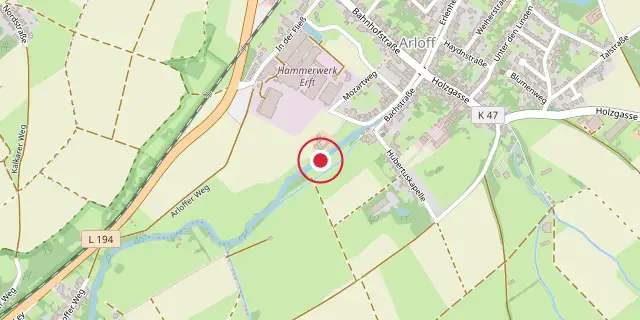
Coordinates: 50°35′31″N 6°47′13″E (50.5920, 6.7870) · Open in OpenStreetMap
Coordinates and connected clubs: the infobox of Wikipedia: Arloff Castle (CC BY-SA 4.0). Map: drawn by Codexery from OpenStreetMap tiles.
Arloff Castle, also known as Burg Arloff, sits along the Erft River in the village of Arloff, which belongs to the town of Bad Münstereifel in North Rhine-Westphalia. Though its buildings now appear unremarkable, this former water castle is a rare and well-preserved example of an Early Gothic fortification, making it typologically significant for the Rhineland. Originally, moats fed by the Erft surrounded it. During the Middle Ages, its position on the border between the Electorate of Cologne and the County of Jülich gave it strategic importance.
History
Arloff Castle is first recorded in 1278. The castle and its associated estates belonged at that time to Gerlach of Dollendorf, whose family, the "nobles of Dollendorf", resided at their family seat of Dollendorf-Schloßthal Castle near Blankenheim from 893 to the mid-15th century. At that time the Dollendorfs were one of the oldest and richest noble houses in the region. Gerlach, whose estate in Arloff in 1278 was enfeoffed to him by the Archbishop of Cologne, Siegfried, had already been forced to do likewise with the castle and its estates belonging to the Dollendorfs in the neighbouring village of Kirspenich.
The balance of power changed ten years later, when the Jülichs stood on the side of the victors against "Siegfried" in the Battle of Worringen (1288). The Count of Jülich, who was one of the victorious allies, succeeded him as liege but had little interest in the small castle. In order to prevent disputes over the castle, its owner was appointed to the council (Landtag) of both principalities. This compromise was sustainable for the next 500 years.
In the 15th and 16th centuries, the lords of Mirbach were the owners of Arloff Castle; they were succeeded in the 17th century by the von Friemersdorfs. In 1865, Werner Dietrich of Friemersdorf, called Pützfeld, sold his allodial knight's seat, along with its mill and appurtenances (Appertinentien) to Philip William of Mockel, Mayor of Cologne. He had an existing dwelling converted into a tenant's house; he himself owned Arloff Castle until 1712.
Wohnturm
Central to the castle is the uniquely preserved residential tower (Wohnturm) from 1269. This three-storey structure, built of rubble stone and now plastered, was erected over an older, originally smaller cellar with a barrel vault. Dendrochronological analysis of the original timber, which is in good condition, determined that the wood was felled in autumn 1269 and worked in 1270, verifying the construction date for most of the tower. Only two upper floors appear to have been inhabited, as they have relatively large windows, unlike the top floor with narrow slits.
The 18th-century roof resembles that of the sister castle in Kirspenich. A Baroque dwelling from 1699, also of rubble stone, was placed next to the tower beside a building that may have served as a zwinger from the 15th to 16th century. The tower once stood free and was secured by water ditches, suggesting a former connection to the nearby Erft, where the old mill belonging to the castle owner still lies.
More in Water Castles in North Rhine-Westphalia
Sources
Compiled from Wikipedia and the sources listed below. Text from Wikipedia is available under CC BY-SA 4.0; this entry is adapted from it.
- Wikipedia: Arloff Castle (CC BY-SA 4.0).
Spotted an error? Know more?
Reader corrections go straight into our review queue. Suggest an edit · How this site is sourced