Frequently Asked Questions
The most-asked questions about virtual reality games.
What exactly are virtual reality games?
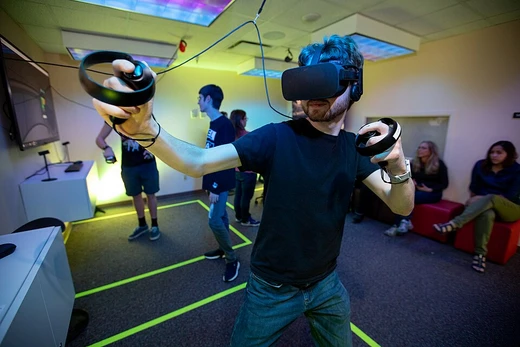
Virtual reality games are interactive experiences where the player wears a headset that tracks head and hand movements, placing them inside a three-dimensional world that responds to their physical actions. Unlike traditional screen-based gaming, the player's real-world body movements translate directly into the virtual space.
What hardware do I need to get started?
The most accessible entry point is a standalone headset like the Meta Quest 3, which requires no external PC or sensors and runs games on its own processor. For higher fidelity, PC-tethered options connect a headset to a gaming computer via cable or Wi-Fi to offload rendering to a dedicated GPU.
What are the best games for a first-time VR player?
Titles like Beat Saber, Superhot VR, and The Walking Dead: Saints & Sinners are frequently recommended because they have short learning curves and immediately showcase why immersive movement feels different from flat-screen play. Many players also start with a free or cheap title to test whether they are comfortable wearing a headset for extended sessions.
Who are the most influential developers in the VR gaming space?
Studios such as Valve (Half-Life: Alyx), Beat Games (Beat Saber), and Skydance Interactive (The Walking Dead: Saints & Sinners) are often cited as setting the quality benchmark for the medium. On the hardware side, Meta and Sony have shaped which platforms dominate consumer VR gaming.
What is the difference between standalone and PC-tethered VR?
Standalone headsets contain their own processor, storage, and display, so they work independently of any computer. PC-tethered setups stream the game from a desktop PC to the headset, generally delivering higher graphical fidelity at the cost of a more complex setup and a required graphics card.
Why do some people get motion sickness in VR?
Discomfort typically arises when the visual sense of motion conflicts with the inner ear's lack of corresponding physical movement, a mismatch the brain interprets as nausea. Reducing the effect usually involves enabling a fixed reference point, playing in well-lit rooms, and gradually increasing session length rather than jumping into fast-paced titles immediately.
What genres work best in virtual reality?
Rhythm games, first-person shooters, and immersive narrative experiences tend to shine because VR's spatial presence and physical interaction add a layer that flat screens cannot replicate. Open-world exploration and cooperative multiplayer also perform well, while fast vehicular or large-scale strategy games can be more challenging to design comfortably.
What are some landmark moments in VR gaming history?
The 2016 launch of the Oculus Rift and HTC Vive is widely regarded as the start of the modern consumer VR era, replacing clunkier early attempts with comfortable room-scale tracking. Valve's 2020 release of Half-Life: Alyx is often called the defining proof that a AAA studio could build a narrative VR experience on par with its non-VR counterparts.
How do VR games track my hands and movements?
Most modern systems use inside-out tracking, where cameras on the headset itself detect the position of the device and attached controllers in real time. Some headsets also incorporate hand-tracking sensors that read finger and palm positions, allowing players to interact without controllers at all.
Can I play VR games with other people?
Yes—many titles include local multiplayer where players share the same physical room, and a growing number support online multiplayer with friends over the internet. Social platforms like VRChat and Rec Room are built entirely around multiplayer interaction, while competitive shooters such as Onward and Pavlov focus on team-based play.