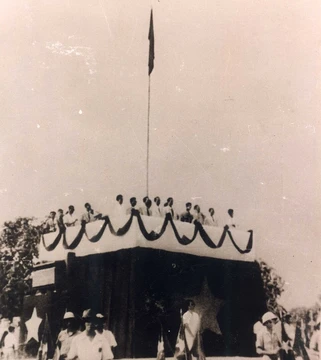
Assassination of Alfred François Bazin
A killing that crippled the Vietnamese Nationalist Party.
On February 9, 1929, the Vietnamese Nationalist Party (VNQDĐ) killed French labour recruiter Alfred François Bazin in Hanoi. This act triggered harsh French reprisals that crippled the young revolutionary movement and set back its fight against colonial rule, ultimately dooming the party.
Quick Facts
- Date of assassination
- February 9, 1929
- Location
- 110 route de Huế, Hanoi
- Victim
- Alfred François Bazin
- Perpetrator
- Nguyễn Văn Viên (with an accomplice)
- Number arrested
- between three and four hundred
- Number convicted
- 78
- Sentences
- between five and twenty years in prison
Facts from the source article.
Biography
The story of Alfred François Bazin’s assassination first appeared in a 1930 book by Paul Monet, a wounded French veteran who, after visiting Vietnam, coined the slur “jaunier” (yellow-slave-trader) by analogy with “négrier.” Monet described Bazin as a graduate of Paris’s École coloniale who became a labour-recruitment supervisor in French Indochina. Since 1883, Vietnam had been a French colony, part of Indochina with Laos and Cambodia. Bazin and other recruiters used Vietnamese foremen to find plantation workers, often through beatings or coercion, since foremen earned a commission per recruit. Labourers were sent to southern Vietnam or distant colonies like the New Hebrides, where conditions were poor and pay low; many Vietnamese believed recruits would never return. French authorities refused to intervene, arguing recruitment was unofficial and helped ease overcrowding in the Red River Delta.
Death
Alfred Bazin had come to symbolize the abuses of the recruitment system among Annamite workers. Within the VNQDĐ, a group led by Nguyễn Văn Viên suggested assassinating him. Nguyễn Thái Học, the party leader, opposed the killing as pointless and likely to provoke a crackdown. Turned down by the leaders, Nguyễn Văn Viên made his own plan and, with an accomplice, shot and killed Bazin as he left the home of his mistress Germaine Carcelle at 110 route de Huế on February 9, 1929. The killing was seen as the first major attack carried out by the movement.
French reaction
As Nguyễn Thái Học had predicted, the French authorities apprehended all known VNQDĐ members they could track down, including a young naturalised Frenchman named Léon Sanh. Sanh confessed but later retracted, claiming only to be a bystander, and implicated Nguyễn Văn Viên as his alleged accomplice. Viên was captured but later committed suicide in prison. Between three and four hundred men were rounded up, including government clerks, officials, schoolteachers, merchants, landowners, and military personnel. Seventy-eight men were convicted and sentenced to five to twenty years in prison; Sanh was acquitted. The arrests severely depleted the VNQDĐ leadership, and Học and Nguyễn Khắc Nhu were among the few who escaped. The pressure led the party to engage in overt violent struggle, culminating in the Yên Bái mutiny of 1930, which resulted in many executions and decapacitated the party as a major threat.
More in Vietnamese Independence Movement
Spotted an error? Know more?
Reader corrections go straight into our review queue. Suggest an edit · How this site is sourced