Multiplayer online battle arena
Team up, control a hero, and destroy the enemy base in this strategic real-time combat genre.

Sssine21 · CC0
Multiplayer online battle arena (MOBA) is a strategy game subgenre where two teams fight on a set battlefield, each player controlling a single hero with unique abilities that get stronger over time. The main goal is to destroy the enemy team's main base while protecting your own, though some games also allow victory by defeating all enemy players. Matches rely on teamwork, tactical decisions, and real-time action. Computer-controlled minions spawn in waves and march along fixed paths toward the enemy base, which is protected by defensive towers. Players can help their minions or kill enemy waves to control lanes and apply map pressure. MOBAs grew out of real-time strategy games but removed base-building and unit production to focus on player-versus-player combat. The genre mixes real-time strategy, role-playing, and action elements, blending strategic depth with character progression and fast fights.
Lore & Background
The first widely accepted game in the genre was Aeon of Strife (AoS), a fan-made custom map released in 2002 for StarCraft, in which four players each control a single powerful unit and, aided by weak computer-controlled units, compete against a stronger computer. Defense of the Ancients (DotA) was created in 2003 by the Warcraft III modding community for Warcraft III: Reign of Chaos and its expansion, The Frozen Throne, with a map based on AoS. DotA was one of the first major titles to establish the core mechanics of the MOBA genre, serving as a direct inspiration for later titles, and the first MOBA for which sponsored tournaments were held. It was followed by two spiritual successors, League of Legends (2009) and Heroes of Newerth (2010), a standalone sequel, Dota 2 (2013), and other games in the genre, including Smite (2014) and Heroes of the Storm (2015).
Reader's Guide
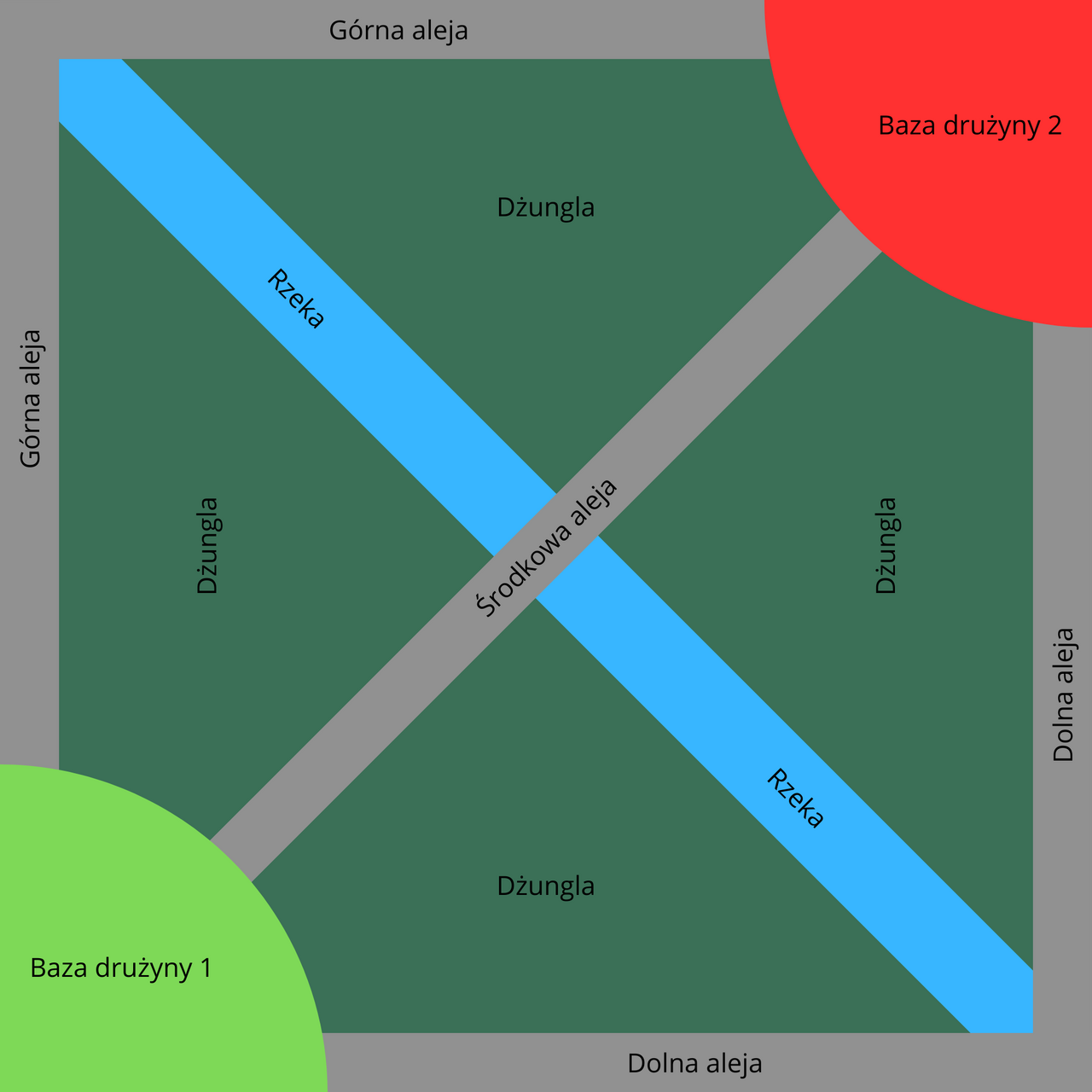
Each match starts with two opposing teams, typically with five players each. Players work together as a team to achieve the ultimate victory condition, which is to destroy their enemy's base whilst protecting their own. Both teams usually have their main structures placed on opposite sides of the battlefield. The first team to destroy the opponents' main structure wins the match, though some games have the option of different victory conditions. Destroying other structures in the enemy's base may provide other benefits. Defensive structures, usually automatic 'towers', are in place to prevent this. Each team is assisted by relatively weak computer-controlled units, called 'minions', that periodically spawn in groups at both bases, marching down predefined paths (called 'lanes') toward the enemy base. While minions naturally engage opposing forces, players can support them to increase their effectiveness in pushing through enemy defenses. There are typically three 'lanes' on the battlefield that serve as primary paths between bases. The lanes are known as top, middle and bottom lane, or, in gamer shorthand – 'top', 'mid' and 'bot'. Between the lanes is an uncharted area called 'jungle'. The 'jungle' is home to neutral monsters hostile to both teams and appear in marked locations on the map known as 'camps'. Defeating these monsters grants various benefits to the players and their team, such as growth in power, temporary buffs, or assistance in pushing the lane. Effective control over lanes and jungle objectives is crucial for maintaining map pressure and dictating the flow of the match. The games are usually played on a battlefield shown from an isometric perspective, but certain MOBAs are played from a third-person or side-view perspective. The battlefield is represented in the interface by the mini-map. A player controls a single powerful in-game unit, known as a 'hero' or 'champion,' with a distinctive set of abilities and a unique playstyle. Heroes gain experience points and gold by being near defeated enemies or delivering the killing blow. Experience allows them to level up and enhance abilities, while gold is used to purchase items that improve their power. Most heroes have four abilities that can be upgraded as they progress.
From Modding Communities to a Defining Genre
The MOBA genre did not arrive fully formed. It grew out of the real-time strategy tradition, specifically from fan-created custom maps that stripped away the broader RTS toolkit—no building construction, no unit production—and instead focused the experience almost entirely on player-versus-player combat. The earliest widely recognized entry was Aeon of Strife, a 2002 StarCraft custom map in which four players each commanded a single powerful unit against a computer-controlled enemy force. A year later, the Warcraft III modding community built upon those ideas to produce Defense of the Ancients, a map for Reign of Chaos and The Frozen Throne that crystallized many of the mechanics we now associate with the genre. DotA became the first MOBA to attract sponsored tournaments and served as a direct blueprint for what followed. That lineage produced League of Legends in 2009, Heroes of Newerth in 2010, the standalone Dota 2 in 2013, Smite in 2014, and Heroes of the Storm in 2015. In the process, the genre fused strategic depth from RTS with character progression borrowed from role-playing games and the fast tempo of action titles, creating a hybrid that had no direct predecessor.
The Architecture of a Match
A typical MOBA match pits two teams of five players against each other on a structured battlefield, usually viewed from an isometric angle and summarized for quick reference by a mini-map in the interface. The two bases sit on opposite ends of the map, connected by three primary corridors known as top, middle, and bottom lanes. Between those corridors lies the jungle, an uncharted region where neutral monsters wait in marked camps; defeating them grants power growth, temporary buffs, or lane-pushing assistance to the team that claims them. At both bases, waves of relatively weak computer-controlled minions spawn on a regular schedule and march down the lanes toward the enemy side. Players can bolster their own minion waves or eliminate the opposing ones to shift lane control. Automatic defensive towers guard each base, and the ultimate victory condition is to tear down the enemy's main structure while keeping your own intact. Some titles offer alternative win conditions, such as eliminating every opposing player, but the core loop of lane pressure, jungle objectives, and base destruction remains the genre's backbone.
Heroes, Roles, and the Discipline of Teamwork
Each player commands a single hero or champion, a unit with a distinctive set of abilities—typically four—that can be upgraded as the match unfolds. Progression is driven by two resources: experience points, earned by being near defeated enemies or landing the killing blow, which allow level-ups and ability enhancements, and gold, used to purchase items that further boost power. If a hero's health reaches zero, the player is removed from the field until a respawn timer expires, and that timer lengthens as the game progresses and heroes level up. Heroes are generally sorted into roles such as tank, damage dealer, and support, each with its own design philosophy, strengths, and weaknesses. Rosters are large and keep growing; League of Legends, for example, launched with forty characters, reached one hundred by 2012, and surpassed one hundred and fifty by 2020. Players often develop a "main"—a hero they excel at—while learning the wider roster. Crucially, no single hero is designed to carry a match alone. The genre deliberately rewards players who coordinate with teammates, execute shared strategies, and leverage each other's abilities to unlock a level of impact that no individual could achieve in isolation.
From Niche Tournaments to a Global Spectacle
The MOBA genre has been one of the principal engines behind the rise of competitive esports. By the early 2010s, it had firmly established itself as a major pillar of the competitive gaming landscape. The financial scale grew dramatically: by 2018, MOBA-related prize pools had climbed past sixty million US dollars, representing roughly forty percent of all esports prize money awarded that year. Professional tournaments are staged in arenas capable of seating tens of thousands of live spectators, while simultaneously being broadcast to online audiences through streaming platforms. The depth of the fanbase created a fertile environment for sponsorship and advertising deals, which in turn funded larger events and higher stakes. What began as a modding community holding small, self-organized competitions—DotA was the first MOBA to field sponsored tournaments—evolved into a global cultural phenomenon. The genre's combination of strategic depth, individual mechanical skill, and team coordination gave it a natural fit for the spectator-friendly, narrative-driven format that esports demands, cementing its place at the center of competitive gaming culture.
Gallery
Frequently Asked Questions
What is a MOBA in simple terms?
A MOBA is a strategy subgenre in which two teams each control a single hero with unique abilities on a fixed, structured map. The core loop is to push through waves of computer-controlled units and ultimately destroy the enemy's central base while defending your own.
How do you actually win a MOBA match?
The standard victory condition is destroying the opposing team's main structure at the far end of the map, though some titles also let you win by wiping out every enemy player. Winning depends on coordinated team strategy, real-time combat decisions, and the fact that your hero's abilities grow stronger the longer the game lasts.
How does a MOBA differ from a traditional real-time strategy game?
Where an RTS player commands an entire army and manages resources, a MOBA limits each player to one hero and removes the resource-gathering layer entirely. The genre instead blends RPG-style character progression with action combat, shifting the skill focus to individual execution and team coordination on a set map.
What roles do heroes typically fill in a MOBA?
Heroes are designed to occupy distinct team functions such as frontline tank, ranged damage dealer, or support, each with a unique kit of abilities that scale over the course of a match. This variety lets the two teams build contrasting compositions, making tactical matchups a central part of the genre's appeal.
More in Video Game Genres
Spotted an error? Know more?
Reader corrections go straight into our review queue. Suggest an edit · How this site is sourced