
Entex Adventure Vision
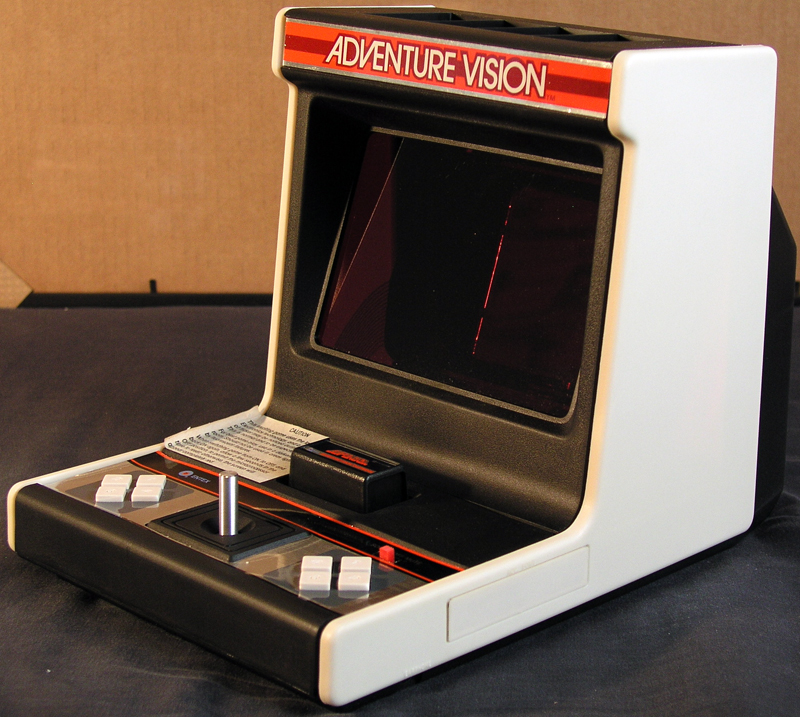
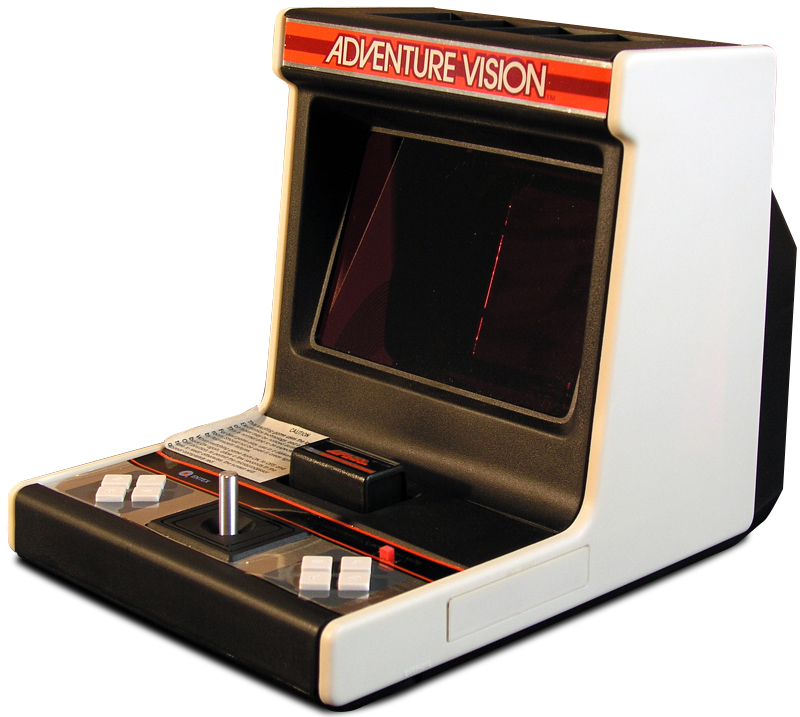
A portable console with a spinning mirror and red LED display.

Rik1138 · CC BY-SA 4.0
The Entex Adventure Vision is a cartridge-based video game console released by Entex Industries in either August or October 1982. It is notable for its unique display technology, using a single vertical line of 40 red LEDs combined with a spinning mirror to create a 150×40 pixel monochrome red image through persistence of vision. The system is entirely self-contained in a portable unit, including the monitor, game controls, and computer hardware.
Quick Facts
- Manufacturer
- Entex Industries
- Generation
- Second generation
- Discontinued
- 1983
- Cpu
- Intel 8048 @ 733 kHz
- Media
- ROM cartridge
- Units Sold
- 50,757
- Predecessor
- Entex Select-A-Game
- Sound
- National Semiconductor COP411L @ 52.6 kHz
- Memory
- 64 bytes, 1K
- Display
- 150 x 40 monochrome oscillating red LED display
- Dimensions
- 13.25 x
- Price
- $79.95
Facts from the source article.
Lore & Background
The Adventure Vision was Entex's second-generation system, following the Entex Select-A-Game released a year earlier in 1981. Control is through a single multi-position joystick and two sets of four buttons, one on each side of the joystick, for ease of play by both left- and right-handed players. Rather than using an LCD screen or an external television set like other systems of the time, the Adventure Vision uses a single vertical line of 40 red LEDs combined with a spinning mirror inside the casing. To produce the image, the LEDs flash in patterns representing sequential vertical segments of a virtual projected screen, precisely timed to the rotation speed of the mirror. The light patterns shine on the mirror and are reflected at specific angles into the player's eyes, with each segment appearing to blend into a single image through persistence of vision. The mirror motor draws a great deal of power from the batteries, which can be avoided by using the built-in AC adapter.
Entex released four Adventure Vision games, all of them ported from arcades: Defender (originally by Williams Electronics), Super Cobra (originally by Konami), Turtles (originally by Konami), and Space Force (originally by Venture Line, similar to Asteroids). The system includes an expansion port and measures 13.25 x 10 x (dimension incomplete in notes).
Reader's Guide
The Adventure Vision's significance lies in its unusual mechanical display method, which was later used in a similar form by Nintendo in the 1995 Virtual Boy. Because of the moving parts used by the system, many units no longer work, with an estimated 100 known operational units left. The system is supported by the MESS emulator and AdViEmulator. On March 31, 2013 at the Revision demoparty, the first-ever homebrew/demo ROM for the system was demonstrated by MEGA - Museum of Electronic Games & Art. MEGA also released the source code for the demo as well as all development tools. The system's legacy is tied to its rarity and the technical challenge of preserving its unique hardware, with a small but dedicated community maintaining emulation and homebrew development.
Did You Know?
- The Adventure Vision uses a spinning mirror and 40 red LEDs to create a 150×40 pixel image through persistence of vision.
- Only four games were released for the system, all arcade ports.
- Approximately 10,000 units were produced, with an estimated 100 still operational.
- The first homebrew demo for the system was shown at the Revision demoparty on March 31, 2013.
Gallery
Frequently Asked Questions
What is the Entex Adventure Vision?
It is a fully portable, cartridge-based console built by Entex Industries and shipped in late 1982. The screen, controller, and processing hardware all live inside one handheld unit, with no external monitor or power adapter required.
How does the Adventure Vision's spinning-mirror display actually work?
A single vertical column of 40 red LEDs is swept across the screen by a small rotating mirror, painting a 150×40 pixel image line by line. Your brain stitches those rapid sweeps together through persistence of vision, producing what looks like a steady red picture.
What CPU and memory does the Adventure Vision use?
The system is driven by an Intel 8048 microprocessor running at 733 kHz, with 1 KB of RAM on the main board plus 64 bytes tucked inside the chip itself. Each cartridge holds 4 KB of ROM for the game code.
When was the Adventure Vision released and how much did it cost?
Entex put the console on shelves in either August or October 1982 at a launch price of $79.95. It was sold as a self-contained portable gaming device, a category that was still very new at the time.
Why do retro-gaming fans still talk about the Adventure Vision?
It predates the Game Boy by several years and is one of the first genuinely portable cartridge consoles ever sold. Its one-of-a-kind spinning-mirror LED screen makes it a fascinating engineering footnote in the history of handheld gaming.
More in Video Game Consoles by Generation, Part 5 1-24
Spotted an error? Know more?
Reader corrections go straight into our review queue. Suggest an edit · How this site is sourced