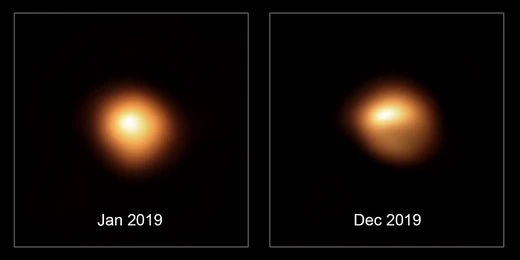
GD 66
A DAV white dwarf with disputed planetary timing signals.

GD 66, also designated V361 Aurigae, is a pulsating white dwarf star of type DAV located 186 light years from Earth in the constellation Auriga. It is notable for its extremely stable pulsation period and for the controversy surrounding proposed planetary timing variations.
- Designation
- GD 66 / V361 Aurigae
- Constellation
- Auriga
- Distance
- 186 light years
- Mass
- 0.64 solar masses
- Type
- DAV pulsating white dwarf
- Cooling age
- 500 million years
- Estimated total age
- 1.2 to 1.7 billion years
Lore & Background
GD 66 was discovered to be a variable star in 1983 by Noël Dolez et al. using photometric data from Haute-Provence Observatory, and received its variable star designation V361 Aurigae in 1985. The star is a pulsating white dwarf of type DAV, exhibiting an extremely stable pulsation period. Small variations in the phase of pulsation led to the suggestion that a giant planet was orbiting the star, causing delays in pulsation timing due to reflex motion around the system's center of mass. Observations with the Spitzer Space Telescope failed to directly detect such a planet, placing an upper mass limit of 5–6 Jupiter masses. Investigation of a separate pulsation mode revealed timing variations in antiphase with the originally analyzed mode, which would not occur if caused by an orbiting planet. This indicates the timing variations have a different origin, illustrating potential pitfalls in using white dwarf pulsation timing to detect planets.
Reader's Guide
GD 66's significance lies in its role as a cautionary example in the search for exoplanets around white dwarfs. The initial interpretation of its pulsation timing variations as evidence of a giant planet was later contradicted by the discovery of antiphase variations in a different pulsation mode, which cannot be explained by a single orbiting body. This case underscores the complexity of white dwarf asteroseismology and the need for multiple independent lines of evidence when claiming planetary detections. The star's estimated total age of 1.2 to 1.7 billion years, derived from its cooling age and main-sequence lifetime, provides context for its evolutionary history. The failure of Spitzer to detect the hypothesized planet, combined with the internal inconsistency in timing data, has made GD 66 a textbook example of how stellar pulsation timing can produce false planetary signals. Its legacy is a reminder that even extremely stable pulsators can yield ambiguous results, and that planetary claims from timing must be rigorously cross-checked.
Did You Know?
- GD 66 has a mass of 0.64 solar masses and is located 186 light years away in Auriga.
- Its cooling age is estimated at 500 million years, with a total age of 1.2 to 1.7 billion years.
- The star was discovered to be variable in 1983 by Noël Dolez et al. at Haute-Provence Observatory.
- Spitzer Space Telescope observations placed an upper limit of 5–6 Jupiter masses on any orbiting planet.
Frequently Asked Questions
What is GD 66?
GD 66, also cataloged as V361 Aurigae, is a pulsating white dwarf star roughly 186 light-years from Earth in the constellation Auriga. It is classified as a DAV type, meaning it has a hydrogen-rich atmosphere and exhibits periodic brightness changes driven by internal oscillations.
What makes GD 66's pulsation period so notable?
Astronomers frequently cite GD 66 as one of the most clock-stable pulsating white dwarfs known, with a period that barely drifts over long observation baselines. That exceptional regularity is exactly what makes any proposed deviations in the timing so tantalizing to the research community.
What is the planetary timing controversy surrounding GD 66?
A few studies have suggested that minute irregularities in GD 66's pulsation clock could be the gravitational tug of an orbiting planet, but other researchers argue the signal is too weak or inconsistent to rule out instrumental or stellar noise. No planet has been confirmed, and the debate over whether a real timing anomaly exists remains open.
How old is GD 66 and what is its mass?
GD 66 has a cooling age of approximately 500 million years, placing it in a mid-stage of white dwarf evolution. Its mass sits at about 0.64 solar masses, a fairly standard figure for a hydrogen-atmosphere white dwarf of its spectral class.
Where in the sky can I find GD 66?
Look toward the constellation Auriga, the Charioteer, which is prominent in the northern winter sky. At 186 light-years it is comparatively close for a white dwarf, though resolving it still calls for at least a modest amateur telescope.
More in Variable Stars, Part 5 1-24
Spotted an error? Know more?
Reader corrections go straight into our review queue. Suggest an edit · How this site is sourced