Frequently Asked Questions
The most-asked questions about variable stars, part 2.
What does Part 2 of this variable-star encyclopedia focus on compared to Part 1?
Part 1 introduced the broad categories of variability and the physics behind pulsation and eclipses. Part 2 dives into specific subtypes like cataclysmic variables, long-period giants, and Be stars, plus the human history of how those classes were actually identified.
Who are the central historical figures a newcomer should know?
John Goodricke is credited with correctly explaining Algol's dimming in 1783, while Henrietta Swan Leavitt uncovered the Cepheid period-luminosity relation in the early 1900s. Caroline Herschel's 1780 redisccovery of Mira also anchors the field's early observational tradition.
What's the practical difference between intrinsic and extrinsic variable stars?
Intrinsic variables change brightness because the star itself is pulsating, erupting, or rotating with spots. Extrinsic variables—most commonly eclipsing binaries—vary only because one component periodically blocks the light of the other from our viewpoint.
Which variable stars are the most rewarding first targets for a backyard observer?
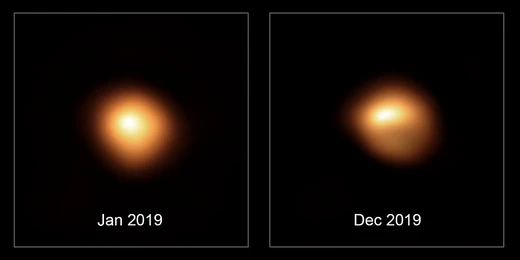
Algol (Beta Persei) and Mira (Omicron Ceti) are classic starting points because they are bright enough for the naked eye and have well-documented histories. Betelgeuse and Polaris add interest for those with a small telescope and a consistent observing schedule.
How does a casual observer actually contribute to variable-star science?
You log the magnitude estimate of a target star at a given time and submit it through a program like the AAVSO or the BAVSO. Thousands of such timed, magnitude-based reports from volunteers worldwide are what allow astronomers to refine light curves and detect new periods.
What makes cataclysmic variables such a dramatic category?
These are white-dwarf systems that accrete material from a companion and can undergo sudden, violent outbursts—novae or dwarf novae—brightening by many magnitudes in days. Recurrent novae like RS Ophiuchi repeat that explosion on a roughly 15-year cycle, making them a long-term observational prize.
Why is the period-luminosity relationship considered a cornerstone of modern astronomy?
Because it lets us read a Cepheid's true brightness directly from how long its pulsation cycle takes, turning the star into a standard candle. This is the first rung in the cosmic distance ladder that ultimately reaches supernovae and the expansion rate of the universe.
What are some landmark 'firsts' in variable-star discovery?
Tycho's 1572 supernova shattered the idea of an unchanging heavens, and Goodricke's 1783 Algol explanation was the first correct physical model for a variable. In 1908, Leavitt's Cepheid relation opened the door to measuring distances to other galaxies.
Where should a beginner start if they want to go beyond reading and actually observe?
Pick two or three bright variables, learn their approximate magnitudes and periods, and begin a simple visual log over several weeks. Registering with the AAVSO gives you structured target lists and a submission portal so your data joins the global dataset.
What are some of the most surprising or 'dramatic' moments a fan will encounter in this field?
Mira's 11-month fade to invisibility and slow return is still startling even to experienced observers, and the 1885 nova in Perseus briefly outshone the entire constellation. More recently, the discovery that many 'pulsating' stars are actually in complex multi-mode oscillation has rewritten textbook descriptions.