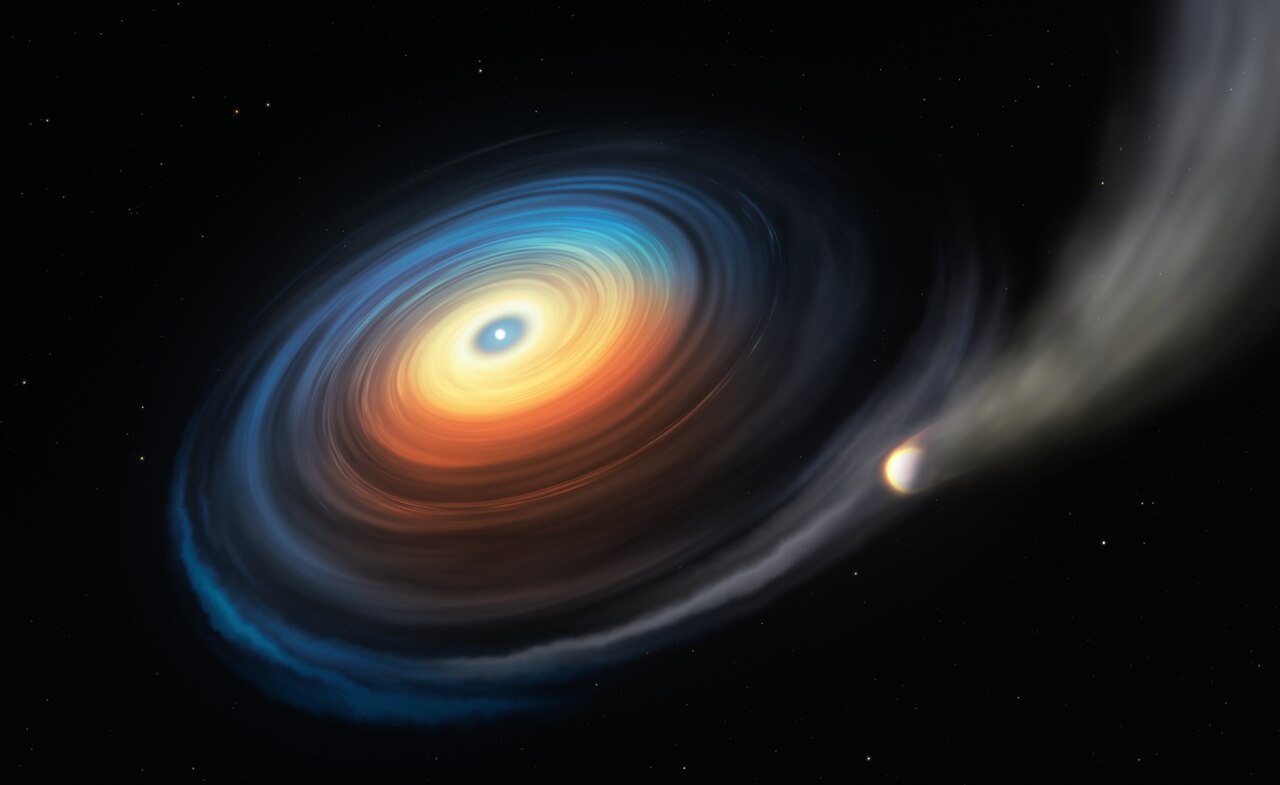
WD J0914+1914
First single white dwarf with an orbiting giant planet.

ESO/M. Kornmesser · CC BY 4.0
WD J0914+1914 is a white dwarf star that hosts a giant planet, the first such single-star system confirmed. Astronomers from the UK, Chile, and Germany found evidence of the planet.
The Sloan Digital Sky Survey (SDSS) first flagged the system as a possible cataclysmic variable due to weak H-alpha emissions. Closer study of the SDSS spectra revealed oxygen and sulfur lines. Follow-up observations using the X-Shooter instrument on ESO's Very Large Telescope confirmed those lines and uncovered additional ones.
Known dusty and gaseous debris disks around white dwarfs usually show strong calcium lines, not H-alpha emission, and come from rocky bodies. The disk around WD J0914+1914 is much larger—roughly 1 to 10 solar radii—too big to have formed from a tidally disrupted minor planet inside the Roche radius. Accretion from a companion star or brown dwarf was also ruled out.
The best explanation is an evaporating giant planet orbiting close to the white dwarf. The star's intense ultraviolet radiation strips the planet's atmosphere. The planet likely sits about 15 solar radii from the white dwarf, completing an orbit every 10 days. The material being accreted resembles deeper layers of the Solar System's ice giants. Over roughly 350 million years, the planet will lose about 0.04 Neptune masses—a negligible fraction—while the white dwarf continues to cool.
- Distance from white dwarf
- about 15 solar radii
- Orbital period
- 10 days
- Disk size
- ~1-10 solar radii
- Mass loss rate
- about 0.04 Neptune masses over 350 million years
- Discovery team origin
- UK, Chile and Germany
Lore & Background
The system was initially identified as a cataclysmic variable on the basis of weak H-alpha emissions in the spectrum by the Sloan Digital Sky Survey (SDSS). After closer inspection the team of astronomers discovered oxygen and sulfur lines in the SDSS spectra. The team then obtained spectroscopic follow-up observations with X-Shooter on ESO's Very Large Telescope. The spectra confirmed the previous observations by SDSS and found additional lines.
Dusty and gaseous debris disks around white dwarfs are known, but they are dominated by calcium lines and no previous disk around a white dwarf showed Hα emission. All previous disks around white dwarfs originate from rocky planetary bodies. The size of the disk around WD J0914+1914 was measured with the help of Doppler-broadbanded emission lines. The disk around the white dwarf is too large (~1-10 solar radii) to be formed by a small minor planet, which was tidally disrupted inside the Roche Radius. The team was also able to exclude accretion of material from a companion star or brown dwarf.
The most plausible explanation is an evaporating giant planet, orbiting close to the white dwarf. The atmosphere of the planet is evaporated by the strong ultraviolet radiation of the hot white dwarf. The composition of the accreted material shows similarity to certain deeper layers of the ice giants in the Solar System. The team estimated that the planet around WD J0914+1914 will, over the span of about 350 million years, lose about 0.04 Neptune masses, a negligible amount. Meanwhile, the dwarf will continue to cool.
Reader's Guide
WD J0914+1914 is significant as the first single white dwarf star found to host a giant planet, challenging previous assumptions that such systems only arise from rocky debris. The discovery was made by a team of astronomers from the UK, Chile and Germany, who identified oxygen and sulfur lines in SDSS spectra and confirmed them with X-Shooter on ESO's Very Large Telescope. Unlike all previously known debris disks around white dwarfs—which are dominated by calcium lines and originate from rocky bodies—this disk shows Hα emission and is too large (~1-10 solar radii) to result from a tidally disrupted minor planet. The team excluded accretion from a companion star or brown dwarf. The most plausible explanation is an evaporating giant planet, whose atmosphere is stripped by the white dwarf's ultraviolet radiation. The planet orbits at about 15 solar radii with a 10-day period, and its accreted material resembles deeper layers of Solar System ice giants. Over 350 million years, the planet will lose only about 0.04 Neptune masses, a negligible amount, while the white dwarf continues to cool. This system provides a unique window into the fate of planetary systems around evolved stars.
Physical Nature and Extreme Density
WD J0914+1914 belongs to a class of stellar remnants so compact that a volume no larger than Earth would contain a mass rivaling our Sun. This extraordinary compression is not the product of ongoing nuclear fusion—those reactions have long since ceased—but rather the result of a unique form of matter support. The material inside such a star is not held together by ordinary chemical bonds between atoms. Instead, it exists as a plasma of free nuclei and electrons, allowing the nuclei to be packed far closer than normal atomic structure would permit. The star resists further gravitational collapse solely through electron degeneracy pressure, a quantum-mechanical effect that sets a hard ceiling on how massive a non-rotating white dwarf can be. That ceiling, known as the Chandrasekhar limit, sits at roughly 1.44 solar masses. In practice, observed white dwarfs tend to cluster between 0.5 and 0.7 solar masses, well below that threshold. For WD J0914+1914, these parameters define a body of matter so dense that a single tonne would fit inside a matchbox.
Place in the Discovery Timeline
The identification of WD J0914+1914 as a white dwarf sits within a broader story of how astronomers came to recognize this class of object. The first such star, 40 Eridani B, was flagged in 1910 when Henry Norris Russell, Edward Charles Pickering, and Williamina Fleming noted that this dim companion in the 40 Eridani triple system carried a spectral type A—far from where its low brightness should have placed it on Russell's luminosity-versus-color diagram. Walter Adams independently confirmed the spectral classification in 1914. A second, Sirius B, had been predicted by Friedrich Bessel in 1844 from positional wobbles and was finally spotted by Alvan Graham Clark in 1862. Adriaan van Maanen added the first isolated example in 1917. Willem Luyten introduced the word "dwarf" in 1922, and Arthur Eddington later popularized the full term "white dwarf." By 1939 eighteen were catalogued; by 1950 the count passed a hundred; by 1999 it exceeded two thousand; and the Sloan Digital Sky Survey has since added more than nine thousand.
The Density Puzzle and Theoretical Breakthrough
When early astronomers first estimated the density of objects like 40 Eridani B, the numbers were staggering. In 1916, Ernst Öpik calculated a density over twenty-five thousand times that of the Sun and simply declared the result "impossible." Arthur Eddington captured the community's disbelief in 1927, paraphrasing the "message" from Sirius's companion as a claim that a tonne of its material would fit in a matchbox, and recalling that most astronomers in 1914 had replied, in effect, "Shut up. Don't talk nonsense." The puzzle was resolved by Subrahmanyan Chandrasekhar, who in 1931 built a physical model showing that a plasma of unbound nuclei and electrons, supported by electron degeneracy pressure rather than thermal pressure from fusion, could sustain precisely such densities. His work established the Chandrasekhar limit and earned him the 1983 Nobel Prize in Physics for his studies of stellar evolution. For WD J0914+1914, this theoretical framework explains how a star can remain stable without any ongoing energy generation.
Cooling, Crystallization, and Cosmic Longevity
WD J0914+1914 is, in a sense, a star in its final act. Because it no longer generates energy through nuclear fusion, it has no internal heat source to counteract gravity. What it does radiate is the residual thermal energy left over from its earlier, more active life, and this radiation is slowly diminishing. When a white dwarf first forms, its surface temperature is extremely high, giving it a bluish-white color. Over vast stretches of time that color temperature drops and the light reddens, the star growing ever fainter. Eventually, if it cools sufficiently, the interior material is expected to begin crystallizing, transitioning from a liquid plasma to a solid lattice. Yet even this slow fade is measured in almost incomprehensible timescales: white dwarfs are projected to persist for on the order of 10 to the 38th power years. For a star like the Sun, which lacks the mass to collapse into a neutron star or black hole, this quiet, dense endpoint is the expected fate—and WD J0914+1914 is one of many already living it out.
Gallery
Frequently Asked Questions
What is WD J0914+1914?
It is a white dwarf star orbited by a giant planet, making it the first confirmed single white dwarf system known to host such a companion. The discovery was made by a team of astronomers from the UK, Chile, and Germany.
How was the planet around WD J0914+1914 detected?
The Sloan Digital Sky Survey initially flagged the system as a possible cataclysmic variable because of faint H-alpha emission. Subsequent spectral analysis uncovered oxygen and sulfur lines, and follow-up observations with the X-Shooter instrument on ESO's Very Large Telescope confirmed and expanded those signatures.
What are the orbital characteristics of WD J0914+1914's planet?
The planet circles its white dwarf at a distance of roughly 15 solar radii, completing one orbit every 10 days. The associated debris disk spans approximately 1 to 10 solar radii in extent.
Why is WD J0914+1914 considered a milestone discovery?
It holds the distinction of being the first single white dwarf confirmed to have a giant planet in orbit. Its debris disk also displays oxygen and sulfur emission lines, which differs from the strong calcium signatures typically seen in other white dwarf debris systems.
How much mass has WD J0914+1914's planet shed over time?
The system has lost approximately 0.04 Neptune masses of material over a span of about 350 million years, indicating the planet is being gradually stripped by its host star.
More in Variable Stars, Part 2 1-24
Spotted an error? Know more?
Reader corrections go straight into our review queue. Suggest an edit · How this site is sourced